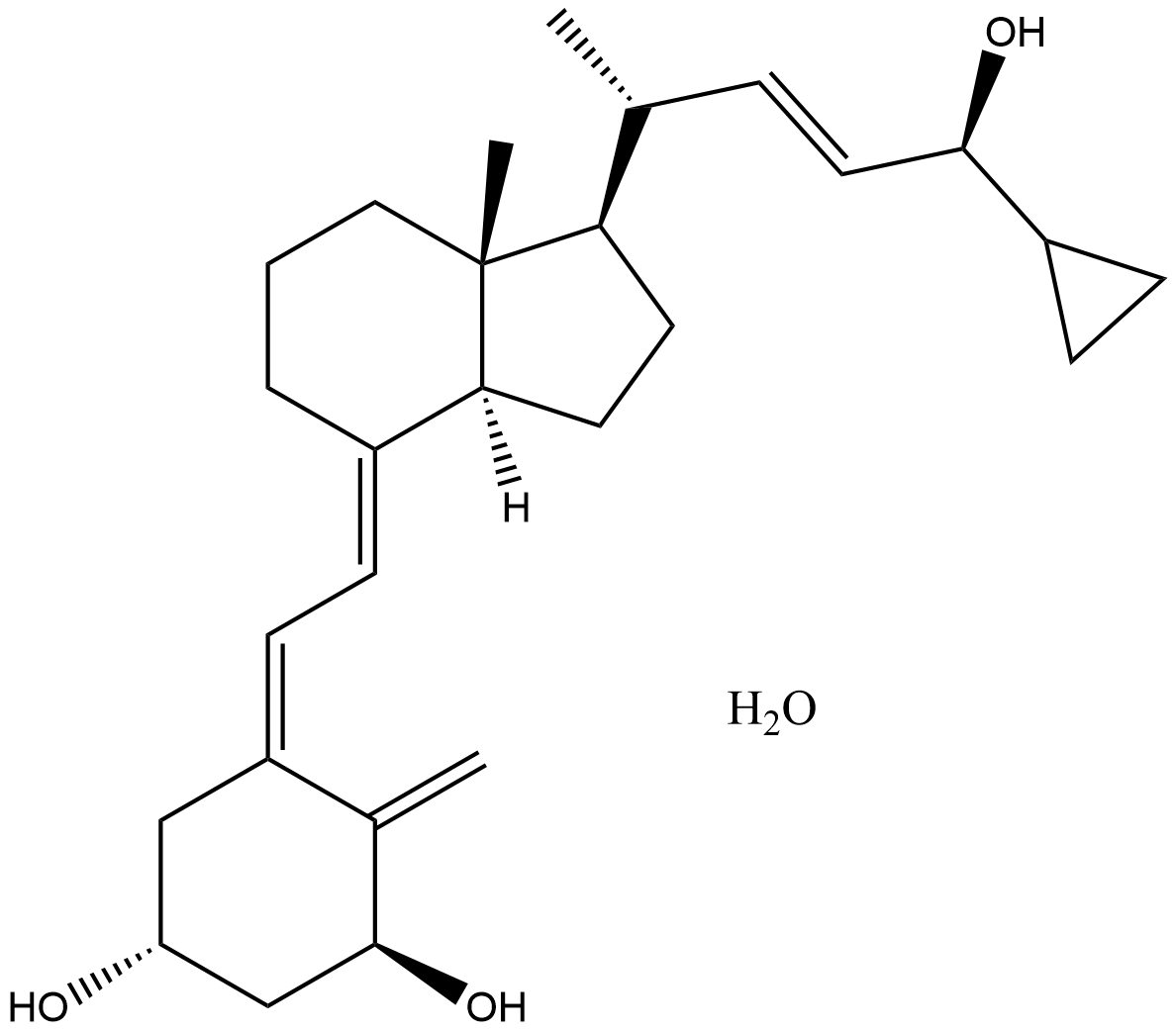


Calcifediol

Calcifediol (also called calcidiol, CAS 19356-17-3) is a prohormone produced by hydroxylation of vitamin D3 in the liver. Activation of the vitamin D receptor (VDR) is beneficial for cardiovascular outcomes and survival in patients with chronic kidney disease. Calcifediol is the major circulating form of vitamin D3 and is commonly used as a natural vitamin D metabolite control (compared with active vitamin D treatment groups) in vascular calcification and chronic kidney disease animal models.
In vitro, Calcifediol induces CYP24A1 expression (EC50 value of 70 nM) and stimulates thrombomodulin expression (EC50 value of 10-100 nM). Confocal microscopy shows that 0.1-10 microM calcifediol induces dose-dependent translocation of VDR into the nucleus, a translocation pattern similar to that in calcitriol-treated cells[1].
In vivo, spontaneously hypertensive rats (SHR) and normotensive Wistar-Kyoto (WKY) rats were injected with 50 ng/d of calcifediol or vehicle alone for 3 consecutive days: control SHR showed decreases in calbindin-D9K and cellular Ca2+ flux; calcifediol increased total cell mass and brush-border calbindin-D9K; compared with vitamin D-treated animals, the elevated Ca2+ flux in SHR was maintained at lower levels, and plasma calcitriol levels were similar to those in WKY rats[2].
In clinical trials, daily, weekly, or single bolus administration of Calcifediol all increase plasma 25(OH)D3 concentrations, with a potency 2-3 times that of vitamin D3; for calcifediol, achieving a plasma 25(OH)D3 level of 30 ng/mL is more rapid and reliable[3].
References: [1] Wu-Wong JR, Chen YW, Nakane M, Wolf M. Differential effects of vitamin d receptor agonists on gene expression in neonatal rat cardiomyocytes. Cardiovasc Drugs Ther. 2011 Jun;25(3):215-22.
[2] Roullet CM, Roullet JB, Martin AS, McCarron DA. In vivo effect of calcitriol on calcium transport and calcium binding proteins in the spontaneously hypertensive rat. Hypertension. 1994 Aug;24(2):176-82.
[3] Jetter A, Egli A, Dawson-Hughes B, Staehelin HB, Stoecklin E, Goessl R, Henschkowski J, Bischoff-Ferrari HA. Pharmacokinetics of oral vitamin D(3) and calcifediol. Bone. 2014 Feb;59:14-9.
| Physical Appearance | A solid |
| Storage | Store at -20°C |
| M.Wt | 400.64 |
| Cas No. | 19356-17-3 |
| Formula | C27H44O2 |
| Solubility | insoluble in H2O; ≥13.65 mg/mL in DMSO; ≥41.2 mg/mL in EtOH |
| Chemical Name | (1S,3Z)-3-[(2E)-2-[(1R,3aS,7aR)-1-[(2R)-6-hydroxy-6-methylheptan-2-yl]-7a-methyl-2,3,3a,5,6,7-hexahydro-1H-inden-4-ylidene]ethylidene]-4-methylidenecyclohexan-1-ol |
| Canonical SMILES | C[C@H](CCCC(C)(C)O)[C@@H](CC1)[C@@](C)(CCC2)[C@@H]1/C\2=C/C=C(/C[C@H](CC1)O)\C1=C |
| Shipping Condition | Small Molecules with Blue Ice, Modified Nucleotides with Dry Ice. |
| General tips | We do not recommend long-term storage for the solution, please use it up soon. |
| Cell experiment [1,2]: | |
|
Cell lines |
Neonatal rat cardiomyocytes, plasmacyoid dendritic cells (pDCs) and conventional DCs |
|
Preparation method |
The solubility of this compound in DMSO is >13.65mg/mL. General tips for obtaining a higher concentration: Please warm the tube at 37 ℃ for 10 minutes and/or shake it in the ultrasonic bath for a while. Stock solution can be stored below -20℃ for several months. |
|
Reacting condition |
0.1-10 μM, 2 hours |
|
Applications |
Calcifediol induced CYP24A1 expression with EC50 of 70 nM. Calcifediol stimulated the expression of thrombomodulin with EC50 at 10-100 nM. Calcifediol (0.1-10 μM) dose-dependently induced VDR translocation into the nucleus. Calcifediol led to significant expression of Cyp24A1 in moDCs after 16 hours. |
| Animal experiment [2]: | |
|
Animal models |
Wistar-Kyoto rats |
|
Dosage form |
50 ng/d calcifediol for 3 days |
|
Application |
In spontaneously hypertensive rats and normotensive Wistar-Kyoto (WKY) rats, calcifediol (50 ng/d for 3 days), calcifediol increased total cell and brush border calbindin-D9K. |
|
Other notes |
Please test the solubility of all compounds indoor, and the actual solubility may slightly differ with the theoretical value. This is caused by an experimental system error and it is normal. |
|
References: [1]. Wu-Wong J R, Chen Y W, Nakane M, et al. Differential effects of vitamin d receptor agonists on gene expression in neonatal rat cardiomyocytes[J]. Cardiovascular drugs and therapy, 2011, 25(3): 215-222. [2]. Karthaus N, Van Spriel A B, Looman M W G, et al. Vitamin D controls murine and human plasmacytoid dendritic cell function[J]. Journal of Investigative Dermatology, 2014, 134(5): 1255-1264. [3]. Roullet C M, Roullet J B, Martin A S, et al. In vivo effect of calcitriol on calcium transport and calcium binding proteins in the spontaneously hypertensive rat[J]. Hypertension, 1994, 24(2): 176-182. | |
Quality Control & MSDS
- View current batch:
Chemical structure