ARCA EGFP mRNA
EGFP (enhanced green fluorescent protein) mRNA can express an enhanced green fluorescence once has been transfected into cells, which is a direct-detection reporter mRNA, used as control to study transfection and expression in mammalian cells by various fluorescence-based assays. You can observe the fluorescence at 509 nm.
A upgraded version of ARCA EGFP mRNA is available, please check out R1007 ARCA EGFP MRNA (5-moUTP) for more details.
Key features:
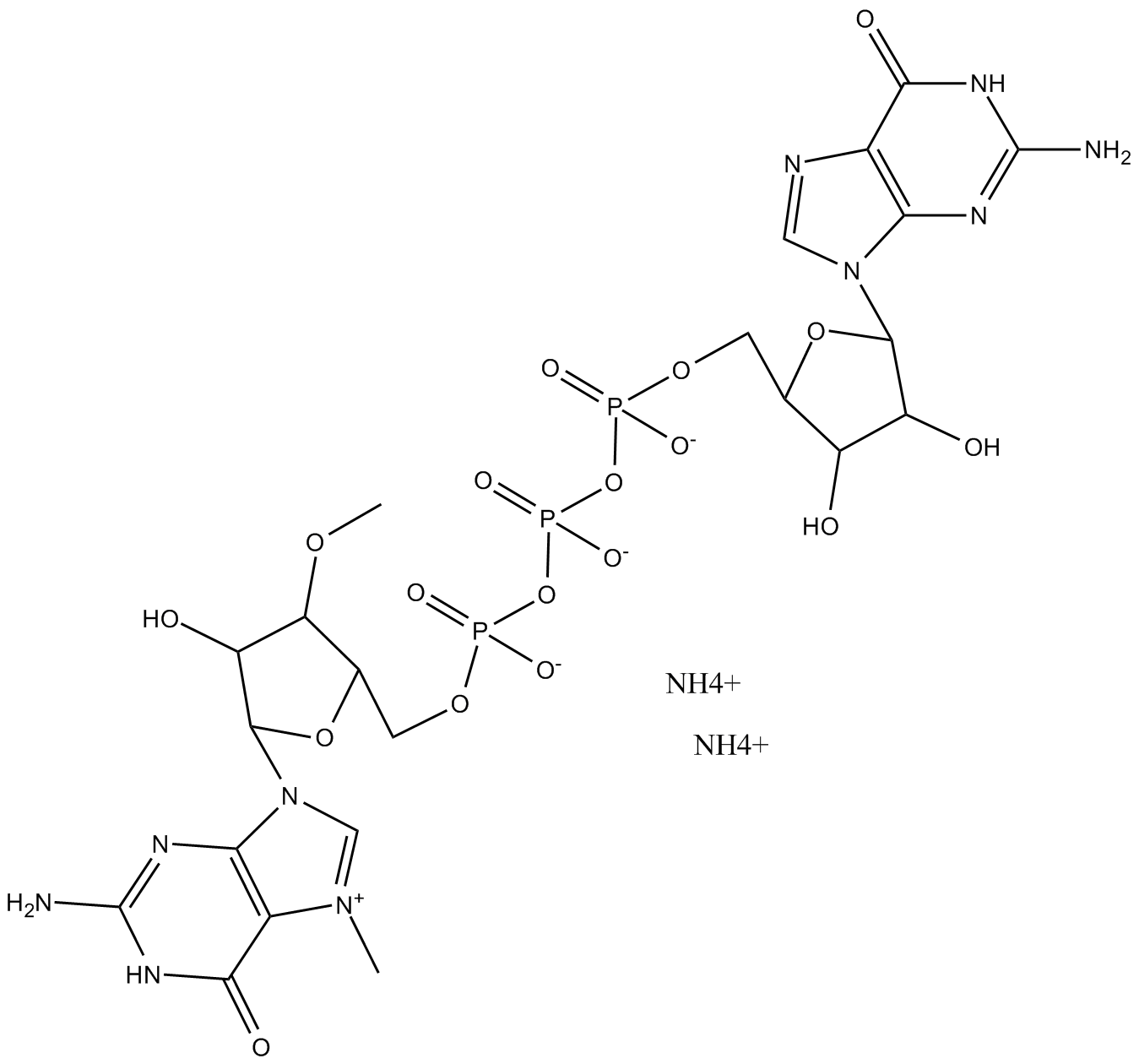
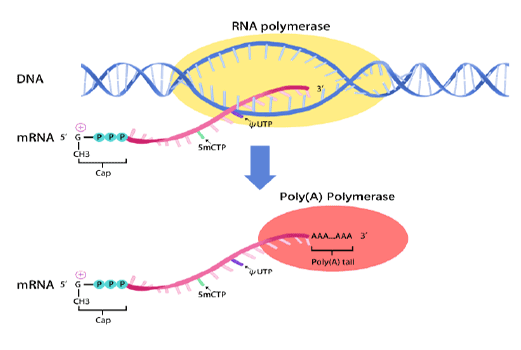
ARCA Structure: ARCA is a cost-effective, co-transcriptionally added cap analog that ensures efficient translation. ARCA remains widely used in early-stage research and cost-sensitive applications due to its proven performance and favorable balance of efficiency and affordability.
poly(A) tail: It contains an optimized poly(A) tail of approximately 100 nucleotides. This specific length is engineered to maximize transcript stability by resisting degradation and to synergize with the 5' cap for superior, sustained translation efficiency, ensuring robust protein yield in your applications.
| mRNA Length | 996 nucleotides | ||
| Concentration | 1 mg/mL | ||
| Buffer | 1 mM Sodium Citrate, pH 6.4 | Storage | -40°C or below |
| General tips | Please dissolve it on ice and protect from RNase carefully. Avoid repeated freeze/thaw cycles as possible. Don’t vortex. Upon first use, centrifuge the tube softly and aliquot it into several single use portions. Use RNase-free reagents and materials with appropriate RNase-free technique. Don’t add to the media with serum unless mixing with a transfection reagent. | ||
| Shipping Condition | ship with dry ice. | ||
- 1. Shunli Fu, Qingping Ma, et al. "In vivo-edited CCR7+ IL-7+ DCs reverse T cell exhaustion by promoting T memory stem cell differentiation." Cell Rep Med. 2026 Sep 30:103086. PMID: 42815468
- 2. Justine Ortega-Méndez, Jose M Rojas, et al. "Induction of β-Defensin 1 (DEFB1) via synthetic mRNA reduces Cryptosporidium parvum infection in human intestinal cells." J Infect Dis. 2026 Jun 12:jiag302. PMID: 42284454
- 3. Changduo Wang, Yaming Guo, et al. "Three-armed biodegradable polyesters with ionization-mimicking cationic lipid properties for VEGF mRNA delivery in critical limb ischemia." Chemical Engineering Journal Available online 26 June 2026
- 4. Ruhani Singh, Kerri Bruce, et al. "Zeolitic imidazolate frameworks enhanced transfection efficiency of mRNA loaded lipid nanoparticles." J Mater Chem B. 2025 Aug 27;13(34):10675-10683. PMID: 40813562
- 5. Zhen Liu, Jiacai Wu, et al. "Structure-guided design of endosomolytic chloroquine-like lipid nanoparticles for mRNA delivery and genome editing." Nat Commun. 2025 May 7;16(1):4241. PMID: 40335474
- 6. Cristina Carucci, Julian Philipp, et al. "Buffer specificity of ionizable lipid nanoparticle transfection efficiency and bulk phase transition." ACS Nano. 2025 Mar12. PMID: 40074542
- 7. Su-Gyeom Kim, Seong Hun Park, et al. "Scalable production of uniform gene-loaded lipid nanoparticles via a fluidity-controlled membrane extrusion." J Colloid Interface Sci. 2025 Jun:687:74-84. PMID: 39946970
- 8. Cheng Ma, Michael Y T Chow, et al. "Robust peptide/RNA complexes prepared with microfluidic mixing for pulmonary delivery by nebulisation." Drug Deliv Transl Res. 2025 Jan 18. PMID: 39827227
- 9. Mingzhu Gao, Yan Li, et al. "Targeted mRNA Nanoparticles Ameliorate Blood−Brain Barrier Disruption Postischemic Stroke by Modulating Microglia Polarization." ACS Nano. 2024 Jan 30;18(4):3260-3275. PMID: 38227975
- 10. Yan Liang, Jingge Zhang, et al. "Biomimetic Mineralized CRISPR/Cas RNA Nanoparticles for Efficient Tumor-Specific Multiplex Gene Editing." ACS Nano. 2023 Aug 8;17(15):15025-15043. PMID: 37481734
- 11. Hao Chen, Lina Guo, et al. "A General and Efficient Strategy for Gene Delivery Based on Tea Polyphenols Intercalation and Self‐Polymerization." Adv Sci (Weinh). 2023 Aug;10(24):e2302620. PMID: 37349886
- 12. Qiming Yin, Xiang Song, et al. "Incorporation of glycyrrhizic acid and polyene phosphatidylcholine in lipid nanoparticles ameliorates acute liver injury via delivering p65 siRNA." Nanomedicine. 2022 Dec 27;48:102649. PMID: 36584740
Identity & Purity
- View current batch:
-
Agarose Gel Mobility: Pass.
- COA
- MSDS (Material Safety Data Sheet)
Concentration ± 6%: Pass.
Related Biological Data
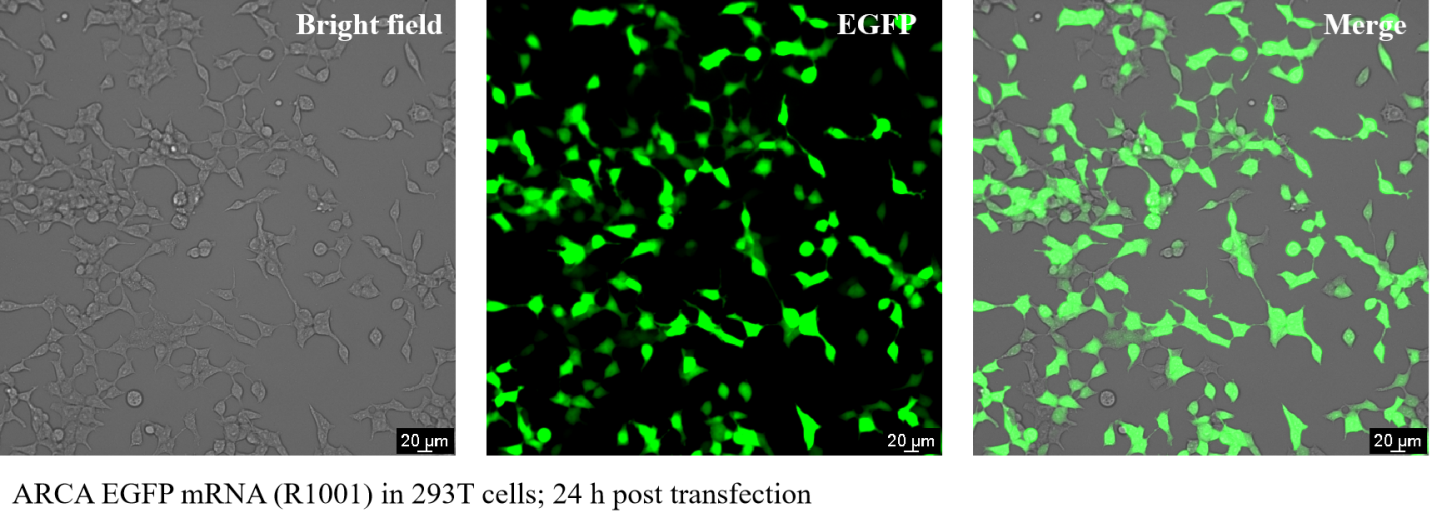
| Cell line | HEK293T |
| Tissue culture plate | 48-well tissue culture plate |
| The plating cell volume | 50,000 |
| Cell density before transfection | cell fusion degree 50%-60% |
| Transfection conditions | After culturing for 17 hours, transfection (1μg mRNA+2μL lipofectamine 2000) in serum- and antibiotic-free medium, 4 hours later, change to complete medium to return to normal growth environment and perform fluorescence photography after 24 hours. |
| RNA amount and transfection reagent | 1μg mRNA and 2μL lipofectamine 2000 are prepared according to the instructions |
| Transfection efficiency | above 90% transfection efficiency |
It can be based on your experimental goals:
- For Tracking Transfection and Translation Efficiency: APExBIO Reporter Gene mRNAs (e.g. EGFP, Firefly Luciferase mRNA) are commonly used to track transfection efficiency and protein expression duration; evaluate gene expression and cell viability; study mRNA localization and bio-distribution via in vivo imaging; optimize transfection conditions and validate LNP delivery system.
- For Gene Editing, Functional Studies and Gene Therapy Research: APExBIO offers various functional protein mRNAs, involving tumor suppressors (e.g. p53, PTEN), cytokines (e.g. IL-12, IL-10), gene-editing tools (e.g. spCas9, Cre Recombinase), gene replacement protein (e.g. EPO), and antigens (e.g. OVA, SARS-CoV-2 Spike).
- For Sustained Protein Expression: APExBIO Self-amplifying RNA (saRNA) and Circular RNA (circRNA) are recommended for applications requiring prolonged protein expression. saRNA enables lasting and strong protein expression at lower doses, while circRNA has enhanced structural stability and extended expression duration.
- Advanced Capping Technology: Utilizes Cap 1 structure (EZ Cap™ Cap) to achieve enhanced translation efficiency and minimizing activation of the host innate immune response. The capping efficiency can reach 90–99%.
- Diverse Modification Options: Provides a range of modified nucleotides, such as m1Ψ, 5-moUTP and Cy5-UTP, which reduce immunogenicity, improve mRNA stability, and maximize protein expression levels.
- Stringent Quality Control: Each batch undergoes rigorous quality assessment including capping efficiency, purity, integrity, and sterility to ensure batch-to-batch consistency.