Setting 
My Cart
Toggle Nav
Close
  • Menu
  • Setting

Tyramine Signal Amplification (TSA)

Tyramine Signal Amplification (TSA)

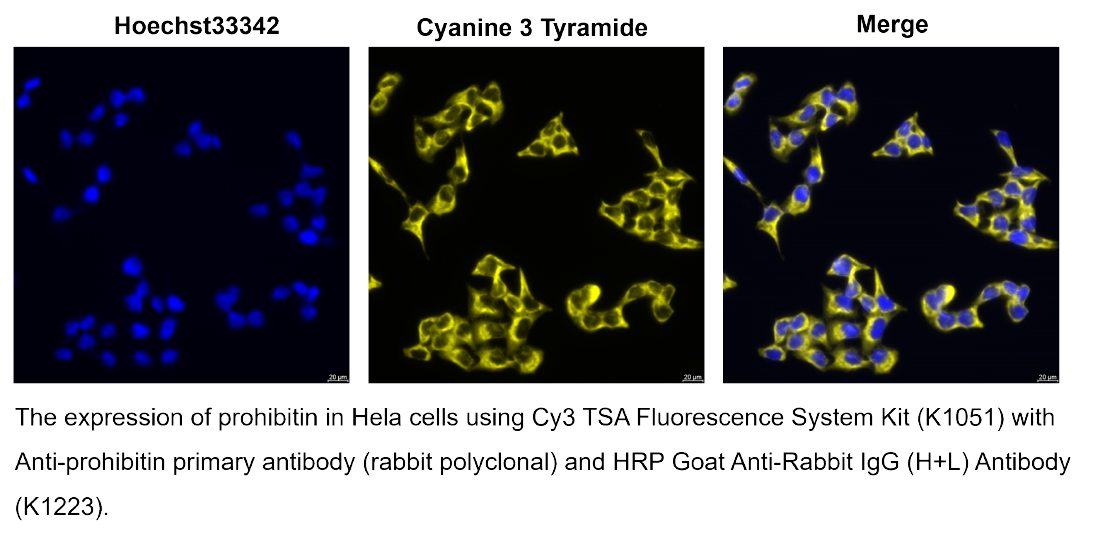
Tyramide Signal Amplification (TSA) is a highly sensitive, enzyme-mediated signal enhancement technique used to detect low-abundance proteins or nucleic acid sequences in situ. TSA relies on horseradish peroxidase (HRP) to catalyze the deposition of tyramide, a phenolic compound that covalently binds to electron-rich regions near the target site. This reaction results in high-density local labeling, producing strong fluorescent or chromogenic signals with minimal background.

TSA is widely applied in immunohistochemistry (IHC), immunocytochemistry (ICC), fluorescence in situ hybridization (FISH/ISH), and other fluorescence imaging workflows, and is compatible with standard cell types and imaging systems.
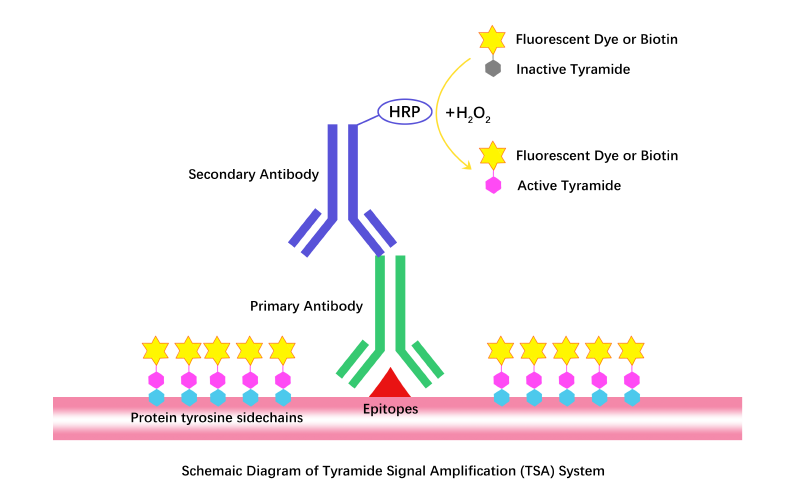
Schemaic Diagram of Tyramide Signal Amplification (TSA) System

Features

★ What is the key advantage of this technology?
It provides high-sensitivity detection of low-abundance targets that are undetectable using conventional methods.
★ Does this approach reduce antibody usage?
Yes. It enables higher antibody dilution ratios, reducing antibody consumption.
★ How complex is the experimental workflow?
The workflow is simple and flexible, requiring only basic incubation steps to generate multicolor signal, and compatible with other amplification and traditional labeling method.
★ Can it be used for multiplex fluorescence labeling?
Yes. It supports multiplex immunohistochemistry (IHC) using antibodies from the same host species.

Validation