

2'3'-cGAMP (sodium salt)
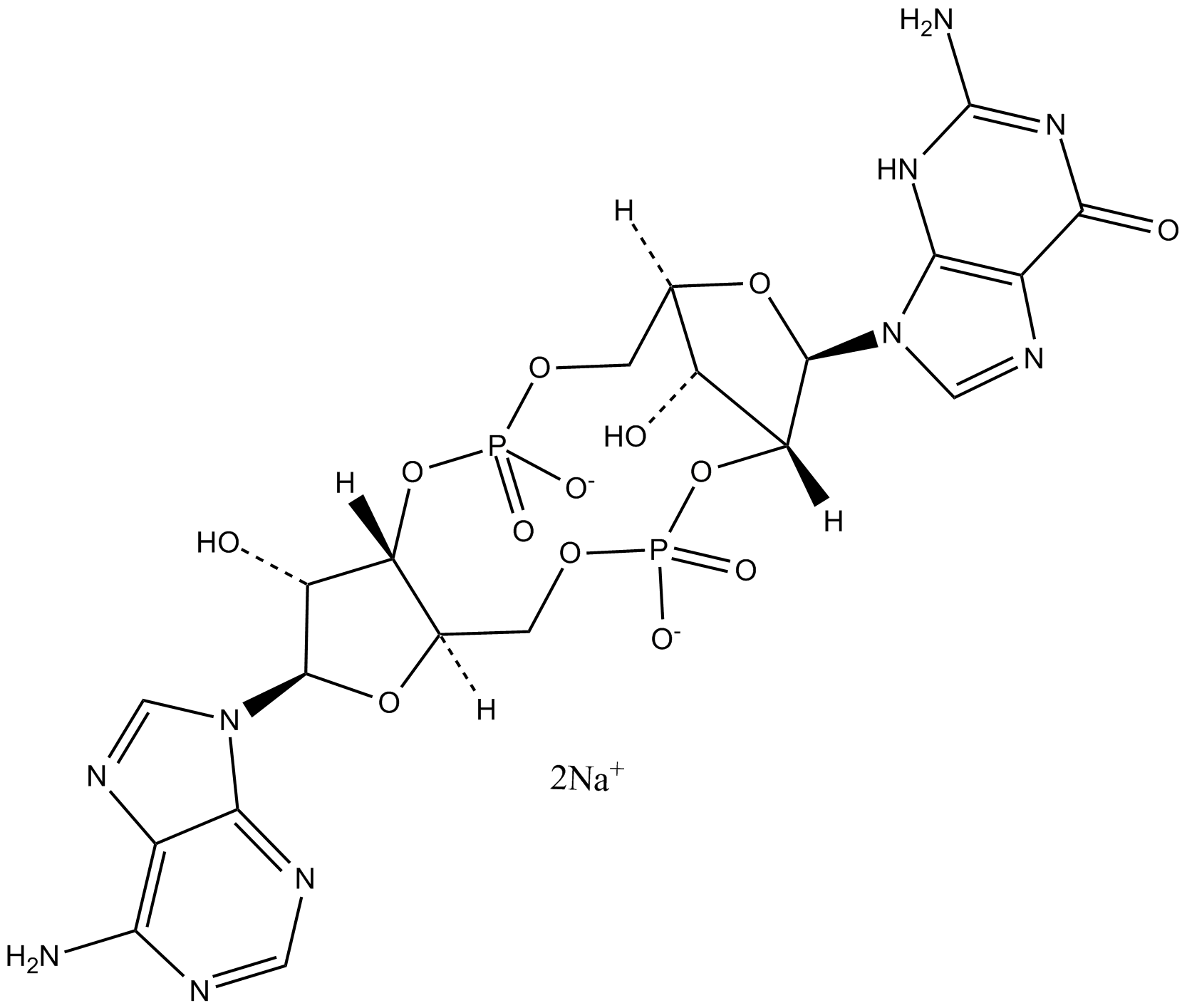
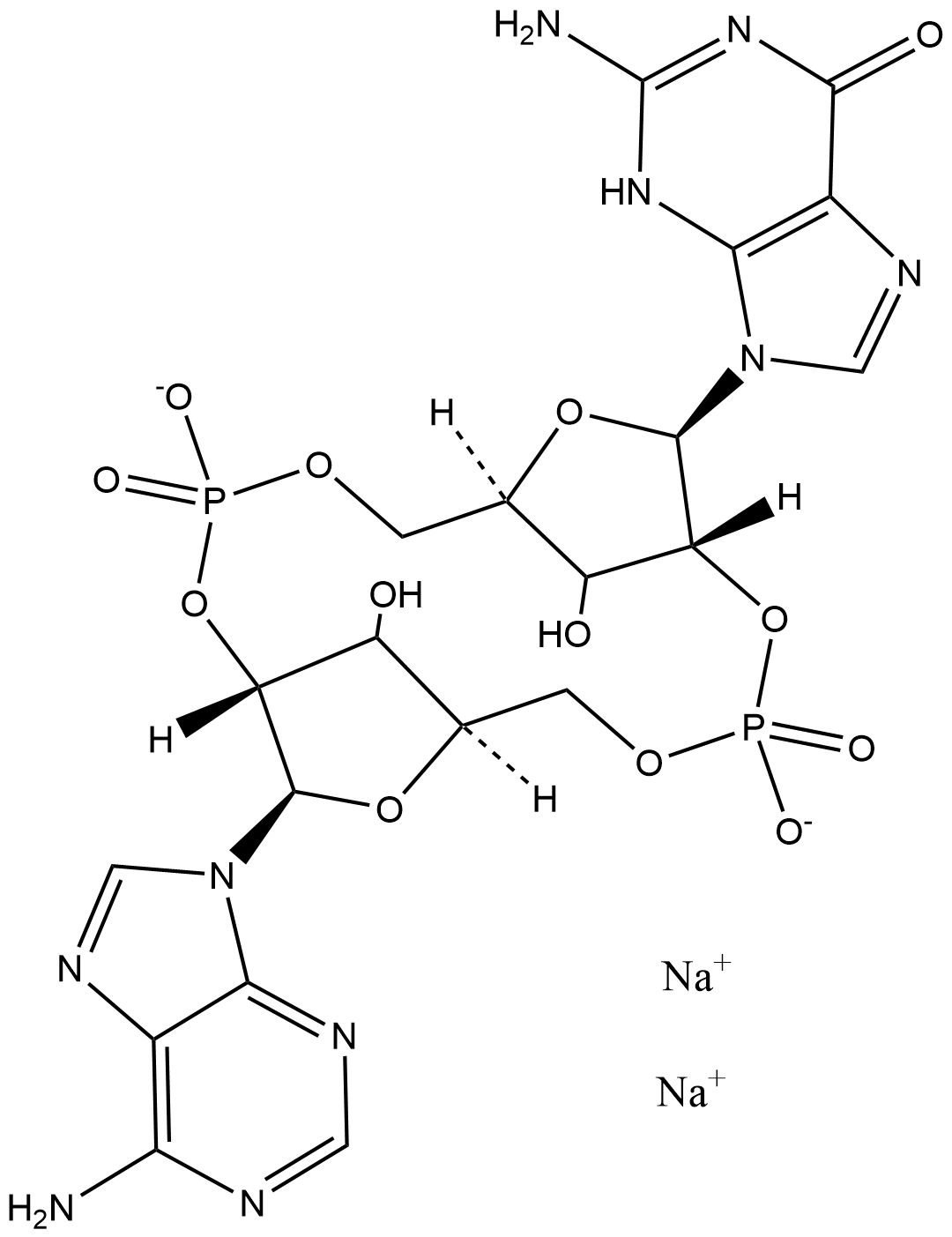
2′,3′-Cyclic GMP-AMP (2′3′-cGAMP, CAS: 2734858-36-5) is the cyclic dinucleotide produced by cyclic GMP-AMP synthase (cGAS). The molecule couples one GMP and one AMP through two asymmetric phosphodiester bonds - one 2′,5′ and one 3′,5′ - which distinguishes it from the symmetric 2′2′- and 3′3′-cGAMP diastereomers.
Double-stranded DNA induces cGAS dimerization, and cGAS then uses GTP and ATP as substrates to form the linear intermediate pppG(2′,5′)pA(3′,5′), which it closes through an intramolecular cyclization into the cyclic dinucleotide bearing both 2′,5′ and 3′,5′ phosphodiester bonds. The synthesized 2′3′-cGAMP diffuses and binds STING on the ER membrane: it inserts into the V-shaped pocket of the STING ligand-binding domain, STING dimerizes and changes conformation, and the complex translocates to the Golgi via the secretory pathway. Oligomerized STING recruits and activates TBK1 at the membrane; activated TBK1 phosphorylates IRF3 and IKKβ, launching type I interferon and NF-κB-dependent inflammatory transcription.
Researchers use 2′3′-cGAMP as a positive control for STING activation to test cellular responses to STING and its downstream effectors: exogenous 2′3′-cGAMP induces IFN-β expression in wild-type cells, whereas this response vanishes in STING-knockout or knockdown cells, distinguishing STING-dependent from STING-independent antiviral signaling. As an adjuvant, 2′3′-cGAMP induces type I interferons through the cGAS-STING pathway and enhances antigen cross-presentation by dendritic cells; it is commonly co-administered with antigen after encapsulation in liposomes or polymeric nanoparticles, raising antigen-specific CD8⁺ T-cell responses and neutralizing antibody titers. In addition, 2′3′-cGAMP crosses the plasma membrane and spreads between cells, thereby activating STING in neighboring bystander cells. However, free 2′3′-cGAMP is rapidly degraded by extracellular phosphodiesterases, and its inherent negative charge limits spontaneous membrane permeation. Consequently, 2′3′-cGAMP cannot maintain an effective concentration in vivo for long, so researchers mostly treat cells in vitro or encapsulate it in adjuvants for local delivery, and rarely use it for prolonged systemic in vivo administration.
References:
Sun L, Wu J, Du F, Chen X, Chen ZJ. Cyclic GMP-AMP synthase is a cytosolic DNA sensor that activates the type I interferon pathway. Science. 2013;339(6121):786-791.
Gao P, Ascano M, Wu Y, et al. Cyclic [G(2′,5′)pA(3′,5′)p] is the metazoan second messenger produced by DNA-activated cyclic GMP-AMP synthase. Cell. 2013;153(21):1094-1107.
Ablasser A, Goldeck M, Cavlar T, et al. cGAS produces a 2′-5′ linked cyclic dinucleotide second messenger that activates STING. Nature. 2013;498(7454):380-384.
Zhang X, Shi H, Wu J, et al. Cyclic GMP-AMP containing mixed phosphodiester linkages is an endogenous high-affinity ligand for STING. Molecular Cell. 2013;51(2):226-235.
Zhong B, Yang Y, Li S, et al. The adaptor protein MITA links virus-sensing receptors to IRF3 transcription factor activation. Immunity. 2008;29(4):538-550.
Khiar S, Quintás-Casas A, Garcin D, et al. 2′3′-cGAMP is a beacon for intracellular DNA sensing. Scientific Reports. 2017;7:4295.
Civril F, Deimling T, de Oliveira Mann CC, et al. Structural mechanism of cytosolic DNA sensing by cGAS. Nature. 2013;498(7454):332-337.
- 1. Xiaofang Liu, Yaning Lin, et al. "Sesquiterpene lactones from Centipeda minima and their STING inhibitory activities." Phytochemistry. 2026 Sep 24:253:115091. PMID: 42785451
- 2. Hari Krishnareddy Rachamala, Naga Malleswara Rao Nakka, et al. "Multifunctional Nano-vaccines Integrating Lipid-conjugated Tumor Antigens with TLR/STING Agonists Enhance Cancer Immunotherapy." Cancer Lett. 2026 Jul 20:658:218736. PMID: 42476286
- 3. Shuting Bai, Yuan Xue, et al. "A Morphology-Driven Cascade Delivery of Antigens for Potent T Cell Immunity." Adv Mater. 2026 May 23:e73396. PMID: 42176335
- 4. Shan Yang, Ting Liu, et al. "Toosendanin inhibits STING signaling pathway to alleviate ulcerative colitis via blocking LYN kinase and STING protein." Biochemical Pharmacology Volume 243, Part 1, January 2026, 117516. PMID: 41187884
- 5. Bin Wang, Shouqing Luo, et al. "Development of D2HG biosensors inspired by the molecular mechanism of D2HG regulation of DhdR." Cell Chem Biol. 2025 Nov 6:S2451-9456(25)00341-1. PMID: 41202821
- 6. Zhengyang Zhang, Jie Gao, et al. "ABCC10-mediated cGAMP efflux drives cancer cell radiotherapy resistance." Cell Death Differ. 2025 Aug 6. PMID: 40770563
- 7. Qiaoqi Chen, Huilin Yu, et al. "An imaging-guided self-amplifying photo-immunotherapeutic nanoparticle for STING pathway activation and enhanced cancer therapy." J Nanobiotechnology. 2025 Jun 21;23(1):459. PMID: 40544257
- 8. Claudia C S Chini, Laura Colman, et al. "Chronic Cellular NAD Depletion Activates a Viral Infection‐Like Interferon Response Through Mitochondrial DNA Leakage." Aging Cell. 2025 Jun 16:e70135. PMID: 40519092
- 9. Jia-Lu Shan, Kai-Ming Zhang, et al. "Reactivating cGAS-STING Signaling by Targeting SOS1 Enhances Antitumor Immunity in NRAS-Mutant Tumors." Cancer Res. 2025 Aug 15;85(16):3015-3031. PMID: 40392233
- 10. Yi Xiong, Jiawen Chen, et al. "Dimethyl fumarate alleviate hepatic ischemia–reperfusion injury through suppressing cGAS‐STING signaling." MedComm (2020). 2025 Jan 28;6(2):e70077. PMID: 39877286
- 11. Huanling Zhang, Zining Wang, et al. "Endothelial STING-JAK1 interaction promotes tumor vasculature normalization and antitumor immunity." J Clin Invest. 2025 Jan 16;135(2):e180622. PMID: 39817453
- 12. Zhaofei Guo, Chenqi Guo, et al. "Antigens and adjuvants co-stabilized Pickering emulsions amplify immune responses of subunit vaccines." J Control Release. 2025 Jan 9:379:177-190. PMID: 39788375
- 13. Yu Deng, Quentin Hahn, et al. "2′ 3′-cGAMP interactome identifies 2′ 3′-cGAMP/Rab18/FosB signaling in cell migration control independent of innate immunity." Sci Adv. 2024 Oct 18;10(42):eado7024. PMID: 39413198
- 14. Ying Luo, Mengda Niu, et al. "Oncoproteins E6 and E7 upregulate topoisomerase I to activate the cGAS-PD-L1 pathway in cervical cancer development." Front Pharmacol. 2024 Aug 2:15:1450875. PMID: 39156107
- 15. Pengfei Yuan, Xiaodie Yan, et al. "Modulating Elasticity of Liposome for Enhanced Cancer Immunotherapy." ACS Nano. 2024 Aug 14. PMID: 39140567
- 16. Huilin Yu, Qiaoqi Chen, et al. "Combination of MHI148 Targeted Photodynamic Therapy and STING Activation Inhibits Tumor Metastasis and Recurrence." ACS Appl Mater Interfaces. 2024 Jun 12;16(23):29672-29685. PMID: 38813586
- 17. Bingbing Li, Lixia Xu, et al. "Neutrophil Extracellular Traps Regulate Surgical Brain Injury by Activating the cGAS-STING Pathway." Cell Mol Neurobiol. 2024 Apr 18;44(1):36. PMID: 38637346
- 18. Yu An, Jinchao Zhu, et al. "Tumor Exosomal ENPP1 Hydrolyzes cGAMP to Inhibit cGAS‐STING Signaling." Adv Sci (Weinh). 2024 May;11(20):e2308131. PMID: 38498770
- 19. Sherin George Shaji, Pratikkumar Patel, et al. "Delivery of a STING Agonist Using Lipid Nanoparticles Inhibits Pancreatic Cancer Growth." International Journal of Nanomedicine Volume 19, 2024 - Issue
- 20. Cunpeng Nie, Tianran Ma, et al. "A STING agonist-loaded bispecific nanobioconjugate modulates macrophage immune responses to enhance antitumor immunotherapy." Chemical Engineering Journal Volume 485, 1 April 2024, 149901
- 21. Sun-Hyok Kong, Lie Ma, et al. "Inhibition of EZH2 alleviates SAHA-induced senescence-associated secretion phenotype in small cell lung cancer cells." Cell Death Discov. 2023 Aug 5;9(1):289. PMID: 375436532
- 22. Yixin Wang, Zhaoting Li, et al. "Nano-STING agonist-decorated microrobots boost innate and adaptive anti-tumor immunity." Research Article. 31 May 2023 Volume 16, pages 9848–9858, (2023)
- 23. Shengwen Chen, Qian Liu, et al. "The role of REC8 in the innate immune response to viral infection." J Virol. 2022 Mar 23;96(6):e0217521. PMID: 35107381
- 24. Xiaojun Chen, Wenxin He, et al. "STING inhibition accelerates the bone healing process while enhancing type H vessel formation." FASEB J. 2021 Nov;35(11):e21964. PMID: 346940305
- 25. Yongsheng Yu, Huan Guo, et al. "Cyclic GMP-AMP promotes the acute phase response and protects against Escherichia coli infection in mice." Biochem Pharmacol. 2021 Jun;188:114541. PMID: 33812857
| Physical Appearance | A solid |
| Storage | Store at -20°C |
| M.Wt | 718.37 |
| Cas No. | 2734858-36-5 |
| Formula | C20H22N10Na2O13P2 |
| Synonyms | Guanosine-Adenosine 2',3'-cyclic monophosphate,2'-3'-Cyclic GMP-AMP |
| Solubility | insoluble in EtOH; insoluble in DMSO; ≥7.56 mg/mL in H2O |
| Chemical Name | adenylyl-(3'→5')-2'-guanylic acid, cyclic nucleotide, disodium salt |
| Canonical SMILES | O=P1([O-])O[C@]([C@@H](O)[C@H](N2C=NC3=C2N=CN=C3N)O4)([H])[C@@]4([H])COP(O[C@@]5([H])[C@H](N6C=NC7=C6NC(N)=NC7=O)O[C@]([C@H]5O)([H])CO1)([O-])=O.[Na+].[Na+] |
| Shipping Condition | Small Molecules with Blue Ice, Modified Nucleotides with Dry Ice. |
| General tips | We do not recommend long-term storage for the solution, please use it up soon. |
Quality Control & MSDS
- View current batch:
Chemical structure

Related Biological Data

Related Biological Data