Disulfiram
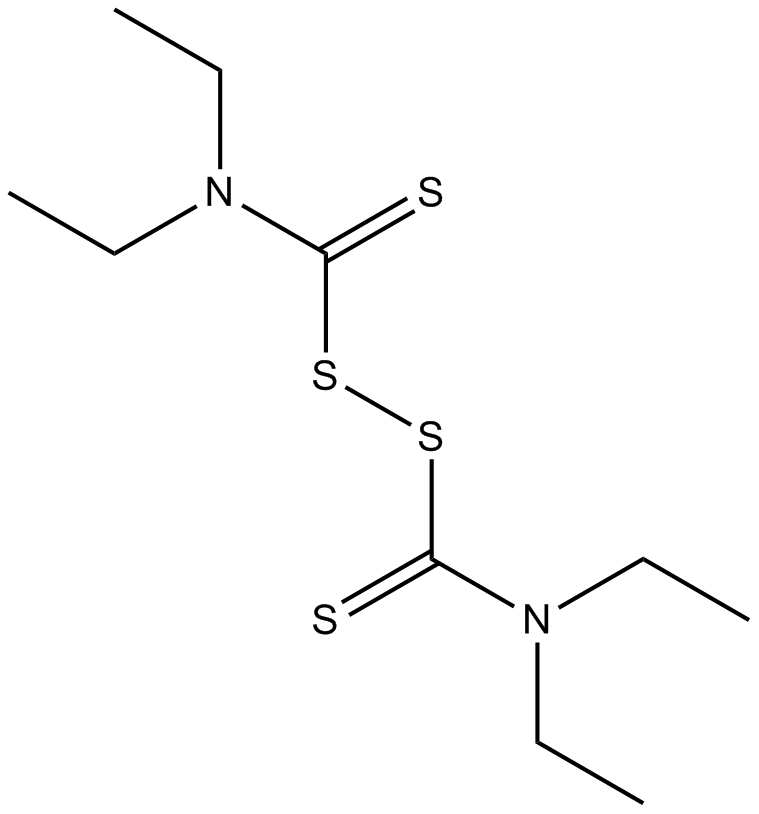
Disulfiram (CAS: 97-77-8) is an FDA-approved drug for the treatment of alcohol use disorder and has been extensively repurposed as a chemical tool for studies of pyroptosis and cuproptosis. Disulfiram itself is not an effective copper chelator. Under physiological conditions, however, it is rapidly reduced to diethyldithiocarbamate (DTC), a dithiocarbamate metabolite that readily coordinates Cu2+ to form neutral, lipophilic copper complexes, which efficiently cross biological membranes and deliver copper into cells and mitochondria, increasing the intracellular pool of bioavailable copper. Subsequent intracellular copper release disrupts copper homeostasis and can induce cuproptosis under conditions of copper overload. Consequently, the anticancer activity of disulfiram is markedly enhanced in the presence of copper supplementation.
In addition to its role as a copper ionophore precursor, disulfiram is a potent inhibitor of gasdermin D (GSDMD). It suppresses inflammasome-dependent pyroptosis, liposome membrane permeabilization, and IL-1β release by covalently modifying Cys191 of human GSDMD (corresponding to Cys192 in mouse GSDMD), a highly reactive cysteine residue located within the pore-forming N-terminal domain. Disulfiram contains an electrophilic thiuram disulfide (–S–S–) bond that undergoes thiol–disulfide exchange with the sulfhydryl group of Cys191. During this reaction, the cysteine thiolate attacks one sulfur atom of the disulfide bond, cleaving the original S–S linkage and generating a stable mixed disulfide between GSDMD and a diethyldithiocarbamoyl moiety. Covalent modification of Cys191 sterically and conformationally interferes with membrane insertion and oligomerization of the GSDMD N-terminal fragment, thereby preventing the assembly of transmembrane pores required for pyroptotic cell death. Because Cys191 is also susceptible to oxidation and other electrophilic modifications, this residue functions as a critical regulatory site controlling GSDMD pore-forming activity.
Beyond its effects on regulated cell death, disulfiram has also been reported to protect cardiomyocytes from H2O2-induced cell death and to improve cardiac function following ischemia–reperfusion (I/R) injury in experimental models, supporting a broader role in oxidative stress-related pathophysiology.
References:
1. Najlah M, Said Suliman A, Tolaymat I, Kurusamy S, Kannappan V, Elhissi AMA, Wang W. Development of Injectable PEGylated Liposome Encapsulating Disulfiram for Colorectal Cancer Treatment. Pharmaceutics. 2019 Nov 14;11(11):610. doi: 10.3390/pharmaceutics11110610. PMID: 31739556; PMCID: PMC6920821.
2. Hu, J.J., Liu, X., Xia, S. et al. FDA-approved disulfiram inhibits pyroptosis by blocking gasdermin D pore formation. Nat Immunol 21, 736–745 (2020). https://doi.org/10.1038/s41590-020-0669-6
- 1. Tingming Liang, Lulu Luo, et al. "ALDH2 inhibition induces synthetic lethality in APC-deficient colorectal cancer via ROS/ASK1/JNK pathway." Genes & Diseases Available online 30 January 2026, 102057
- 2. Kulpa DA, Talla A, et al. "Differentiation to an effector memory phenotype potentiates HIV-l latency reversal in CD4+ T cells." J Virol. 2019 Oct 2. pii: JVI.00969-19 PMID: 31578289
| Physical Appearance | A solid |
| Storage | Store at -20°C |
| M.Wt | 296.54 |
| Cas No. | 97-77-8 |
| Formula | C10H20N2S4 |
| Solubility | insoluble in H2O; ≥12 mg/mL in DMSO; ≥24.2 mg/mL in EtOH with ultrasonic |
| Chemical Name | diethylcarbamothioylsulfanyl N,N-diethylcarbamodithioate |
| Canonical SMILES | CCN(CC)C(SSC(N(CC)CC)=S)=S |
| Shipping Condition | Small Molecules with Blue Ice, Modified Nucleotides with Dry Ice. |
| General tips | We do not recommend long-term storage for the solution, please use it up soon. |
| Kinase experiment [1]: | |
|
Binding assays |
The chymotrypsin-like activity of purified 20S proteasome was measured. Briefly, 17.5 ng of purified 20S proteasome were incubated in 100 μL of assay buffer (50 mmol/L Tris-HCl, pH 7.5) with or without different concentrations of copper chloride, Disulfiram, or the Disulfiram-copper mixture and 10 μmol/L fluorogenic peptide substrate Suc-LLVY-AMC (for the proteasomal chymotrypsin-like activity) for 2 hrs at 37℃. After incubation, production of hydrolyzed AMC groups was measured with a Wallac Victor3 multilabel counter with an excitation filter of 365 nm and an emission filter of 460 nm. |
| Cell experiment [1]: | |
|
Cell lines |
MDA-MB-231 cells |
|
Preparation method |
The solubility of this compound in DMSO is >10 mM. General tips for obtaining a higher concentration: Please warm the tube at 37℃ for 10 minutes and/or shake it in the ultrasonic bath for a while. Stock solution can be stored below -20℃ for several months. |
|
Reaction Conditions |
5 ~ 20 μM; 24 hrs |
|
Applications |
The Disulfiram-copper complex potently inhibited the proteasomal activity in cultured breast cancer MDA-MB-231 cells, before induction of apoptotic cancer cell death. |
| Animal experiment [1]: | |
|
Animal models |
Mice bearing MDA-MB-231 tumor xenografts |
|
Dosage form |
50 mg/kg/d; p.o.; 29 days |
|
Applications |
In mice bearing MDA-MB-231 tumor xenografts, Disulfiram significantly inhibited tumor growth (by 74%), associated with in vivo proteasome inhibition and apoptosis induction. |
|
Other notes |
Please test the solubility of all compounds indoor, and the actual solubility may slightly differ with the theoretical value. This is caused by an experimental system error and it is normal. |
|
References: [1]. Chen D, Cui QC, Yang H, Dou QP. Disulfiram, a clinically used anti-alcoholism drug and copper-binding agent, induces apoptotic cell death in breast cancer cultures and xenografts via inhibition of the proteasome activity. Cancer Res. 2006 Nov 1;66(21):10425-33. |
|
Quality Control & MSDS
- View current batch:
Chemical structure