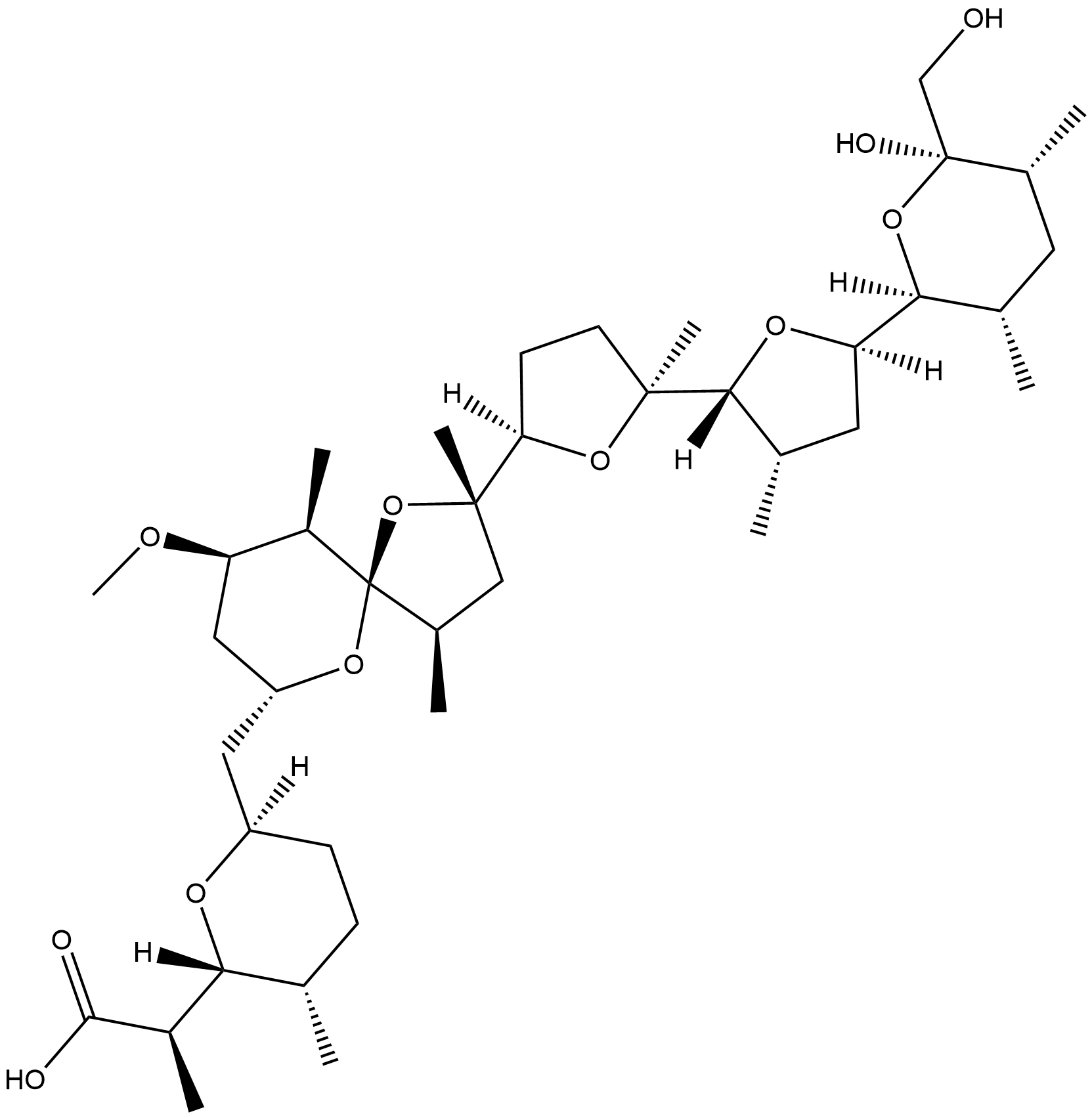
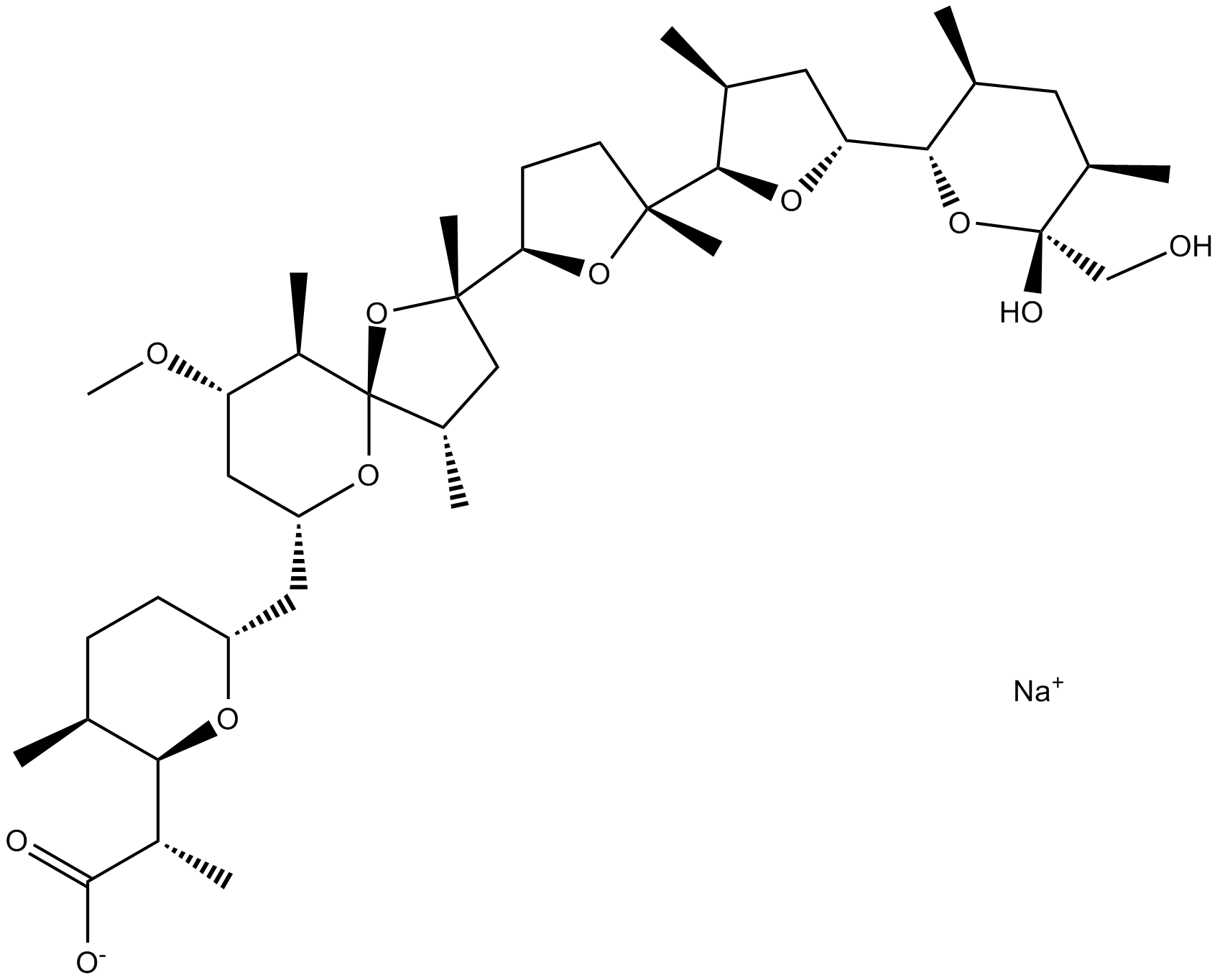
Nigericin
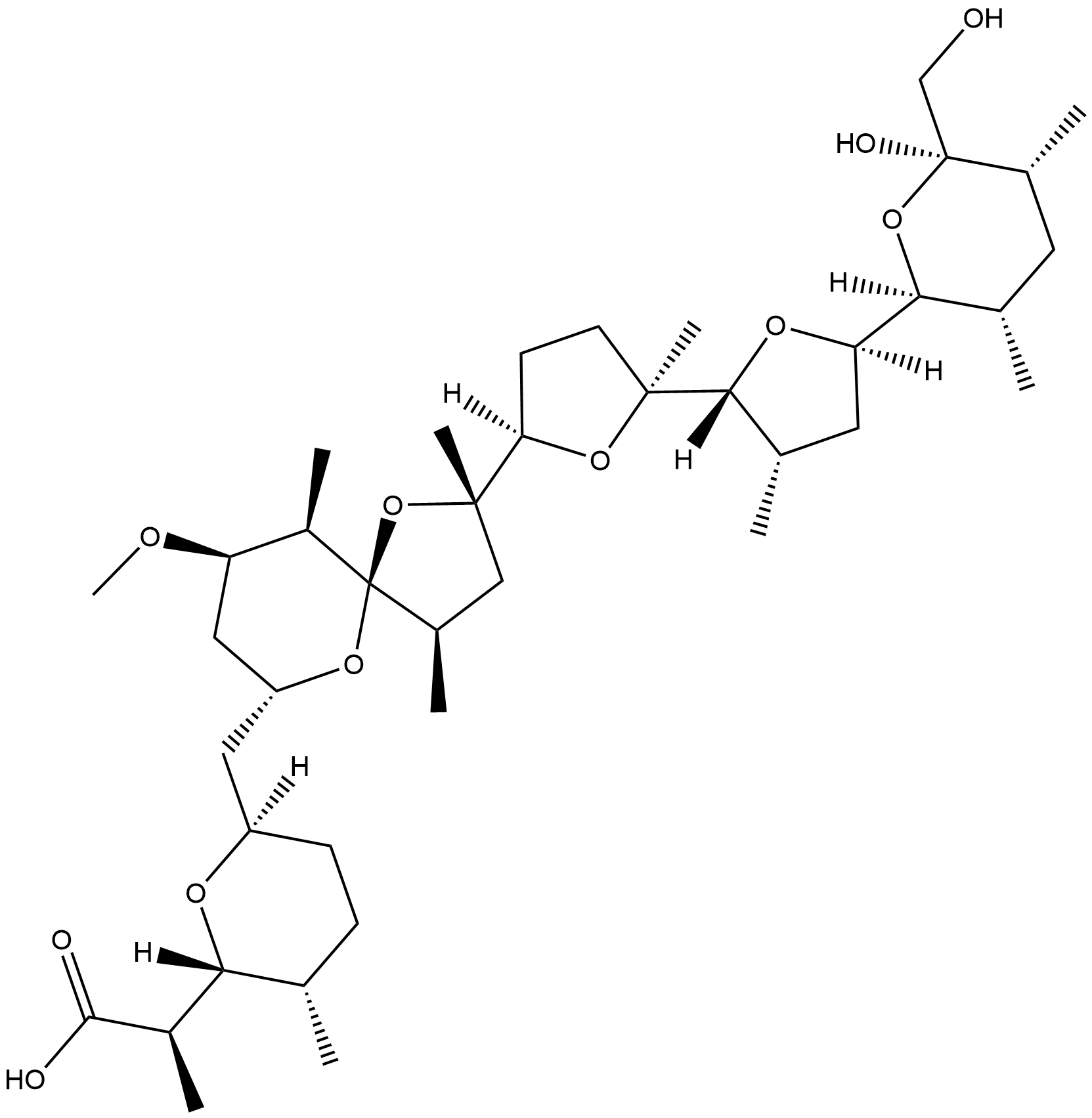
Nigericin (CAS: 28380-24-7) is a lipophilic polyether ionophore that functions as an electroneutral K+/H+ antiporter. Nigericin reversibly binds K+ through coordination of the cation by its polyether oxygen atoms, forming a neutral, membrane-permeable complex that diffuses across the lipid bilayer. After releasing K+ on the opposite side of the membrane, nigericin binds H+ and transports it in the reverse direction. Through repeated cycles of K+ binding, transmembrane diffusion, ion exchange, and proton return, nigericin mediates exchange of K+ and H+ across biological membranes without generating a net electrical current. This process rapidly dissipates transmembrane K+ and proton gradients, resulting in intracellular K+ depletion and cytosolic acidification.
In inflammasome research, nigericin is widely used as a potent activator of the NLRP3 inflammasome and a classical inducer of pyroptosis. Following lipopolysaccharide (LPS)-mediated priming, nigericin promotes rapid K+ efflux, which lowers intracellular potassium concentrations below the threshold required to maintain the inactive conformation of NLRP3. The resulting conformational change triggers NLRP3 oligomerization and recruitment of the adaptor protein ASC through pyrin domain (PYD)-PYD interactions. ASC subsequently recruits pro-caspase-1 via caspase recruitment domain (CARD)-CARD interactions, leading to inflammasome assembly and caspase-1 activation. Activated caspase-1 cleaves gasdermin D (GSDMD) to generate its pore-forming N-terminal fragment and processes the precursor forms of interleukin-1β (IL-1β) and interleukin-18 (IL-18) into their mature cytokines. GSDMD-mediated plasma membrane pore formation ultimately results in cell swelling, membrane rupture, cytokine release, and pyroptotic cell death.
In addition to its widespread application in inflammasome studies, nigericin has been extensively used to investigate ion transport and bioenergetics. In Na⁺-containing media, nigericin has little effect on ADP-induced platelet aggregation but only modestly inhibits thrombin-induced platelet aggregation, an effect that has been attributed primarily to nigericin-induced cytosolic acidification rather than alterations in potassium homeostasis. Nigericin has also been reported to function as an efficient ion carrier for Pb2+, and physiological concentrations of Ca2+ or Mg2+ have minimal influence on nigericin-mediated Pb2+ transport, whereas varying concentrations of K+ or Na+ produce only minor effects, suggesting potential applications in studies of lead detoxification. Furthermore, nigericin modulates mitochondrial energy metabolism by inhibiting ATP-driven transhydrogenase activity over a broad range of ATP concentrations, with more pronounced inhibition observed at lower ATP levels, while simultaneously stimulating the carbonyl reduction reaction under saturating ATP conditions.
Reference:
1. P. Rozario, M. Pinilla, L. Gorse, A.C. Vind, K.S. Robinson, G.A. Toh, M.J. Firdaus, J.F. Martínez, S.K. Kerk, Z. Lin, J.C. Chambers, S. Bekker-Jensen, E. Meunier, & F. Zhong, Mechanistic basis for potassium efflux–driven activation of the human NLRP1 inflammasome, Proc. Natl. Acad. Sci. U.S.A. 121 (2) e2309579121, https://doi.org/10.1073/pnas.2309579121 (2024).
2. den Hartigh AB, Fink SL. Pyroptosis Induction and Detection. Curr Protoc Immunol. 2018 Aug;122(1):e52. doi: 10.1002/cpim.52. Epub 2018 Jul 20. PMID: 30028908; PMCID: PMC6339837.
3. Kitagawa S, Awai M, Kametani F. Relationship of the effects of nigericin on the aggregation and cytoplasmic pH of bovine platelets in the presence of different cations. Biochim Biophys Acta, 1987, 930(1): 48-54.
4. Hamidinia SA, Tan B, Erdahl WL, et al. The ionophore nigericin transports Pb2+ with high activity and selectivity: a comparison to monensin and ionomycin. Biochemistry, 2004, 43(50): 15956-15965.
5. Eytan GD, Carlenor E, Rydström J. Energy-linked transhydrogenase. Effects of valinomycin and nigericin on the ATP-driven transhydrogenase reaction catalyzed by reconstituted transhydrogenase-ATPase vesicles. J Biol Chem, 1990, 265(22): 12949-12954.
- 1. Yilin Zhong, Juan Guo, et al. "Exogenous NADH promotes the bactericidal effect of aminoglycoside antibiotics against Edwardsiella tarda." Virulence. 2024 Dec;15(1):2367647. PMID: 38884466
- 2. Qian Liu, Dianbing Wang, et al. "A genetically encoded fluorescent protein sensor for mitochondrial membrane damage detection." Biochem Biophys Res Commun. 2024 May 21:709:149836. PMID: 38564937
| Storage | -20°C |
| M.Wt | 724.96 |
| Cas No. | 28380-24-7 |
| Formula | C40H68O11 |
| Solubility | ≥2.65 mg/mL in DMSO with gentle warming and ultrasonic; ≥53.1 mg/mL in EtOH; insoluble in H2O |
| Chemical Name | (R)-2-((2R,3S,6R)-6-(((2S,4R,5R,7R,9R,10R)-2-((2S,2'R,3'S,5R,5'R)-5'-((2S,3S,5R,6R)-6-hydroxy-6-(hydroxymethyl)-3,5-dimethyltetrahydro-2H-pyran-2-yl)-2,3'-dimethyloctahydro-[2,2'-bifuran]-5-yl)-9-methoxy-2,4,10-trimethyl-1,6-dioxaspiro[4.5]decan-7-yl)meth |
| Canonical SMILES | O=C(O)[C@H](C)[C@]1([H])O[C@](C[C@H]2O[C@@]3([C@H](C)C[C@]([C@]4([H])O[C@@]([C@@]5([H])[C@@H](C)C[C@@]([C@]6([H])[C@@H](C)C[C@@H](C)[C@@](CO)(O)O6)([H])O5)(C)CC4)(C)O3)[C@H](C)[C@H](OC)C2)([H])CC[C@@H]1C |
| Shipping Condition | Small Molecules with Blue Ice, Modified Nucleotides with Dry Ice. |
| General tips | We do not recommend long-term storage for the solution, please use it up soon. |
Quality Control & MSDS
- View current batch:
Chemical structure