

L-NAME hydrochloride
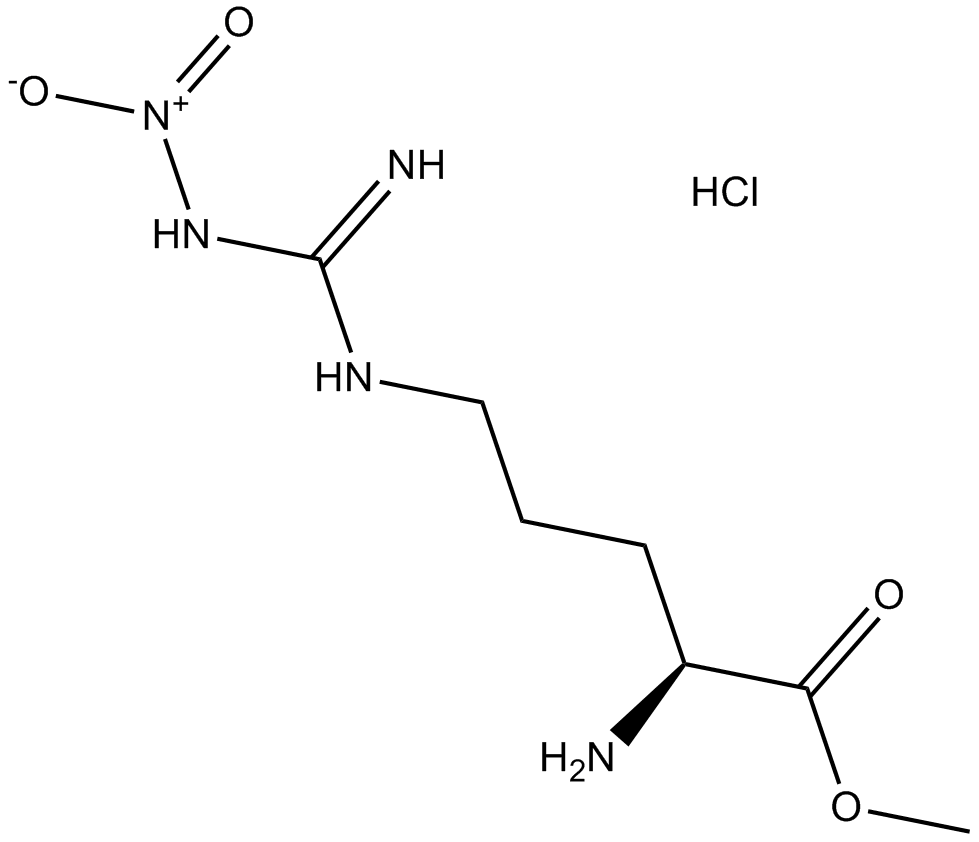
L-NAME Hydrochloride (Nomega-nitro-L-arginine methyl ester hydrochloride; CAS 51298-62-5) is a nitric oxide synthase (NOS) inhibitor with an IC50 of 70 micromol/L[1]. NOS is the enzyme involved in NO production; NO is the smallest known signaling molecule, regulating autoregulatory functions such as neurotransmission and vascular tone, modulating gene transcription and mRNA translation, and producing post-translational modifications of proteins[2]. In the concentration range of 10(-9) to 10(-3) M, L-NAME hydrochloride inhibits NOS purified from rat brain in a dose-dependent manner, with an IC50 of 70 micromol/L[1]. In another study, 0.1-100 mM L-NAME hydrochloride produced concentration-dependent inhibition of Ca(2+)-dependent endothelial NOS from porcine aorta and caused endothelium-dependent contraction, inhibiting acetylcholine (ACh)-induced endothelium-dependent relaxation[3]. In anesthetized rats, L-NAME hydrochloride (0.03-300 mg/kg, intravenous) dose-dependently raises mean systemic arterial blood pressure accompanied by bradycardia; 100 mg/kg intravenously significantly inhibits the hypotensive responses to ACh and bradykinin; its pressor and bradycardic effects are dose-dependently reversed by L-arginine (30-100 mg/kg, intravenous)[3].
[1]. Pfeiffer S, Leopold E, Schmidt K, et al. Inhibition of nitric oxide synthesis by NG-nitro-L-arginine methyl ester (L-NAME): requirement for bioactivation to the free acid, NG-nitro-L-arginine. British Journal of Pharmacology, 1996, 118(6): 1433-1440.
[3]. Rees D D, Palmer R M, Schulz R, et al. Characterization of three inhibitors of endothelial nitric oxide synthase in vitro and in vivo. British Journal of Pharmacology, 1990, 101(3): 746-752.
Long-term administration of L-NAME inhibits NO synthesis, causing endothelial dysfunction and elevated blood pressure, and is commonly used to establish hypertension (endothelial dysfunction) animal models.
[2]. Forstermann U, Sessa W C. Nitric oxide synthases: regulation and function. European Heart Journal, 2012, 33(7): 829-837.
- 1. Bo-Wei Su, Hai-Xia Yang, et al. "FXR-mediated transcriptional regulation of KLF11 mitigates contrast-induced acute kidney injury via suppressing JAK2/STAT3 pathway." International Immunopharmacology Volume 177, 15 May 2026, 116494. PMID: 41855776
- 2. Zhen-Min Zhang, Ru-Yue Zhang, et al. "Characterization and anti-inflammatory studies of supramolecular assemblies of chlorogenic acids with metal ions." Front Pharmacol. 2026 Feb 9;16:1726226. PMID: 41737010
- 3. Benjamin Werbner, Sophie L Stephens, et al. "Hypertension and obesity independently drive hypertrophy and alter mitochondrial metabolism in a mouse model of heart failure with preserved ejection fraction." Physiol Rep. 2024 Sep;12(18):e70072. PMID: 39776299
- 4. Yong Fan, et al. "Nitric oxide-induced lipophagic defects contribute to testosterone deficiency in rats with spinal cord injury." Front Endocrinol (Lausanne). 2024 Feb 22:15:1360499. PMID: 38455652
- 5. Jie Wu, Pingfan Guo, et al. "Glucagon-like peptide-1 affects human umbilical vein endothelial cells in high glucose by the PI3K/Akt/eNOS signaling pathway." Turk J Biochem. 2017 09 11
| Physical Appearance | A solid |
| Storage | Store at -20°C |
| M.Wt | 269.7 |
| Cas No. | 51298-62-5 |
| Formula | C7H15N5O4·HCl |
| Synonyms | L-NAME, L-NAME HCL |
| Solubility | ≥27 mg/mL in H2O; insoluble in EtOH; ≥23 mg/mL in DMSO |
| Chemical Name | methyl (2S)-2-amino-5-[[amino(nitramido)methylidene]amino]pentanoate;hydrochloride |
| Canonical SMILES | [C@H](CCCNC(NN(=O)=O)=N)(C(OC)=O)N.Cl |
| Shipping Condition | Small Molecules with Blue Ice, Modified Nucleotides with Dry Ice. |
| General tips | We do not recommend long-term storage for the solution, please use it up soon. |
| Cell experiment:[1] | |
|
Cell lines |
Bovine retinal endothelial cells (BRECs) and rat retinal müller cell line rMC-1 |
|
Reaction Conditions |
1 mM L-NAME for 5 d incubation |
|
Applications |
L-NAME inhibited production of NO and prostaglandin E2 as well as expression of iNOS and COX-2 in rMC-1 cells exposed to 25 mM glucose. Moreover, L-NAME also reduced BREC and rMC-1 cell death in the high glucose condition. |
| Animal experiment:[2] | |
|
Animal models |
Male Wistar rats, 200 ~ 300 g |
|
Dosage form |
0.03 ~ 300 mg/kg Intravenous administration (i.v.) |
|
Applications |
L-NAME (0.03 ~ 300 mg/kg, i.v.) induced a dose-dependent increase in mean systemic arterial blood pressure accompanied by bradycardia. Furthermore, L-NAME (100 mg/kg, i.v.) inhibited significantly the hypotensive responses to acetylcholine and bradykinin. The increases in blood pressure and bradycardia produced by L-NAME were reversed by L-arginine (30 ~ 100 mg/kg, i.v.) in a dose-dependent manner. Therefore, L-NAME could be used to study the important role of NO synthesis in the maintenance of vascular tone and blood pressure. |
|
Note |
The technical data provided above is for reference only. |
|
References: 1. Du Y, Sarthy VP, Kern TS. Interaction between NO and COX pathways in retinal cells exposed to elevated glucose and retina of diabetic rats. American Journal of Physiology-Regulatory, Integrative and Comparative Physiology, 2004, 287(4): R735-741. 2. Rees DD, Palmer RM, Schulz R, et al. Characterization of three inhibitors of endothelial nitric oxide synthase in vitro and in vivo. British Journal of Pharmacology, 1990, 101(3): 746-752. |
|
| Description | L-NAME hydrochloride is a NO synthase inhibitor. | |||||
| Targets | ||||||
| IC50 | ||||||
Quality Control & MSDS
- View current batch:
Chemical structure

Related Biological Data