


Cell Proliferation
Overview
Understanding the dynamics of cell growth, division, and survival is fundamental to life science research and drug discovery. Our comprehensive portfolio of advanced tools is designed to deliver accurate, sensitive, and reliable data for your cell proliferation and viability studies. Whether you are performing high-throughput screening, kinetic monitoring of live cells, or detailed mechanistic analysis, we provide robust solutions—from classic endpoint assays to real-time technologies. Accelerate your research with our trusted reagents, optimized protocols, and integrated platforms to gain deeper insights into cellular health, compound toxicity, and therapeutic mechanisms.
Cell Proliferation Assays Selection
| Method | Maker | Benefits | Limitations |
|---|---|---|---|
| Metabolism Activity |
|
||
| DNA synthesis |
|
||
| ATP Assay |
|
||
| Proliferation Maker |
|
||
| Dye Dilution Assay |
|
||
Metabolism Activity
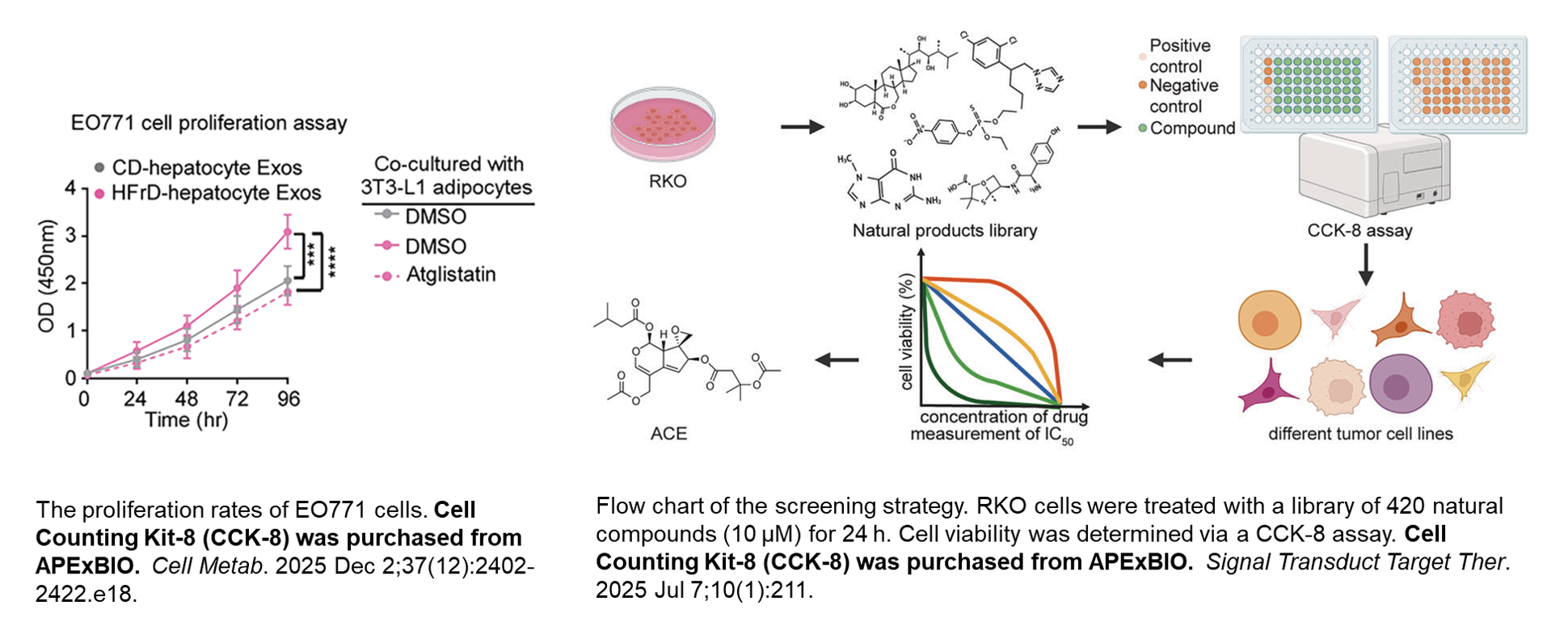
Measures cell viability and proliferation by quantifying the metabolic activity of live cells. Simple, widely used, suitable for microplate reader, and scalable for high-throughput screening.
| Products | Catalog No. | Detection | Features |
|---|---|---|---|
| MTT Cell Proliferation Assay Kit |
Absorbance at 570 nm
|
||
|
|
|
||
| Cell Counting Kit-8 (CCK-8) |
Absorbance at 450 nm
|
||
| Cell Counting Kit-8 (CCK-8) Plus |
Absorbance at 450 nm
|
||
| Resazurin Cell Viability Assay Kit |
Fluorescence at 570/595 nm
|
||
| Calcein AM Cell Viability Assay Kit | |||
Validation
DNA Synthesis
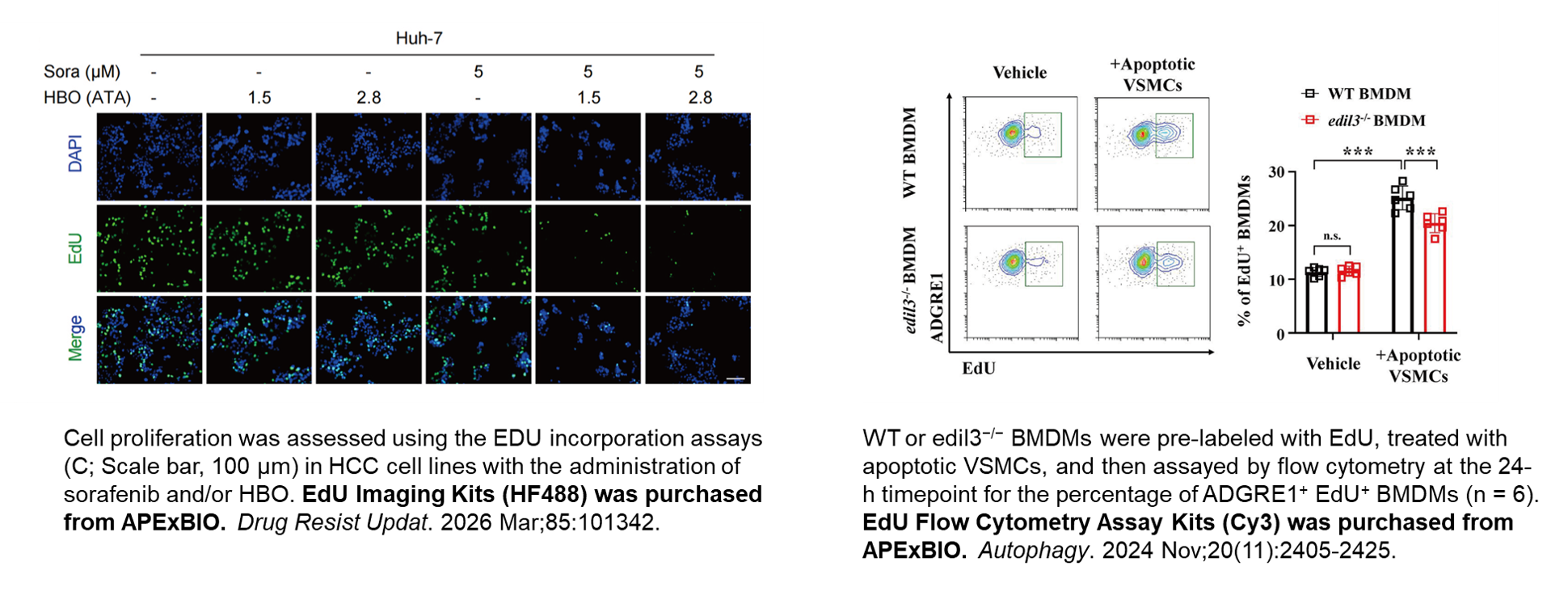
Detects DNA synthesis in proliferating cells using a thymidine analog. Highly sensitive and rapid, this series covers applications from flow cytometry and fluorescence microscopy to optical imaging and microplate detection.
| Products | Catalog No. | Detection | Features |
|---|---|---|---|
|
Fluorescence at 496/516 nm
|
|
||
|
Fluorescence at 496/516 nm
|
|
||
|
|||
|
|||
|
|||
Validation
ATP Assay
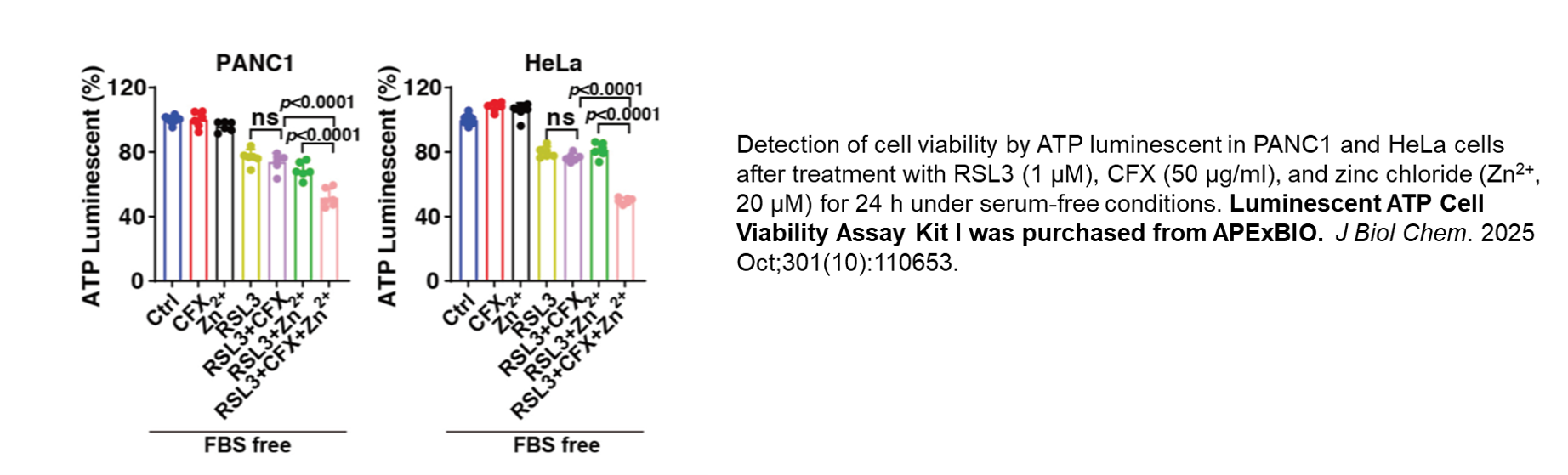
Quantifies intracellular ATP as a direct indicator of metabolically active cells. It is highly sensitive and provides results in as little as 10 minutes, making it ideal for rapid proliferation and cytotoxicity screening.
| Products | Catalog No. | Detection | Features |
|---|---|---|---|
|
Luminescence
|
|
||
Validation
Proliferation Maker
Uses antibodies to detect specific proteins expressed during active phases of the cell cycle. Ideal for immunohistochemistry, imaging, and flow cytometry.
| Products | Catalog No. | Target | Application |
|---|---|---|---|
|
Human
|
IHC-P
|
||
|
Human
|
WB, IHC-P, ICC/IF, FC
|
||
|
Human, Mouse, Monkey, Rat, Hamster
|
WB, ICC/IF, IP
|
||
|
Human, Mouse, Rat
|
WB, IHC-P
|
||
|
Human, Mouse, Monkey, Rat, Hamster
|
WB, IHC-F, IHC-P, ICC/IF, IP
|
||
|
Human, Mouse
|
WB
|
||
|
Human, Mouse, Rat
|
WB, ICC/IF, IP
|
Dye Dilution Assay
Tracks cell division by measuring the progressive dilution of a fluorescent dye in daughter cells. Perfect for long-term proliferation studies and flow cytometry analysis.
| Products | Catalog No. | Detection | Features |
|---|---|---|---|
|
Fluorescence at 494/521 nm
|
|
||
|
Fluorescence at 577/602 nm
|
|