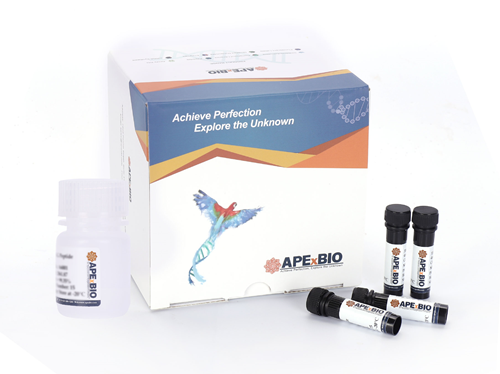
Cell Counting Kit-8 (CCK-8) Plus
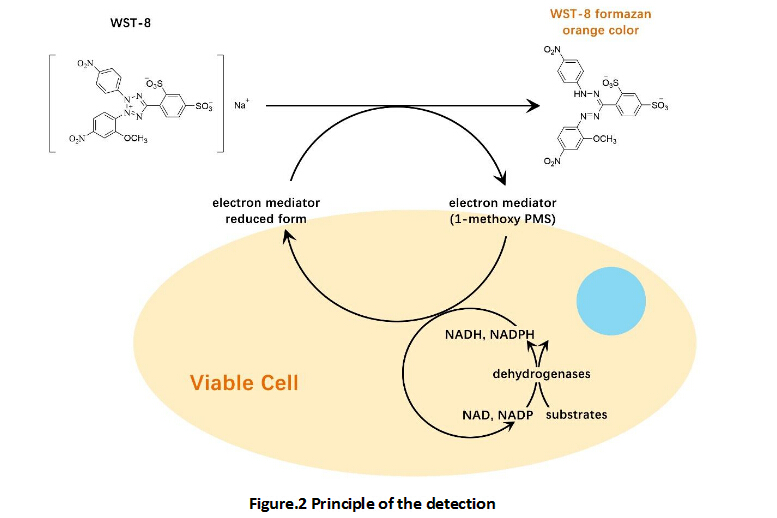
Cell Counting Kit-8 (CCK-8) Plus is a convenient and sensitive cell proliferation/toxicity assay. It uses a highly water-soluble tetrazolium salt, WST-8, which is reduced in the presence of electron-coupled reagents by the abundant dehydrogenases in living cells to the formazan, an orange dye that is soluble in culture media. The amount of formazan produced by dehydrogenase is directly and linearly related to the number of viable cells.
This kit is optimized, only requiring 0.5-1 h to complete the detection, which is more sensitive, faster, and has a wider linear range than the common CCK-8.
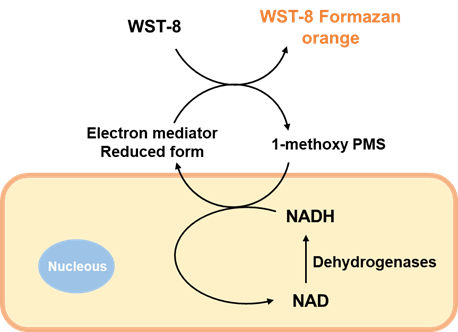
Figure 1: Schematic diagram of CCK-8 proliferation detection
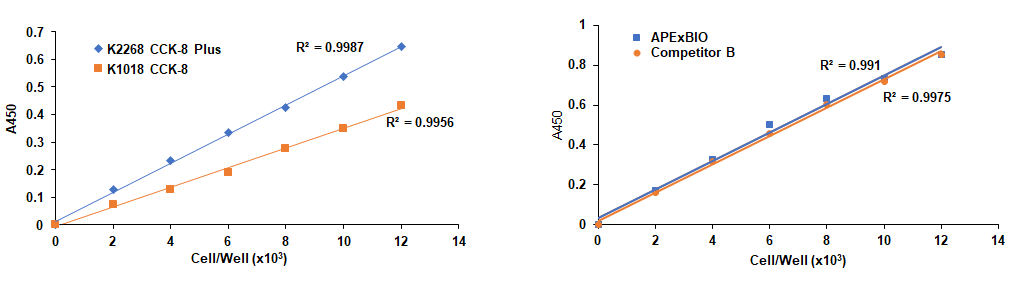
Figure 2. Performance comparison of CCK-8 Plus (K2268), Classic CCK-8 (K1018) and a competitor reagent using HeLa cells.
- 1. Dandan Zhang, Xiaoyu Ma, et al. "Activated olfactory ensheathing cells suppress astrocyte reactivity and CSPGs expression through IL-10 signaling in an in vitro scratch-injury model of glial scarring." Brain Res. 2026 Sep 17:1892:150552. PMID: 42753885
- 2. Xinhui Wang, Sujun Wu, et al. "A genome-wide CRISPR knockout screen identified host genes essential for Brucella invasion and intracellular survival." Emerg Microbes Infect. 2026 Dec;15(1):2713322. PMID: 42617139
- 3. Nan Zhang, Zhiyuan Zhang, et al. "IRF1-mediated sensing of oxidized mitochondrial DNA drives macrophage PANoptosis in lung ischemia–reperfusion injury." Apoptosis. 2026 Jul 25;31(8):198. PMID: 42502101
- 4. Xiangbo Zeng, Yuanchao Zhu, et al. "AARS2-mediated lactylation of ULK1 promotes autophagy-dependent progression of clear cell renal cell carcinoma." Autophagy. 2026 Jul 1. PMID: 42381569
- 5. Xiaomei Wang, Fei Guo, et al. "Angiotensin‐(1–7) Alleviates Isoproterenol‐Induced Cardiac Hypertrophy by Suppressing Autophagy and Apoptosis Through the Synergistic Action of Mas Receptor …." Acta Physiol (Oxf). 2026 Mar 26;242(4):e70200. PMID: 41886752
- 6. Qinjie Yang, Kun Liu, et al. "Colistin-induced acute kidney injury via zinc Dyshomeostasis-triggered GSDMD-executed Pyroptosis." International Immunopharmacology Volume 168, Part 1, 1 January 2026, 115768. PMID: 41176907
- 7. Hao Jiang, Yuanyuan Xue, et al. "Tubeimoside Ⅰ Targets Sodium/Potassium ATPase alpha 1 Subunit to Selectively Eliminate Senescent Cells and Alleviate Aging-associated Abnormalities." Phytomedicine Available online 15 April 2026, 158202
- 8. DongQiang Yang, LianMei Zhao, et al. "SLC11A1 can activate TGF-β1 signaling pathway to resist ferroptosis in colorectal cancer." Sci Rep. 2025 Dec 23. PMID: 41436829
- 9. Er-bu Aga, Ming-xin Pai, et al. "Four Isosteroidal Alkaloids from Fritillaria Alleviate Lipopolysaccharide-Induced Inflammation in vitro and in vivo through MyD88-and TRIF-Dependent Signaling …." Chin J Integr Med. 2025 Nov 18. PMID: 41252117
- 10. Hankun Lu, Jiahui Xiang, et al. "Alteration of the Secretome in Airway Epithelial Cells by Air Pollutants: Evidence from an Air–Liquid Interface Model." Lung. 2025 Oct 13;203(1):98. PMID: 41081902
- 11. Xiaolong Chen, Qing Wang, et al. "TRIP13-induced NUSAP1 upregulation promotes CcRCC progression through EMT and PI3K/AKT/mTOR pathway." J Transl Med. 2025 Aug 11;23(1):890. PMID: 40790482
- 12. Boqi Zhang, Nan Wang, et al. "Akkermansia muciniphila‐Derived Outer Membrane Vesicles as a Novel Therapeutic Approach for Mastitis: Insights From In Vitro and Vivo Studies." FASEB J. 2025 Jun 30;39(13):e70770. PMID: 40586785
- 13. Dengshuai Zhao, Ping Li, et al. "Venetoclax-induced degradation of VP8* lectin domain disrupts group A rotavirus replication." International Journal of Biological Macromolecules Volume 327, Part 2, October 2025, 147505
| Components |
K2268-100 T |
K2268-500 T |
K2268-1000 T |
K2268-3000 T |
K2268-10000 T |
|
Cell Counting Kit-8 (CCK-8) Plus |
1×1 mL |
5×1 mL |
2×5 mL |
6×5 mL |
20×5 mL |
|
Store at -20°C away from light, stable for 1 year. For frequent use, keep it at 4°C away from light, and stable for at least 2 weeks. |
|||||
1. What is the difference between CCK-8 Plus and classic CCK-8?
A: CCK-8 Plus (K2268) is an upgraded version of the standard CCK-8 (K1018), offering higher sensitivity and faster color development. It generates stronger signals in a shorter incubation period, making it ideal for experiments with low cell viability or low seeding densities.
2. How should CCK-8 Plus be stored?
A: CCK-8 Plus is highly stable. For short-term use, store it at 4°C. For long-term storage, keep it at -20°C. Minimize the number of freeze-thaw cycles to maintain optimal performance.
3. How much CCK-8 Plus should be added to the wells?
A: Add a volume of CCK-8 Plus equal to 1/10 of the culture medium volume in the well.
4. Is CCK-8 Plus cytotoxic?
A: CCK-8 Plus is virtually non-cytotoxic and does not affect normal cell functions.
5. Will colored test compounds interfere with the CCK-8 Plus assay?
A: Yes, they may cause interference. Consider replacing the medium containing the compound with fresh medium before adding CCK-8 Plus.