4-hydroperoxy Cyclophosphamide
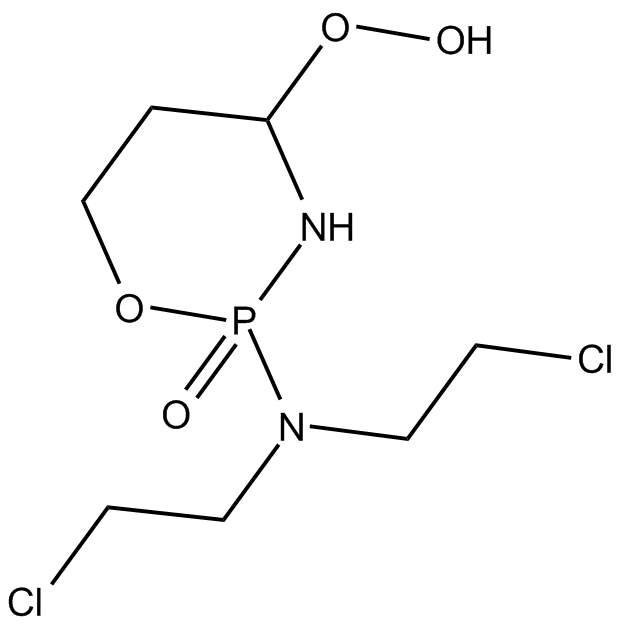
4-hydroperoxy Cyclophosphamide is the active metabolite form of the prodrug Cyclophosphamide. It crosslinks DNA and induces T cell apoptosis independent of death receptor activation, but activates mitochondrial death pathways through production of reactive oxygen species (ROS)[1]. Formulations containing the prodrug Cyclophosphamide are used to treat lymphomas and autoimmune disorders[2,3].
References:
[1]. Strauss G, Westhoff M A, Fischer-Posovszky P, et al. 4-hydroperoxy-cyclophosphamide mediates caspase-independent T-cell apoptosis involving oxidative stress-induced nuclear relocation of mitochondrial apoptogenic factors AIF and EndoG. Cell Death Differ, 2008, 15(2): 332-343.
[2]. Ahmed A R, Hombal S M. Cyclophosphamide (Cytoxan). A review on relevant pharmacology and clinical uses. J. Am. Acad. Dermatol, 1984, 11(6): 1115-1126.
[3]. Appel G B. New and future therapies for lupus nephritis. Cleve. Clin. J. Med, 2012, 79(2): 134-140.
| Physical Appearance | A solid |
| Storage | -20°C |
| M.Wt | 293.08 |
| Cas No. | 39800-16-3 |
| Formula | C7H15Cl2N2O4P |
| Synonyms | 4-OOH-CY |
| Solubility | Soluble in DMSO |
| Chemical Name | 2-(bis(2-chloroethyl)amino)-4-hydroperoxy-1,3,2-oxazaphosphinane 2-oxide |
| Canonical SMILES | O=P1(N(CCCl)CCCl)OCCC(OO)N1 |
| Shipping Condition | Small Molecules with Blue Ice, Modified Nucleotides with Dry Ice. |
| General tips | We do not recommend long-term storage for the solution, please use it up soon. |