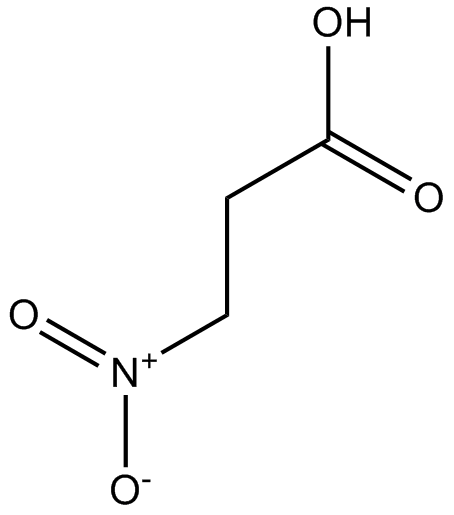
3-Nitropropionic acid
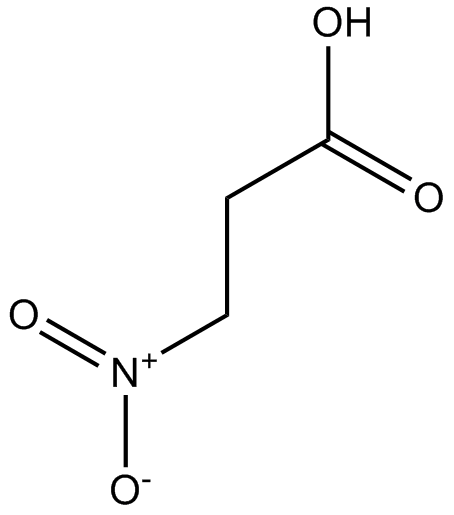
3-Nitropropionic acid (CAS No.: 504-88-1) is a naturally occurring nitroaliphatic toxin produced by certain plants and fungi and is widely utilized as a biochemical tool compound in studies of mitochondrial dysfunction and neurodegeneration. It acts as an irreversible inhibitor of mitochondrial respiratory complex II (succinate dehydrogenase), forming a covalent adduct within the enzyme active site and thereby disrupting electron transport chain function, leading to impaired ATP production, cellular energy depletion, and enhanced generation of reactive oxygen species. This mitochondrial impairment is associated with oxidative stress, mitochondrial DNA damage, and induction of apoptotic cell death pathways. In vitro, 3-nitropropionic acid exhibits biological activity in the low micromolar range, including reported antimycobacterial effects, and is frequently employed to model oxidative stress and mitochondrial toxicity in cultured cells. In vivo, it is extensively used to induce striatal neurodegeneration and reproduce key pathological and behavioral features of Huntington’s disease, as well as to study seizure susceptibility and neuroprotective interventions in rodent and primate models. Its applications in biomedical research include probing mitochondrial bioenergetics, evaluating antioxidant or anti-apoptotic strategies, and screening compounds targeting neurodegenerative disease mechanisms, with experimental concentrations or dosing regimens varying depending on specific study designs.
| Physical Appearance | A solid |
| Storage | -20°C |
| M.Wt | 119.08 |
| Cas No. | 504-88-1 |
| Formula | C3H5NO4 |
| Synonyms | β-Nitropropionic Acid; 3-NP; NSC 64266 |
| Solubility | ≥103 mg/mL in H2O; ≥114.2 mg/mL in EtOH; ≥6 mg/mL in DMSO |
| Chemical Name | 3-nitropropanoic acid |
| Canonical SMILES | OC(CC[N+]([O-])=O)=O |
| Shipping Condition | Small Molecules with Blue Ice, Modified Nucleotides with Dry Ice. |
| General tips | We do not recommend long-term storage for the solution, please use it up soon. |
| Cell experiment:[3] | |
|
Cell lines |
PC12 cells |
|
Reaction Conditions |
4 or 8 mM 3-nitropropionic acid for 48 h incubation |
|
Applications |
3-Nitropropionic acid induced cytotoxicity by triggering ROS production and mitochondrial DNA damage, which could be avoided by overexpressing Bcl-2 in PC12 cells. |
| Animal experiment:[2] | |
|
Animal models |
Female ICR mice |
|
Dosage form |
6.25, 12.5 and 25 mg/kg Continuous intraperitoneal injection for 7 days |
|
Applications |
3-Nitropropionic acid induced granulosa cell apoptosis, large follicle atresia, and an increase of ROS levels in the ovary. Thus, 3-nitropropionic acid could be used to establish an in vivo model of ovarian oxidative stress for studying the mechanism of resulting damage induced by free radicals and for the screening of novel antioxidants. |
|
Note |
The technical data provided above is for reference only. |
|
References: 1. Huang LS, Sun G, Cobessi D, et al. 3-Nitropropionic acid is a suicide inhibitor of mitochondrial respiration that, upon oxidation by complex II, forms a covalent adduct with a catalytic base arginine in the active site of the enzyme. Journal of Biological Chemistry, 2006, 281(9): 5965-5972. 2. Zhang JQ, Shen M, Zhu CC, et al. 3-Nitropropionic acid induces ovarian oxidative stress and impairs follicle in mouse. PLoS One, 2014, 9(2): e86589. 3. Mandavilli BS, Boldogh I, Van Houten B. 3-Nitropropionic acid-induced hydrogen peroxide, mitochondrial DNA damage, and cell death are attenuated by Bcl-2 overexpression in PC12 cells. Brain research. Molecular brain research, 2005, 133(2): 215-223. |
|
Quality Control & MSDS
- View current batch:
Chemical structure