

Levodopa
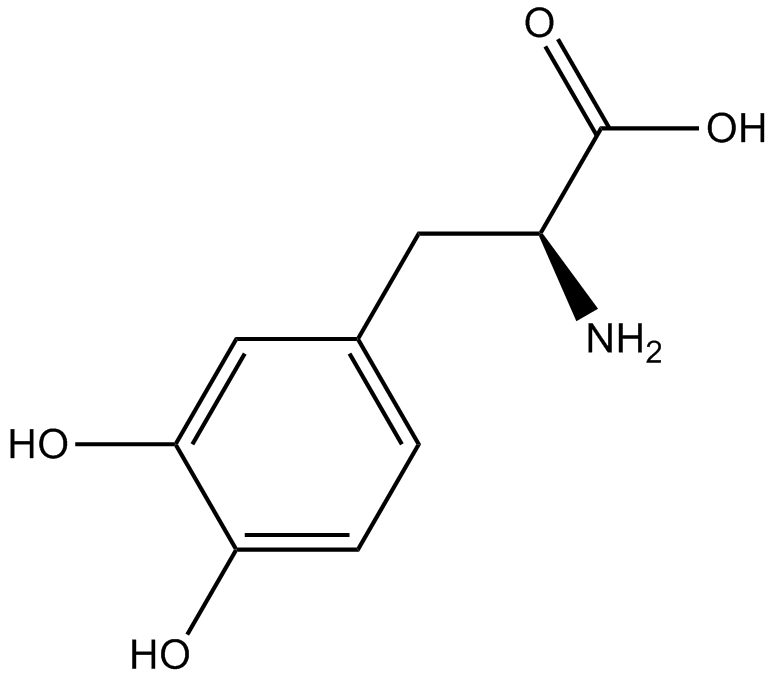
Levodopa (CAS 59-92-7) is a dopamine precursor produced by tyrosine hydroxylase; unlike dopamine itself, it can be orally administered and absorbed and can cross the blood-brain barrier [1], is rapidly taken up by dopaminergic neurons and converted to dopamine, and is used in the treatment of Parkinson's disease. Long-term administration in 6-OHDA-lesioned rats induces a levodopa-induced dyskinesia (LID) model.
References
[1] Berends HI, Nijlant JM, et al. The clinical use of drugs influencing neurotransmitters in the brain to promote motor recovery after stroke; a Cochrane systematic review. Eur J Phys Rehabil Med. 2009 Dec;45(4):621-30.
Levodopa is an immediate precursor of dopamine, produced by tyrosine hydroxylase. Unlike dopamine itself, it can be taken orally and crosses the blood-brain barrier[1]. It is rapidly taken up by dopaminergic neurons and converted to dopamine. It is also used as an anticholinergic drug and used in the treatment of Parkinson's disease.
Reference:
[1] Berends HI, Nijlant JM, et al. The clinical use of drugs influencing neurotransmitters in the brain to promote motor recovery after stroke; a Cochrane systematic review. Eur J Phys Rehabil Med. 2009 Dec;45(4):621-30.
| Physical Appearance | A solid |
| Storage | Store at -20°C |
| M.Wt | 197.19 |
| Cas No. | 59-92-7 |
| Formula | C9H11NO4 |
| Synonyms | L-DOPA |
| Solubility | insoluble in DMSO; insoluble in EtOH; ≥6.57 mg/mL in H2O with gentle warming |
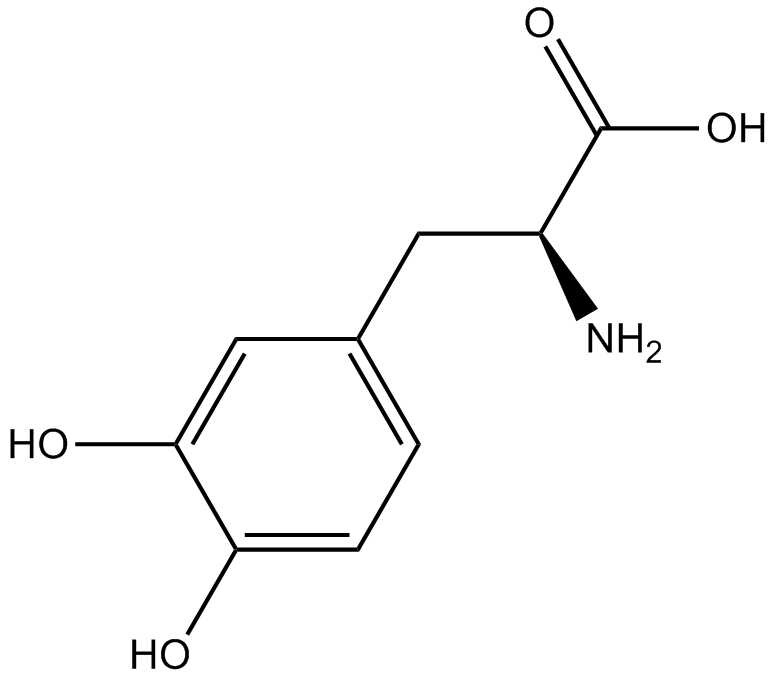
| Chemical Name | (2S)-2-amino-3-(3,4-dihydroxyphenyl)propanoic acid |
| Canonical SMILES | N[C@@H](Cc(cc1)cc(O)c1O)C(O)=O |
| Shipping Condition | Small Molecules with Blue Ice, Modified Nucleotides with Dry Ice. |
| General tips | We do not recommend long-term storage for the solution, please use it up soon. |
Quality Control & MSDS
- View current batch:
Chemical structure