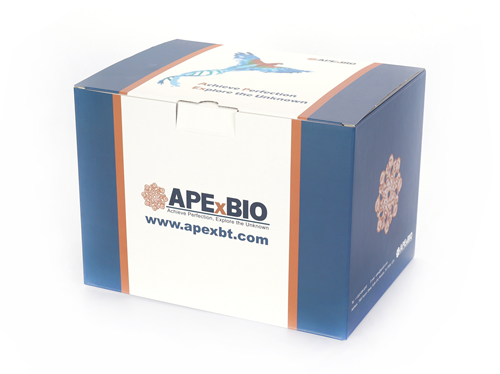
Biotin Labeling Kit for Avi-tag Protein (BirA)
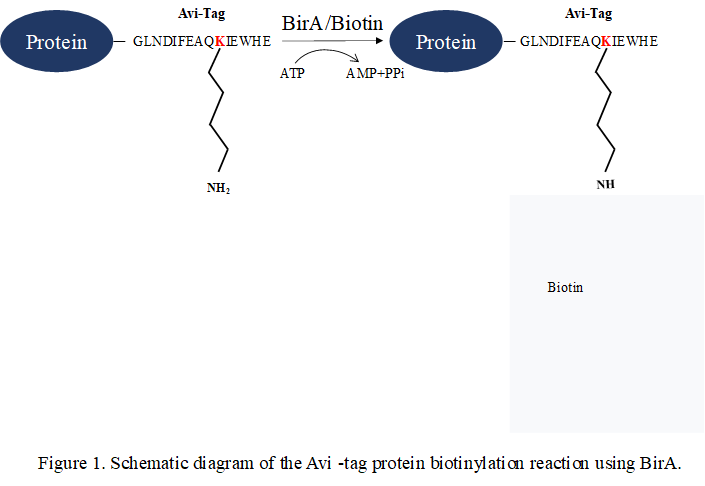
The Avi tag is a short peptide tag composed of 15 amino acids, and BirA is able to link biotin to the lysine residue of the Avi tag in the presence of ATP and biotin to achieve biotin labeling of the protein of interest. This method has several advantages, including small Avi tag and low impact on fusion proteins, high biotin labeling efficiency and good reproducibility, and high affinity of the labeled protein to Streptavidin.
After AVI tag protein biotin labeling, it can be applied to a variety of biological detection methods, such as immunofluorescence, in situ hybridization, or flow cytometry, for visualization and quantification. In addition, the binding system of biotin and streptavidin has the advantages of high affinity, high sensitivity, strong specificity and good stability, and is widely used in a variety of detection systems.
The Biotin Labeling Kit for Avi-tag Protein (BirA) is a tool for biotin labeling of proteins or peptides fused with Avi tags using biotin ligase (BirA). This kit enables efficient and fast biotin labeling, which can be used to detect and purify target proteins using Streptavidin or Avidin.
This product provides all the necessary components for site-specific biotinylation of Avi-tagged proteins or peptides; users simply need to add the sample to be labeled to initiate the reaction. In a 50 µL standard reaction system (containing 0.5 µL of 100× BirA), the recommended final substrate concentration is 40 µM, corresponding to a total substrate amount of 2 nmol in the system. This translates to approximately 40 µg, 100 µg, and 200 µg of labeled protein for proteins with molecular weights of 20 kDa, 50 kDa, and 100 kDa, respectively. Furthermore, the system can be proportionally scaled up or down as needed (e.g., to 25 µL or 100 µL) while maintaining the final concentration of each component, allowing flexible adaptation to different protein sample amounts and ensuring consistent and reliable labeling efficiency.
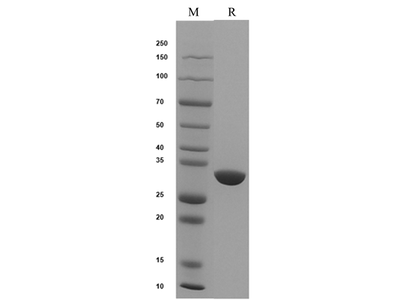
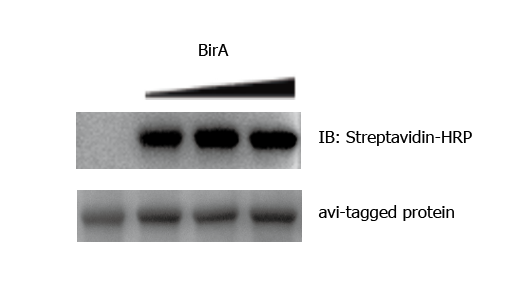
Related Biological Data
|
Components |
20 Assays |
100 Assays |
500 Assays |
Storage |
|
BirA (100X) |
10 μL |
50 μL |
5x50uL |
-20℃ |
|
Biotin Ligase Buffer A (10X) |
100 μL |
0.5 mL |
2x1.25mL |
-20℃ |
|
Biotin Ligase Buffer B (10X) |
100 μL |
0.5 mL |
2x1.25mL |
-20℃ |
|
Shipping: Blue ice |
Shelf life: 12 months |
|||
Q1: Does the target protein need to contain an Avi tag? Can the kit directly add an Avi tag to the protein?
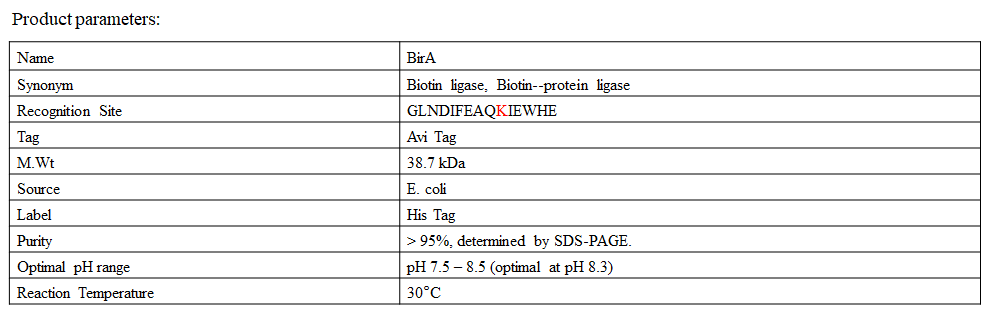
A: Yes, the protein must contain an Avi tag. The Avi tag (sequence: GLNDIFEAQKIEWHE) needs to be fused to the N-terminus, C-terminus, or an exposed loop of the target protein via genetic engineering. This kit is responsible for attaching biotin to the pre-existing Avi tag, not for adding the tag to the protein.
Q2: Does the kit contain D-Biotin, or do I need to purchase it separately?
A: No separate purchase is needed. The kit already contains biotin and all other required components for the reaction. Simply follow the protocol provided with the kit.
Q3: How do I remove BirA enzyme from the reaction system after labeling?
A: The BirA enzyme in this kit carries a His tag. After the labeling reaction, it can be removed by Ni-NTA affinity chromatography (collect the biotinylated protein in the flow-through). If downstream applications require higher purity, further purification can be performed using desalting columns or size-exclusion chromatography.
Q4: Can the labeling efficiency reach 100%?
A: 100% labeling efficiency cannot be guaranteed. Labeling efficiency is influenced by various factors including experimental conditions, protein purity, and Avi tag accessibility. It is recommended to assess the actual labeling efficiency via SDS-PAGE followed by Streptavidin-HRP Western blot, or by using the HABA/Avidin colorimetric assay for quantitative analysis.
Q5: Do commonly used salts or reagents in protein samples affect the reaction?
A: Yes. BirA biotin ligase is sensitive to the concentration of salts and additives in the reaction buffer. High concentrations of certain components can inhibit enzyme activity. To ensure efficient labeling, the final concentrations in the reaction are recommended to be: NaCl < 100 mM, glycerol < 5%, (NH₄)₂SO₄ < 50 mM, Tris < 50 mM. If your protein sample contains these components at higher-than-recommended levels, we suggest exchanging the buffer (e.g., by dialysis or desalting) to a suitable buffer such as PBS before performing the labeling reaction.
Q6: My protein concentration is very low (e.g., 4.2 µM in 300 µL) and cannot be concentrated. Can I directly perform labeling using the standard protocol?
A: Direct labeling with the standard protocol is not feasible. The kit requires a final protein concentration of 40 µM in the reaction. It is recommended to first try ultrafiltration for concentration. If concentration is not possible, consider scaling up the reaction system proportionally (e.g., from 50 µL to a larger volume) to achieve an equivalent total substrate amount of 2 nmol (i.e., 40 µM × 50 µL), while increasing all other components at the same ratio and ensuring the molar ratio of BirA to substrate remains unchanged.
Q7: After labeling, is it necessary to remove BirA before downstream applications such as SPR?
A: Removal is recommended. Although BirA carries a His tag and can be removed via Ni-NTA (see Q3), if the presence of BirA may interfere with downstream detection (e.g., non-specific binding or background signal in SPR), purification after labeling is advisable. If uncertain about the potential impact, it is recommended to perform a small-scale pilot experiment first.
Q8: Why can't I detect the biotinylation signal by Western blot, or why is the signal very weak?
A: This issue can usually be attributed to the following causes. Please troubleshoot accordingly:
1. The Avi tag is masked by protein folding, preventing BirA access. If the Avi tag is fused to the N- or C-terminus and is buried within the three-dimensional structure, BirA will not effectively recognize and catalyze biotin attachment. It is advisable to introduce a flexible linker (e.g., (GGGGS)n or (EAAAK)n) between the Avi tag and the target protein during vector design to improve tag accessibility.
2. The protein sample contains interfering substances (e.g., imidazole, high salt). Components in Ni-NTA eluates such as imidazole, high salt, or glycerol may inhibit BirA activity or disrupt the reaction system. Desalt or dialyze the protein sample against a compatible buffer (e.g., PBS, pH 7.4) prior to labeling. Imidazole concentration should be reduced to below 20 mM, and NaCl to below 150 mM. Refer to Q5 for specific compatible concentration ranges.
3. BirA enzyme is inactivated or has low activity. BirA is sensitive to storage conditions; repeated freeze-thaw cycles or prolonged storage at -20°C may reduce activity. Use freshly prepared reaction mixtures and ensure the enzyme has been aliquoted and stored at -80°C as recommended. If low activity is suspected, increase the BirA amount or use a new batch of enzyme.
4. Inappropriate reaction time or temperature. The standard reaction condition is 30°C for 30 minutes. If labeling efficiency is suboptimal, try extending the incubation to 1–2 hours, or increasing the temperature to 37°C. For some difficult-to-label proteins, overnight incubation (at 4°C or 16°C) may also improve labeling efficiency.
5. Insufficient biotin concentration. This kit already contains sufficient biotin and required cofactors; follow the recommended protocol without additional supplementation.
Additional suggestion: If none of the above resolves the issue, set up a positive control (e.g., a known efficiently labelable Avi-tagged peptide or standard protein) to verify that all kit components are functional. If the positive control is labeled successfully but your target protein is not, the issue most likely lies in the accessibility of the Avi tag on your target protein.
Q9: Can the reaction system be scaled up or down?
A: Yes. The 50 µL standard system can be proportionally scaled down (e.g., to 20 µL) or up (e.g., to 100 µL), as long as the final concentration of each component is maintained. When scaling, note that the total substrate amount changes with volume; ensure that the labeling yield meets the requirements of your downstream applications.
Q10: How can I assess the labeling efficiency of the labeled protein?
A: Commonly used detection methods include:
Streptavidin-HRP Western blot: Detects biotinylated protein signals using HRP-conjugated streptavidin.
SDS-PAGE in-gel detection: Observes mobility shifts of the protein after biotinylation.
HABA/Avidin colorimetric assay: Quantifies the ratio of biotin incorporation.
Q11: What are the advantages of Avi-tag technology? How does it differ from traditional chemical biotinylation methods?
A: Compared to traditional chemical methods (e.g., NHS ester-based random labeling of primary amines), the BirA enzymatic method offers the following advantages:
Site specificity: Only labels a specific lysine residue within the Avi tag, without affecting functional regions of the protein.
High product homogeneity: Labeling site and stoichiometry are consistent, ensuring good reproducibility.
Mild reaction conditions: Enzyme-catalyzed reaction conditions are gentle and preserve protein activity.
Small tag size: The Avi tag consists of only 15 amino acids, minimizing impact on fusion protein structure and function.