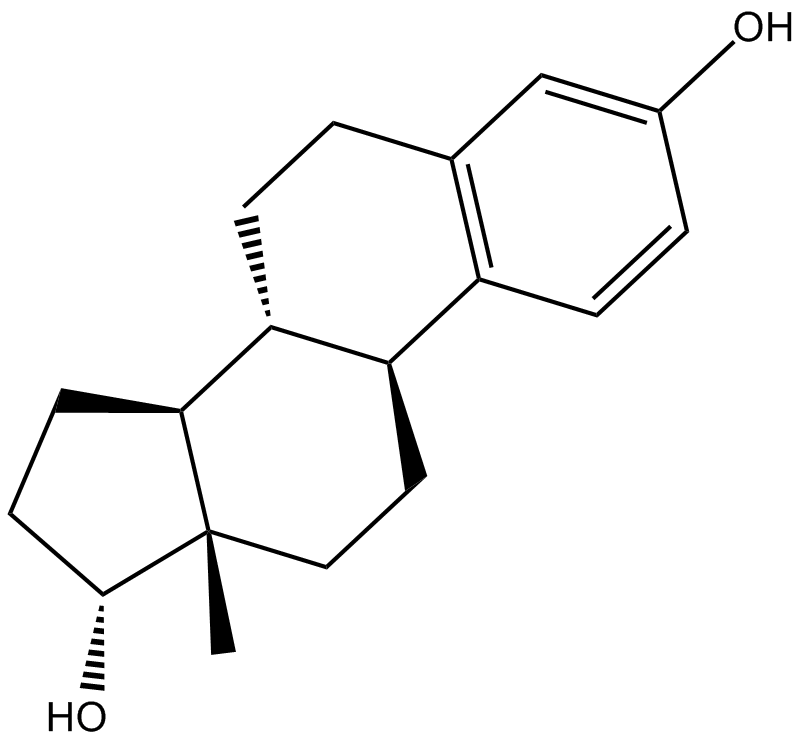


Estradiol

Estradiol (CAS 50-28-2) is a natural estrogen (steroid hormone), the principal female sex hormone in women and also present in men as an active metabolite of testosterone. Estradiol binds to estrogen receptors (ERalpha/ERbeta) and is the major estrogen regulating the functions of reproductive organs and bone, among others; in modeling it is often used as an essential estrogen support in endometriosis models and is also used to establish estrogen-induced uterine fibroid models.
As a major form of estrogen, estradiol interacts with the two estrogen receptors (ER), ERalpha and ERbeta, and exerts its effects by mediating distinct non-genomic and genomic signaling pathways.
In three different cell lines lacking endogenous ERalpha and ERbeta expression, U2OS (25), HEK293 (26), and Hs578T (23), the ERbeta-specific effect of estradiol treatment on gene expression was investigated. Among 76 ERbeta-regulated genes, 17 were co-regulated by ERalpha and ERbeta, indicating that estradiol-mediated transcriptional effects via ERalpha and ERbeta are distinctly different in U2OS cells. In 24-h estradiol treatment, 95 and 61 genes were identified as ERbeta-regulated in Hs578T and HEK293 cells, respectively. Only three genes (PTGER4, ENPP2, and DKK1) were co-regulated in both HEK293 and Hs578T cells, indicating that ERbeta evokes distinct gene responses in different types of target cells. By using estradiol, novel roles of ERbeta signaling were established, including a protective function in epithelial-mesenchymal transition and a regulatory role in cell proliferation in the colon[ 2 ].
Estrogen has a protective effect on cardiovascular disease. In mice and in vitro human aortic endothelial cells, estradiol treatment significantly increases expression of mitochondrial superoxide dismutase. Estradiol upregulates superoxide dismutase by tethering the estrogen receptor to Sp1 and increasing Sp1 binding to the GC-box on the superoxide dismutase promoter; on the superoxide dismutase promoter, ERalpha responds to estradiol-mediated gene activation, whereas ERbeta maintains a certain level of basal gene expression. In HepG2-ERalpha cells, E2 reduces PS levels and inhibits mRNA production and PS antigen. In addition, in HepG2-ERalpha cells, E2 may inhibit PROS1 transcription, depending on ERalpha-Sp1 recruitment of the transcriptional repressor. High levels of E2 cause reduced plasma PS levels, a risk for deep vein thrombosis in pregnant women[ 1,3 ].
References: [1]. Liu ZY, Gou YL, Zhang HY, et al. Estradiol improves cardiovascular function through up-regulation of SOD2 on vascular wall. Redox Biology, 2014, 3: 88-99.
[2]. Zhao CY, Dahlman-Wright K, Gustafsson J. Estrogen signaling via estrogen receptor beta*. The Journal Of Biological Chemistry, 2010, 51: 39575-39579.
[3]. Suzuki A, Sanda N, Miyawaki Y, et al. Down-regulation of pros1 gene expression by 17 beta-estradiol via estrogen receptor alpha (er alpha)-sp1 interaction recruiting receptor-interacting protein 140 and the corepressor-hdac3 complex. Journal Of Biological Chemistry, 2010, 285(18): 13444-13453.
- 1. Xiuting Xiang, Weizhou Jiang, et al. "Estrogen receptor–autophagy axis protects the heart, aorta and kidneys during perimenopausal aging: Evidence from human cohort and mouse experiments." Life Sciences Volume 387, 15 February 2026, 124183. PMID: 41490658
- 2. Feiyan Meng, Lihong Zhang, et al. "Two forms of G protein-coupled estrogen receptor 1 in the ricefield eel: Expression and functional characterization in relation to ovarian follicle development." Gen Comp Endocrinol. 2021 Apr 1;304:113720. PMID: 33508329
| Storage | Store at -20°C |
| M.Wt | 272.38 |
| Cas No. | 50-28-2 |
| Formula | C18H24O2 |
| Solubility | insoluble in H2O; ≥11.25 mg/mL in EtOH; ≥13.5 mg/mL in DMSO |
| Chemical Name | (8R,9S,13S,14S,17S)-13-methyl-6,7,8,9,11,12,14,15,16,17-decahydrocyclopenta[a]phenanthrene-3,17-diol |
| Canonical SMILES | C[C@](CC1)([C@@H](CC2)[C@H](CC3)[C@H]1c(cc1)c3cc1O)[C@H]2O |
| Shipping Condition | Small Molecules with Blue Ice, Modified Nucleotides with Dry Ice. |
| General tips | We do not recommend long-term storage for the solution, please use it up soon. |
Quality Control & MSDS
- View current batch:
Chemical structure