Capsaicin
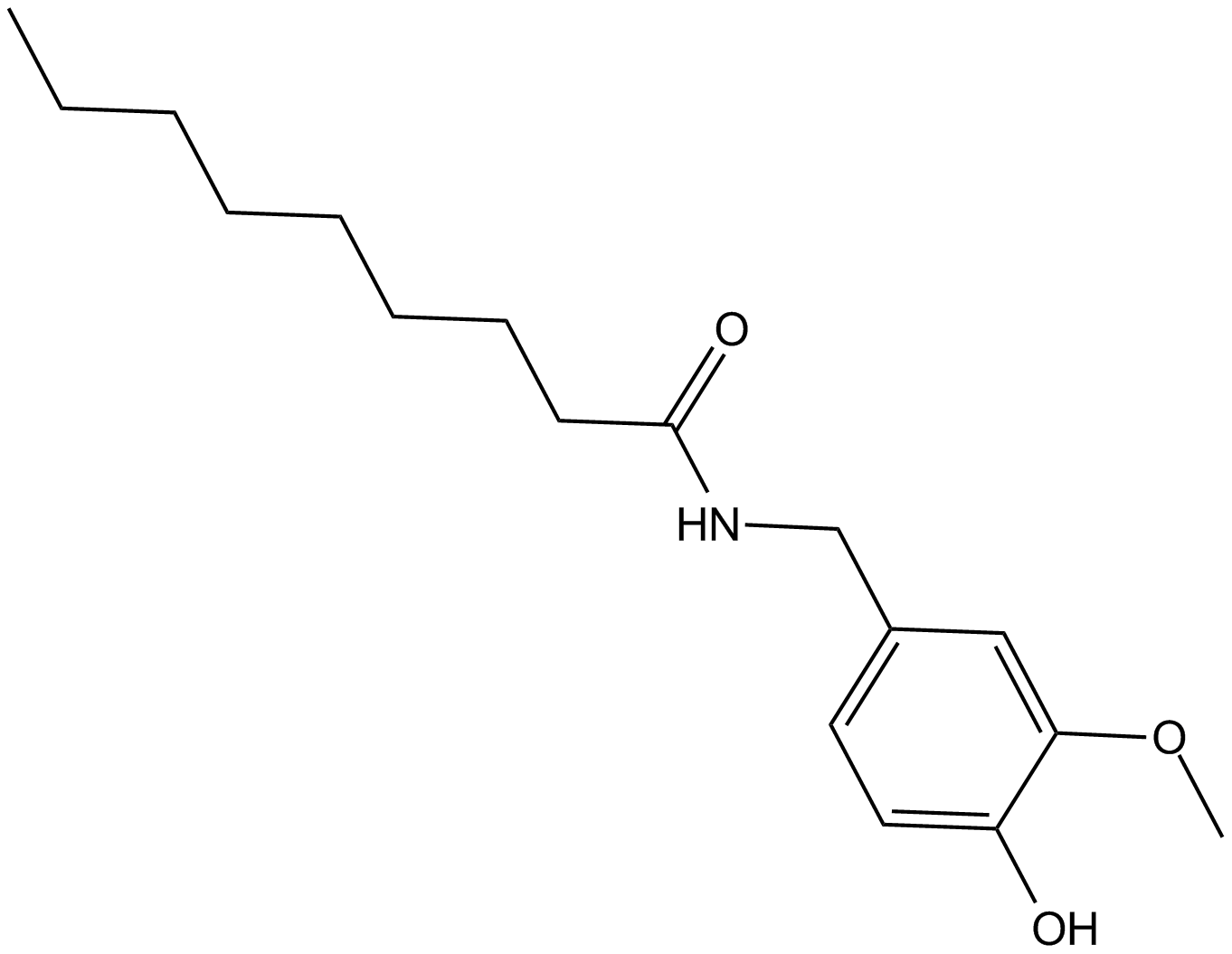
Capsaicin (CAS No. 404-86-4) is a natural vanillamide compound. Its core biological functions are activation of the transient receptor potential vanilloid subtype 1 (TRPV1) ion channel and competitive, reversible inhibition of lysine-specific demethylase 1A (KDM1A/LSD1). It also has effects including analgesia, anti-inflammation, inhibition of gastric cancer cell proliferation / migration / invasion and reversal of epithelial - mesenchymal transition (EMT), and regulation of pain and itch perception in chronic dermatitis.
Key activity data include biochemical inhibition of KDM1A with IC₅₀=0.6±0.0421 μM; inhibition of proliferation of human gastric cancer BGC-823 cells with IC₅₀=4.659 μM, which increases to 29.981 μM after KDM1A knockdown. In animal experiments it is often used for model treatment; common models include the SADBE-induced chronic dermatitis mouse model, the imiquimod-induced psoriasis mouse model, gastric cancer cell xenograft models, and neuropathic pain / osteoarthritis pain models.
Common applications and concentrations: in cell culture, BGC-823 gastric cancer cells commonly use 0.25-2 μM, and mouse trigeminal ganglion / dorsal root ganglion neurons commonly use 500 μM; in animal experiments, chronic dermatitis mice receive cheek subcutaneous injection of 500 μM (20 μL), pain models use local / intrathecal administration, and tumor models use oral administration; clinically, an 8% topical patch is used for treatment of chronic neuropathic pain. Effective concentrations are: at the cellular level, 0.25-1 μM can significantly inhibit malignant phenotypes of gastric cancer cells; at the animal level, 500 μM can activate TRPV1 in lesion tissue and regulate pain/itch responses; clinically, an 8% topical patch can effectively relieve chronic pain.
References:
[1] Jia G, Cang S, Ma P, Song Z. Capsaicin: A "hot" KDM1A/LSD1 inhibitor from peppers. Bioorg Chem. 2020 Oct;103:104161. doi: 10.1016/j.bioorg.2020.104161. Epub 2020 Aug 21. PMID: 32889380.
[2] Mogi M, Mendonza AE, Chastain J, Demirs JT, Medley QG, Zhang Q, Papillon JPN, Yang J, Gao Y, Xu Y, Stasi K. Ocular Pharmacology and Toxicology of TRPV1 Antagonist SAF312 (Libvatrep). Transl Vis Sci Technol. 2023 Sep 1;12(9):5. doi: 10.1167/tvst.12.9.5. PMID: 37672251; PMCID: PMC10484039.
[3] Yu G, Liu P, Huang X, Qi M, Li X, Feng W, Shang E, Zhou Y, Wang C, Yang Y, Zhu C, Wang F, Tang Z, Duan J. 20-HETE mediated TRPV1 activation drives allokinesis via MrgprA3+ neurons in chronic dermatitis. Theranostics. 2024 Feb 4;14(4):1615-1630. doi: 10.7150/thno.85214. PMID: 38389848; PMCID: PMC10879873.
[4] Hefner S, Oprita G, Pantke S, Hage A, Leffler A. Nav1.8, TRPV1 and TRPA1 as possible targets of ambroxol when used for topical treatment of neuropathic pain. J Pain. 2025 Dec;37:105563. doi: 10.1016/j.jpain.2025.105563. Epub 2025 Sep 16. PMID: 40967389.
| Storage | Store at -20°C |
| M.Wt | 305.41 |
| Cas No. | 404-86-4 |
| Formula | C18H27NO3 |
| Synonyms | (E)-Capsaicin, Capsaicine, Chilli Orange |
| Solubility | ≥49.4 mg/mL in DMSO; ≥49.4 mg/mL in EtOH; insoluble in H2O |
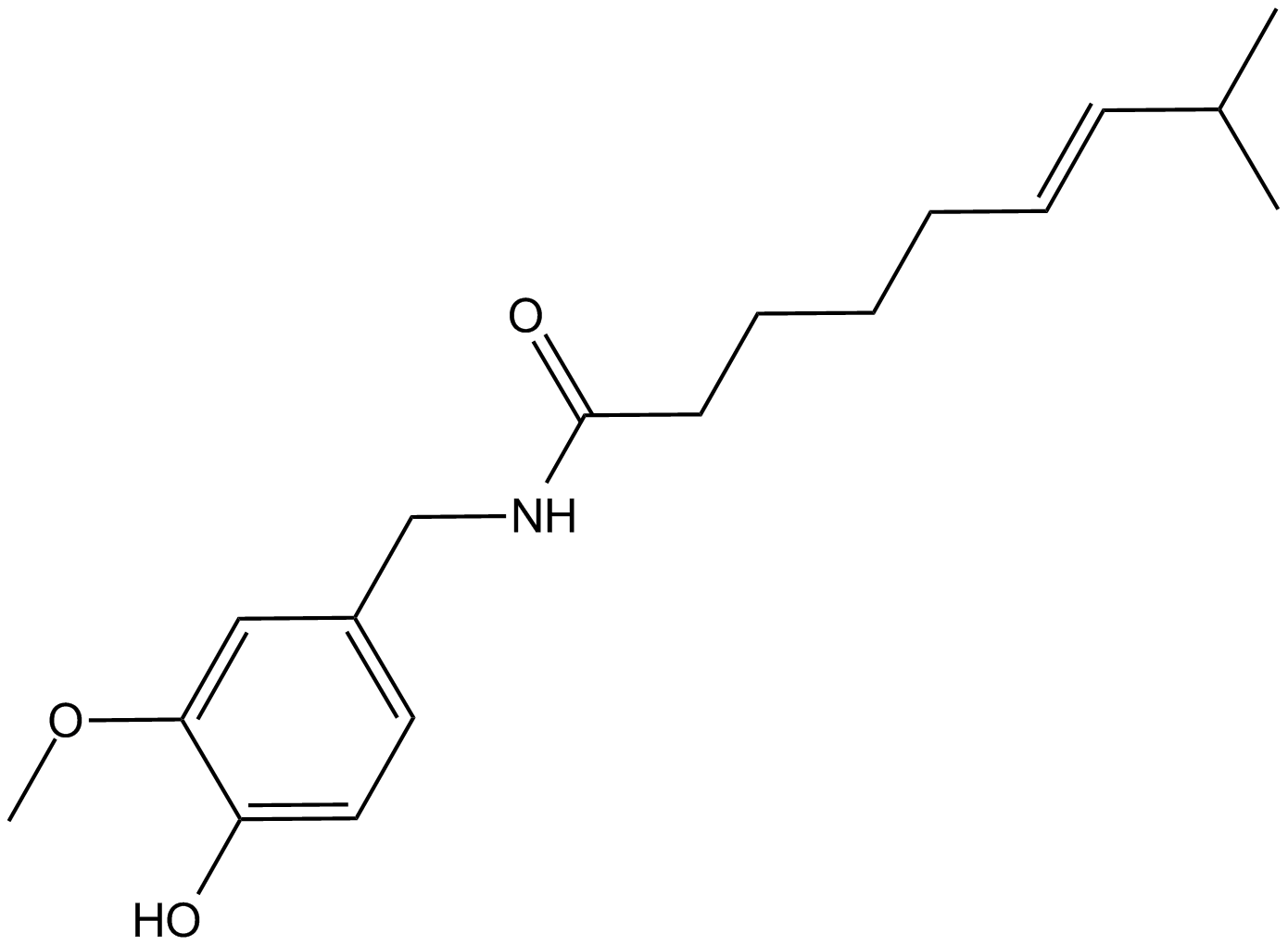
| Chemical Name | (E)-N-(4-hydroxy-3-methoxybenzyl)-8-methylnon-6-enamide |
| Canonical SMILES | COC1=CC(CNC(CCCC/C=C/C(C)C)=O)=CC=C1O |
| Shipping Condition | Small Molecules with Blue Ice, Modified Nucleotides with Dry Ice. |
| General tips | We do not recommend long-term storage for the solution, please use it up soon. |
Quality Control & MSDS
- View current batch:
Chemical structure