9-(2,2-Dicyanovinyl)julolidine
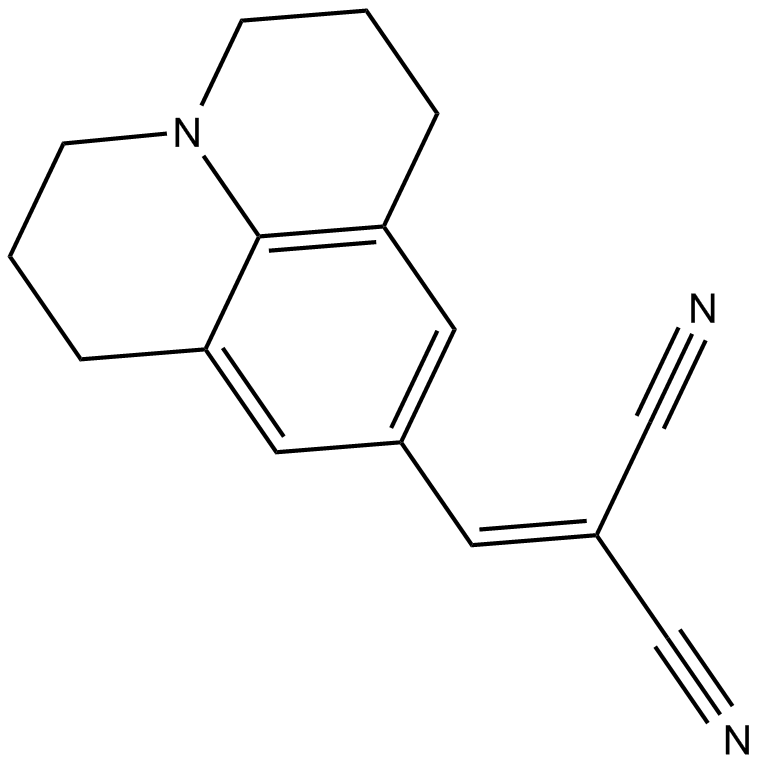
9-(2,2-Dicyanovinyl)julolidine (CAS No.: 58293-56-4) is a small-molecule fluorogenic dye classified as a viscosity-sensitive molecular rotor widely used in biophysical and cellular studies of membrane dynamics and cytoskeletal organization. Its fluorescence properties are governed by intramolecular rotational relaxation, resulting in marked increases in emission intensity in environments of elevated viscosity or upon binding to macromolecular structures, with excitation and emission maxima typically observed around 450 nm and 480–505 nm, respectively. This probe interacts with key cytoskeletal proteins, including tubulin and actin, exhibiting enhanced fluorescence upon polymerization and differential responses depending on microtubule structural states, thereby enabling the investigation of cytoskeletal assembly and dynamics. In addition, its affinity for phospholipid bilayers supports its application in probing membrane fluidity and lipid organization. Functionally, 9-(2,2-Dicyanovinyl)julolidine has been employed to monitor cellular processes such as mast cell degranulation kinetics, reflecting its sensitivity to local microenvironmental changes. While it does not act as a classical enzyme inhibitor or receptor ligand, its activity in vitro is characterized by fluorescence modulation in response to biomolecular interactions, typically observed across nanomolar to micromolar concentration ranges depending on assay conditions. This compound is broadly utilized in cell-based imaging, mechanistic studies of cytoskeletal and membrane-associated processes, and high-content screening platforms where microviscosity and structural transitions are of interest, with experimental concentrations adjusted according to specific assay requirements.
| Physical Appearance | A crystalline solid |
| Storage | -20°C |
| M.Wt | 249.31 |
| Cas No. | 58293-56-4 |
| Formula | C16H15N3 |
| Synonyms | DCVJ; 9-Julolidine Methylene Malononitrile; NSC 160064 |
| Solubility | ≤0.2mg/ml in ethanol;20mg/ml in DMSO;20mg/ml in dimethyl formamide |
| Chemical Name | 2-((1,2,3,5,6,7-hexahydropyrido[3,2,1-ij]quinolin-9-yl)methylene)malononitrile |
| Canonical SMILES | N#C/C(C#N)=C\C1=CC2=C3N(CCC2)CCCC3=C1 |
| Shipping Condition | Small Molecules with Blue Ice, Modified Nucleotides with Dry Ice. |
| General tips | We do not recommend long-term storage for the solution, please use it up soon. |