Cytochalasin B
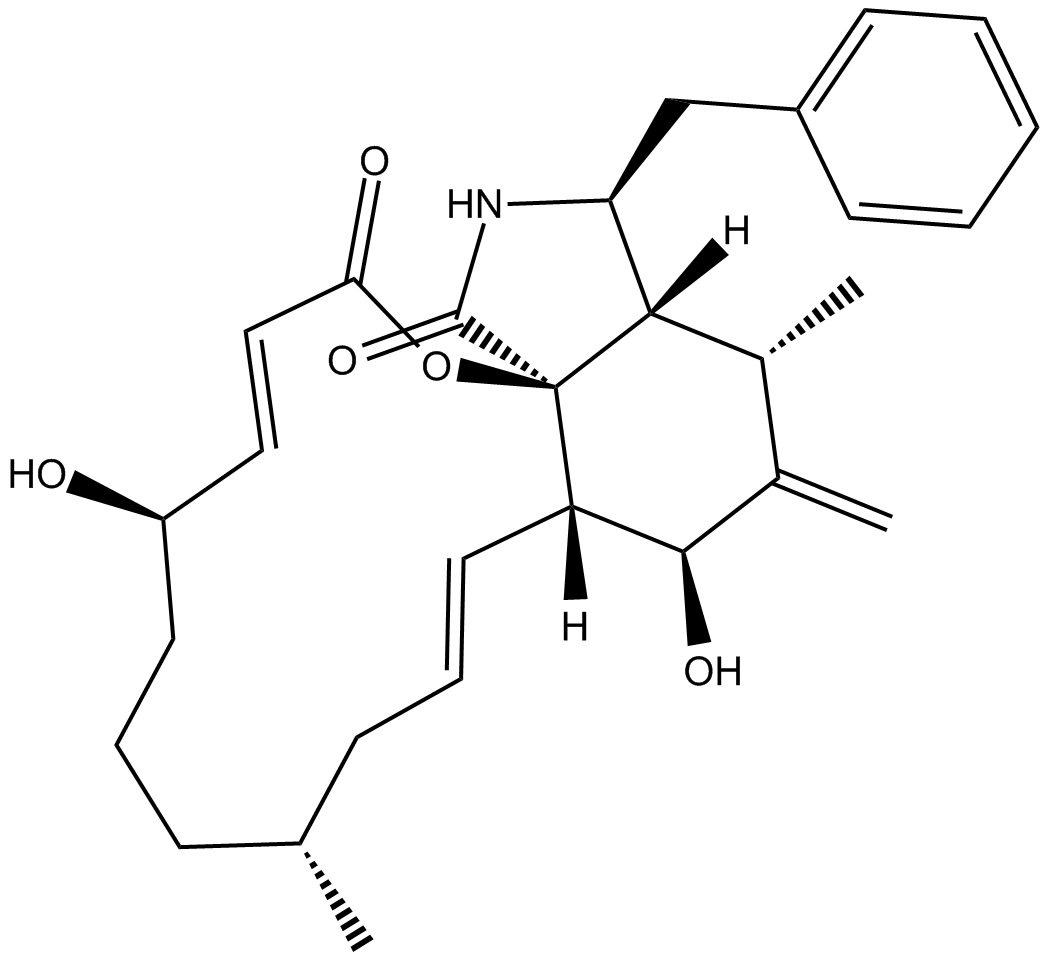
Cytochalasin B (CAS No.: 14930-96-2) is a cell-permeable fungal-derived mycotoxin widely used as a pharmacological tool in cytoskeletal research and drug discovery, characterized by its high-affinity binding to the barbed ends of actin filaments, where it reversibly inhibits both polymerization and depolymerization dynamics, with nanomolar affinity for filamentous actin. By disrupting actin filament assembly and promoting the conversion of F-actin to G-actin, it effectively perturbs actin-dependent cellular processes, including cell division, migration, phagocytosis, exocytosis, chemotaxis, and glucose transport, making it a valuable probe for studying cytoskeletal organization and cell motility pathways. In vitro studies demonstrate that Cytochalasin B exerts inhibitory effects on multiple cancer cell lines at low micromolar concentrations, consistent with its role in blocking actin-driven processes essential for tumor cell proliferation and invasion. In vivo, it has shown dose-dependent activity in murine leukemia models, suggesting potential utility in evaluating cytoskeleton-targeting therapeutic strategies, although its primary application remains experimental rather than clinical. Cytochalasin B is commonly employed in cell-based assays, mechanistic studies of actin dynamics, and screening platforms investigating cytoskeletal modulators, with experimental concentrations or dosing regimens varying according to specific study designs and biological contexts.
| Physical Appearance | A crystalline solid |
| Storage | -20°C |
| M.Wt | 479.61 |
| Cas No. | 14930-96-2 |
| Formula | C29H37NO5 |
| Synonyms | NSC 107658; Phomin |
| Solubility | ≤20mg/ml in ethanol;20mg/ml in DMSO;30mg/ml in dimethyl formamide |
| Chemical Name | (3S,3aS,4S,6S,6aS,7E,10R,14R,15E,18aS)-3-benzyl-6,14-dihydroxy-4,10-dimethyl-5-methylene-3,3a,4,5,6,6a,9,10,11,12,13,14-dodecahydro-1H-[1]oxacyclotetradecino[2,3-d]isoindole-1,17(2H)-dione |
| Canonical SMILES | O=C1/C=C/[C@@H](CCC[C@H](C/C=C/[C@]([H])([C@@]23O1)[C@@H](C([C@H]([C@]2([C@@H](NC3=O)CC4=CC=CC=C4)[H])C)=C)O)C)O |
| Shipping Condition | Small Molecules with Blue Ice, Modified Nucleotides with Dry Ice. |
| General tips | We do not recommend long-term storage for the solution, please use it up soon. |