

Busulfan
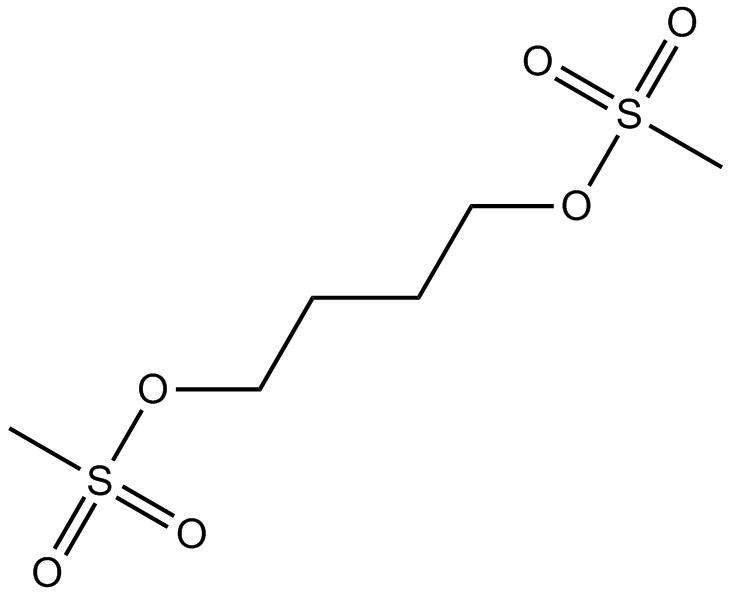
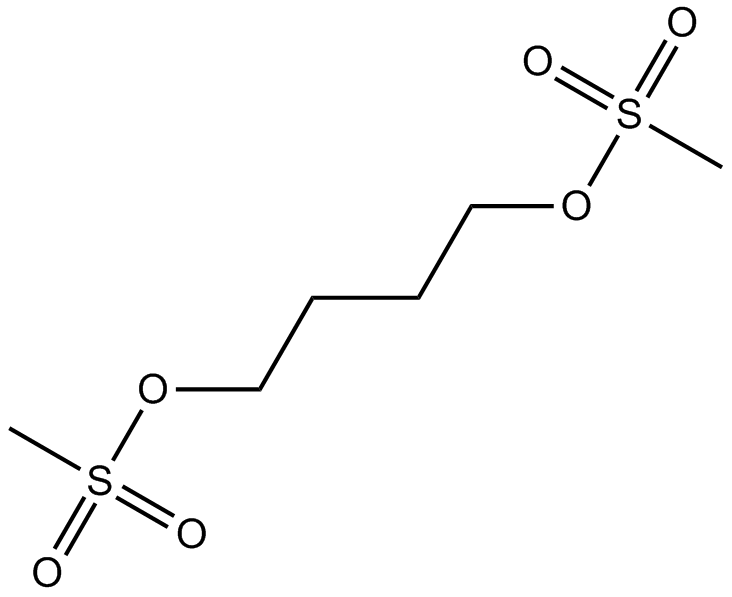
Busulfan (CAS 55-98-1) is a DNA alkylating agent[1]. Busulfan is commonly used to establish male infertility (azoospermia) animal models.
DNA alkylating agents bind to the guanine bases of DNA, causing DNA damage by cross-linking the guanine bases of the double helix, thereby inhibiting tumor growth[1].
In normal human diploid WI38 fibroblasts, busulfan (7.5–120 µM) induces senescence in a dose-dependent manner, which is associated with prolonged activation of c-Jun N-terminal kinase (JNK)/p38 mitogen-activated protein kinase (MAPK) and extracellular signal-regulated kinase (Erk)[2]. The induction of senescence is initially caused by a transient depletion of intracellular glutathione (GSH), followed by increased reactive oxygen species (ROS) generation and activation of the Erk and p38 MAPK pathways[1].
In adult mouse testes, busulfan induces apoptosis and reduces testicular weight. During the first week, apoptosis occurs mainly in spermatogonia. In the following week, the spermatogonia-specific markers Stra8 and c-kit decrease while Gli1 remains unchanged, indicating apoptosis of differentiated type A spermatogonia[3].
References: [1]. Probin V, Wang Y, Zhou D. Busulfan-induced senescence is dependent on ROS production upstream of the MAPK pathway. Free Radic Biol Med, 2007, 42(12): 1858-1865.
[2]. Probin V, Wang Y, Bai A, et al. Busulfan selectively induces cellular senescence but not apoptosis in WI38 fibroblasts via a p53-independent but extracellular signal-regulated kinase-p38 mitogen-activated protein kinase-dependent mechanism. J Pharmacol Exp Ther, 2006, 319(2): 551-560.
[3]. Choi YJ, Ok DW, Kwon DN, et al. Murine male germ cell apoptosis induced by busulfan treatment correlates with loss of c-kit-expression in a Fas/FasL- and p53-independent manner. FEBS Lett, 2004, 575(1-3): 41-51.
- 1. Heng Xie, Bin Zhou, et al. "Dual recombinases-mediated genetic tracing reveals no postnatal neo-oogenesis in mice." iScience (2026)
- 2. Tuan Anh Phu, Ngan K Vu, et al. "ApoE enhances mitochondrial metabolism via microRNA-142a/146a-regulated circuits that suppress hematopoiesis and inflammation in hyperlipidemia." Cell Rep. 2023 Oct 31;42(10):113206. PMID: 37824329
- 3. Hao Zhou, Qing Zhang, et al. "Epigenetic silencing of ZCCHC10 by the lncRNA SNHG1 promotes progression and venetoclax resistance of acute myeloid leukemia." Int J Oncol. 2023 May;62(5):64. PMID: 37052262
| Physical Appearance | A solid |
| Storage | Store at -20°C |
| M.Wt | 246.3 |
| Cas No. | 55-98-1 |
| Formula | C6H14O6S2 |
| Solubility | ≥12.3 mg/mL in DMSO; ≥2.35 mg/mL in H2O with gentle warming; ≥2.82 mg/mL in EtOH with gentle warming |
| Chemical Name | 4-methylsulfonyloxybutyl methanesulfonate |
| Canonical SMILES | CS(OCCCCOS(C)(=O)=O)(=O)=O |
| Shipping Condition | Small Molecules with Blue Ice, Modified Nucleotides with Dry Ice. |
| General tips | We do not recommend long-term storage for the solution, please use it up soon. |
| Cell experiment [1]: | |
|
Cell lines |
WI38 cells (human embryonic lung diploid fibroblasts) |
|
Preparation method |
Soluble in DMSO > 12.3mg/mL. General tips for obtaining a higher concentration: Please warm the tube at 37℃ for 10 minutes and/or shake it in the ultrasonic bath for a while. Stock solution can be stored below -20℃ for several months. |
|
Reacting condition |
120μM for 24 h. |
|
Applications |
Busulfan , an alkylating agent that causes DNA damage by crosslinking DNAs and DNA and proteins, induced senescence in normal human diploid WI38 fibroblasts through the extracellular signal-regulated kinase (Erk) and p38 mitogen-activated protein kinase (p38 MAPK) cascade independent of the p53-DNA damage pathway. |
| Animal experiment [2]: | |
|
Animal models |
ICR male mice ranging in age from 8 to 12weeks |
|
Dosage form |
Diluted in sesame oil, 40 mg/kg body weight, intraperitoneal injection |
|
Application |
Busulfan-treated mice exhibited a marked increase in apoptosis and a decrease in testis weight. The percentage of apoptosis-positive tubules and the apoptotic cell index increased in a time-dependent manner. Increased depletion of male germ cells in the busulfan-treated mouse was mediated by loss of c-kit/SCF(stem cell factor) signaling but not by p53- or Fas/FasL(Fas ligand) -dependent mechanisms. |
|
Other notes |
Please test the solubility of all compounds indoor, and the actual solubility may slightly differ with the theoretical value. This is caused by an experimental system error and it is normal. |
|
References: [1]. Probin V, Wang Y, Zhou D. Busulfan-induced senescence is dependent on ROS production upstream of the MAPK pathway. Free Radic Biol Med, 2007, 42(12): 1858-1865. [2]. Choi YJ, Ok DW, et al. Murine male germ cell apoptosis induced by busulfan treatment correlates with loss of c-kit-expression in a Fas/FasL- and p53-independent manner. FEBS Lett, 2004, 575(1-3): 41-51. | |
Quality Control & MSDS
- View current batch:
-
Purity = 98.00%
- COA (Certificate Of Analysis)
- MSDS (Material Safety Data Sheet)
- Datasheet
Chemical structure