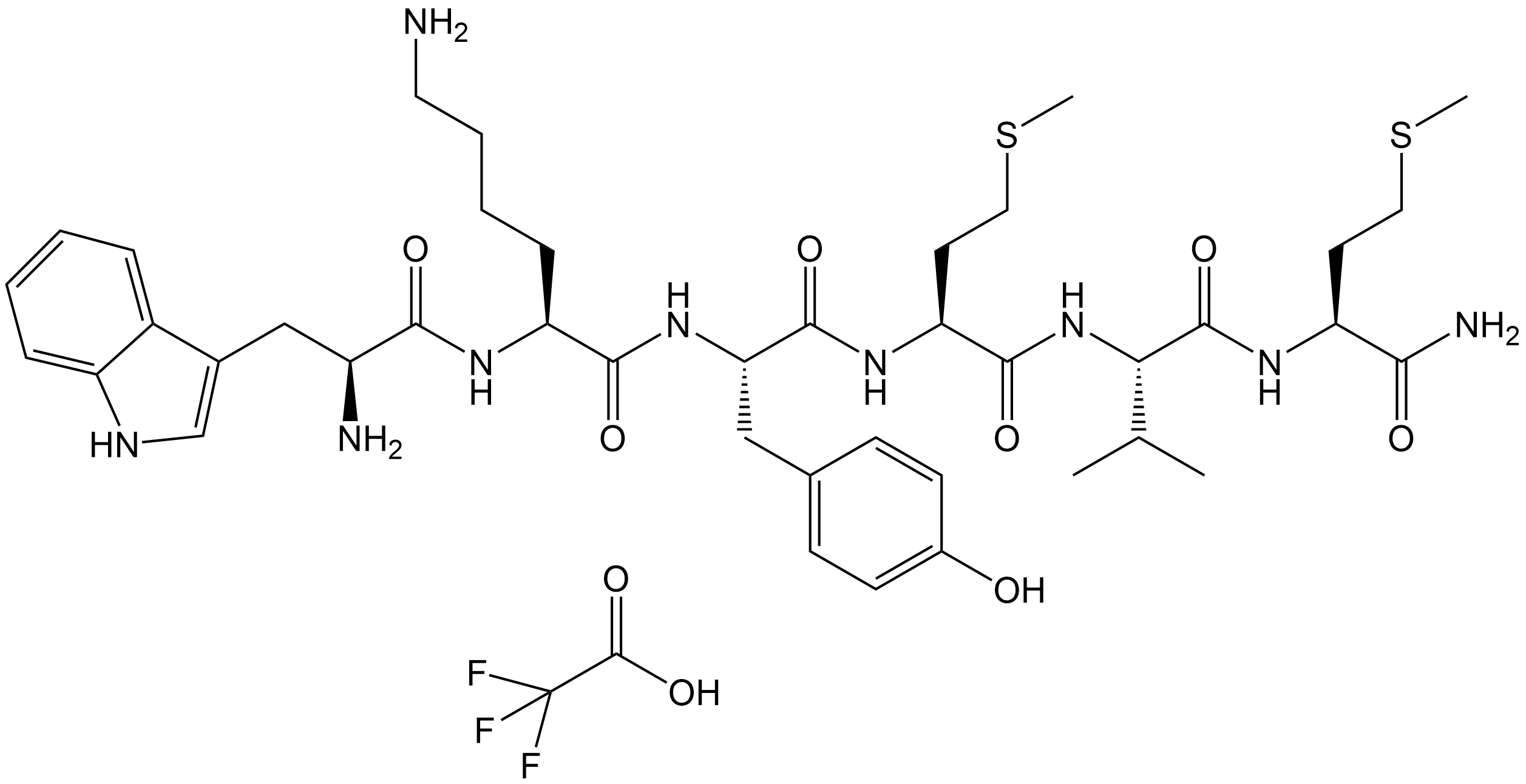
WKYMVM-NH2 TFA
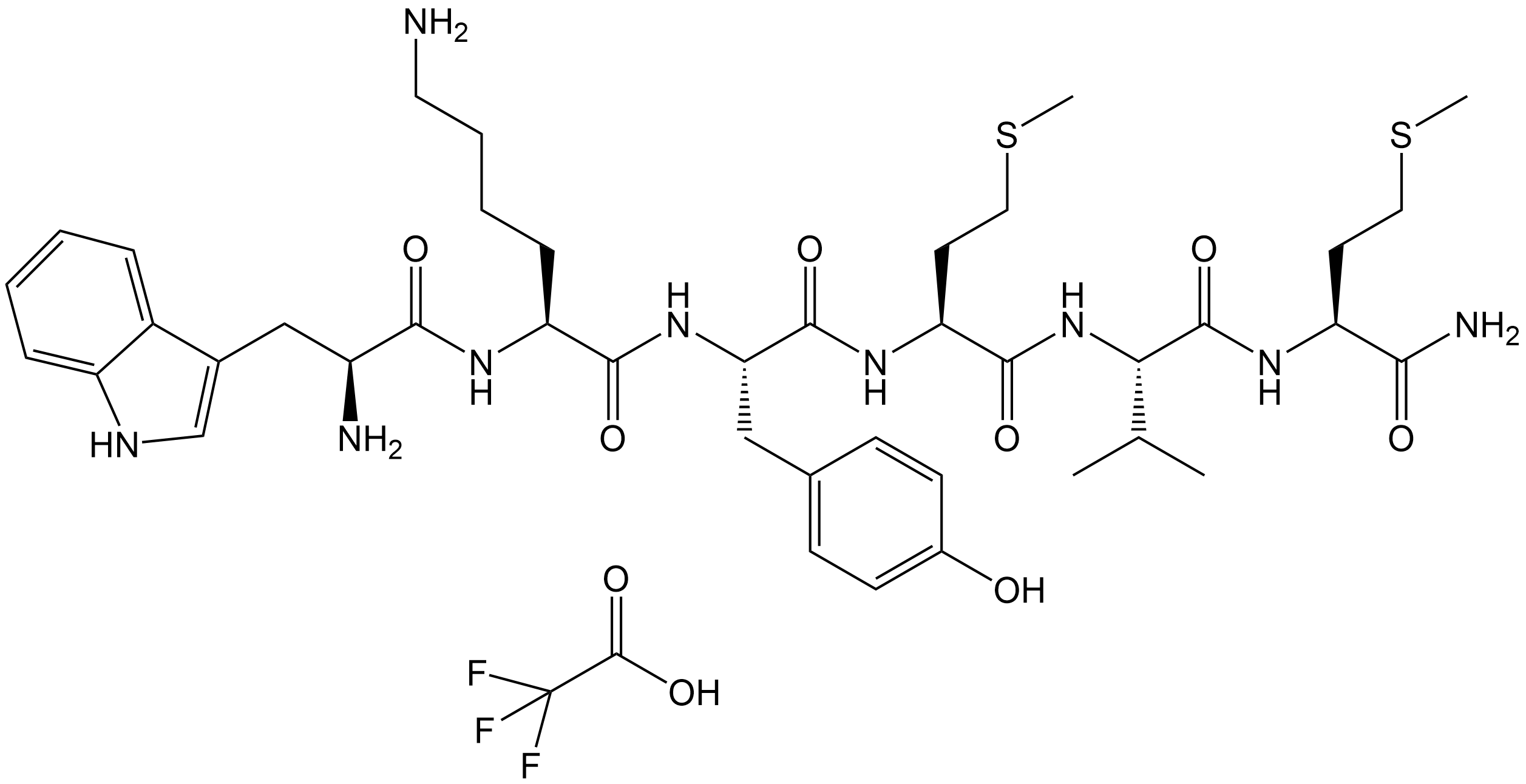





WKYMVm TFA (CAS No.: 1435781‑74‑0) is a C-terminally amidated hexapeptide formyl peptide receptor (FPRs) selective agonist in the trifluoroacetate salt form, with the highest affinity for FPR2 (FPRL1/ALX), while also activating FPR1 and FPR3 (FPRL2). In functional assays, the EC₅₀ of WKYMVm-mediated FPR2 calcium mobilization is approximately 75 pM, and the EC₅₀ of FPR3 calcium mobilization is approximately 3 nM; in radioligand competitive binding assays, its IC₅₀ for FPR2 is 30–40 nM, and its IC₅₀ for FPR3 is 2.5–3 μM. Its L-methionine analog WKYMVM acts only on FPR2 and FPR3, with calcium mobilization EC₅₀ values of 2 nM and 80 nM, respectively, an equilibrium dissociation constant K_D for binding to FPR2 of approximately 160 nM, and an EC₅₀ of approximately 75 nM for inducing superoxide anion production in neutrophils.
At the signaling pathway level, WKYMVm can initiate multiple downstream cascades after activating FPRs. In myeloid immune cells, it can activate the PLC–PKC, PI3Kγ–AKT, Rho, and Ras–MAPK (ERK/JNK/p38) pathways, thereby driving effector responses such as chemotactic migration, degranulation, phagocytosis, and reactive oxygen species generation; in neutrophils, it enhances the killing capacity against pathogenic microorganisms by promoting phosphorylation of STAT1 at Ser727 and upregulating IRF1; in osteoclast precursor cells, it directly inhibits phosphorylation of NF‑κB and STAT3, and negatively regulates osteoclast differentiation and maturation by downregulating the CD9/gp130/STAT3 pathway; in macrophages, it can induce M2 polarization through the JAK1/STAT6 axis, exerting anti-inflammatory and tissue repair-promoting effects.
At the application level, WKYMVm is widely used in intervention studies in various animal models of inflammation and tissue injury, including LPS (Cat. No.: N2894)-induced acute lung injury, inflammatory calvarial osteolysis, sepsis and pneumonia sepsis caused by bacterial/fungal infection, bleomycin (Cat. No.: A8331)-induced scleroderma, diabetic wound healing impairment, ulcerative colitis, ischemia-reperfusion injury, and spinal cord injury, to evaluate its anti-inflammatory, tissue-protective, and functional reconstruction effects. Common in vitro concentrations range from nanomolar to low micromolar levels: in dHL‑60 neutrophil-like cells, treatment with 1 μM for 1 h can significantly enhance MPO and NO release, with no obvious cytotoxicity within the range of 1–1000 nM; in osteoclast differentiation systems of RAW264.7 and bone marrow-derived macrophages, 0.1–10 μM is commonly used and can dose-dependently inhibit osteoclast formation and bone resorption; in Caco‑2 intestinal epithelial cells, 10–1000 nM can promote cell proliferation. In animal experiments, commonly used doses are mostly 2.5–8 mg/kg, with administration routes including intraperitoneal injection, subcutaneous injection, and intranasal administration. For example, in an acute lung injury model, intraperitoneal injection of 2.5–5 mg/kg/day for 4 consecutive days can significantly alleviate lung inflammation and tissue injury; in an inflammatory osteolysis model, subcutaneous calvarial administration of 4–8 mg/kg once every 48 hours for a total of 7 doses can significantly reduce bone loss. Pharmacokinetic data show that this peptide is rapidly degraded in vivo: when administered intraperitoneally to rats at 2.5 mg/kg, the half-life is approximately 4.9 min, and when administered intravenously at the same dose, the half-life is approximately 15.7 min, suggesting that dosing frequency or sustained-release/carrier optimization should be considered when designing dosing regimens.
References:
[1] Christophe T, Karlsson A, Dugave C, Rabiet MJ, Boulay F, Dahlgren C. The synthetic peptide Trp-Lys-Tyr-Met-Val-Met-NH2 specifically activates neutrophils through FPRL1/lipoxin A4 receptors and is an agonist for the orphan monocyte-expressed chemoattractant receptor FPRL2. J Biol Chem. 2001 Jun 15;276(24):21585-93. doi: 10.1074/jbc.M007769200. Epub 2001 Apr 2. PMID: 11285256.
[2] Hu J, Li X, Chen Y, Han X, Li L, Yang Z, Duan L, Lu H, He Q. The protective effect of WKYMVm peptide on inflammatory osteolysis through regulating NF-κB and CD9/gp130/STAT3 signalling pathway. J Cell Mol Med. 2020 Jan;24(2):1893-1905. doi: 10.1111/jcmm.14885. Epub 2019 Dec 14. PMID: 31837208; PMCID: PMC6991638.
[3] Lee H, Lee J, Park Y, Kim JH, Eickelberg O, Yang SR. WKYMVm ameliorates acute lung injury via neutrophil antimicrobial peptide derived STAT1/IRF1 pathway. Biochem Biophys Res Commun. 2020 Dec 10;533(3):313-318. doi: 10.1016/j.bbrc.2020.09.036. Epub 2020 Sep 18. PMID: 32958247.
[4] Yang Y, Zhao J, Jiang C, Zhang Y, Han M, Liu H. WKYMVm Works by Targeting Immune Cells. J Inflamm Res. 2023 Jan 6;16:45-55. doi: 10.2147/JIR.S390394. PMID: 36636250; PMCID: PMC9831254.
| Storage | -20℃, sealed storage, away from moisture |
| M.Wt | 970.13 |
| Cas No. | 1435781-74-0 |
| Formula | C43H62F3N9O9S2 |
| Synonyms | WKYMVM-NH2 TFA |
| Solubility | ≥53.4 mg/mL in DMSO; insoluble in EtOH; ≥4.05 mg/mL in H2O with ultrasonic |
| Chemical Name | (S)-6-amino-2-((S)-2-amino-3-(1H-indol-3-yl)propanamido)-N-((5S,8S,11S,14S)-5-carbamoyl-15-(4-hydroxyphenyl)-8-isopropyl-11-(2-(methylthio)ethyl)-7,10,13-trioxo-2-thia-6,9,12-triazapentadecan-14-yl)hexanamide 2,2,2-trifluoroacetate |
| Canonical SMILES | Trp-Lys-Tyr-Met-Val-Met-NH2 (TFA) |
| Shipping Condition | Small Molecules with Blue Ice, Modified Nucleotides with Dry Ice. |
| General tips | We do not recommend long-term storage for the solution, please use it up soon. |
Quality Control & MSDS
- View current batch:
Chemical structure