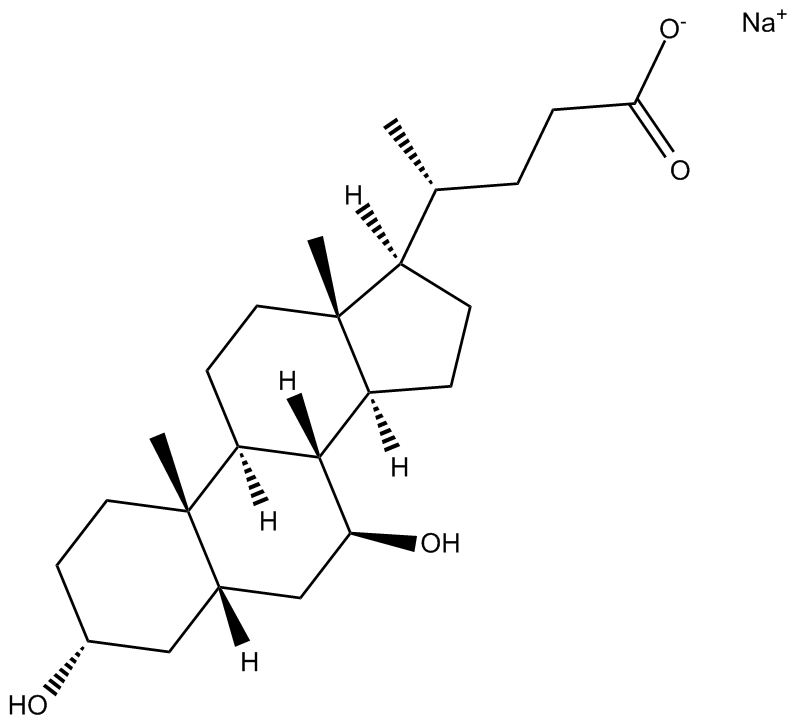
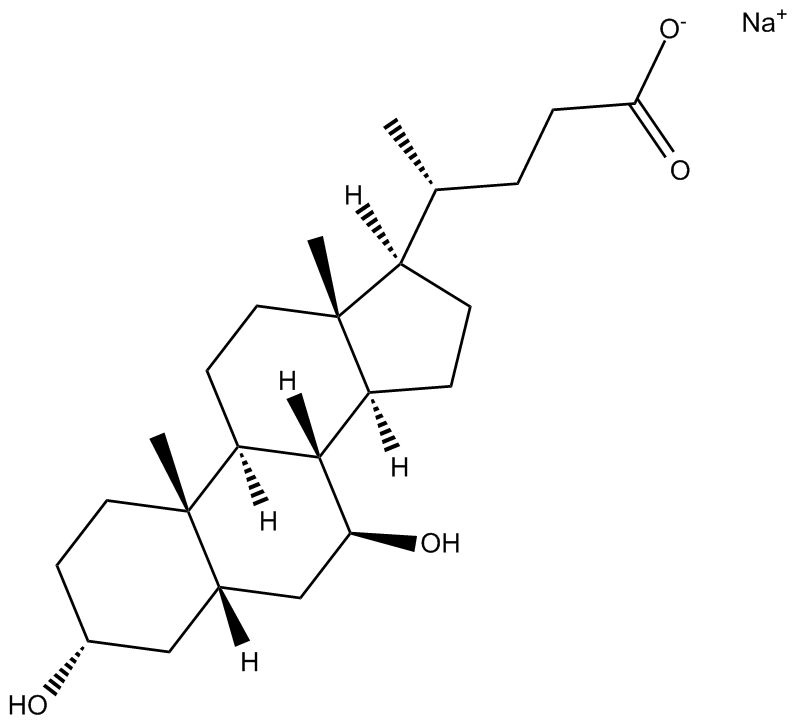
Ursodeoxycholic Acid (sodium salt)
Ursodeoxycholic Acid (sodium salt) (CAS No.: 2898-95-5) is a naturally occurring secondary bile acid formed from cholic acid through microbial transformation in the intestine. It plays a key regulatory role in maintaining intestinal barrier integrity and lipid metabolism. As a signaling molecule, Ursodeoxycholic Acid sodium interacts with bile acid-activated receptors, especially G protein-coupled bile acid receptor 5 (TGR5, GPCR19) and farnesoid X receptor (FXR), influencing multiple signaling pathways related to liver and gastrointestinal research. In vitro, its activity is typically observed in the nanomolar to micromolar range. In research, it is commonly used in cell and animal models to explore its ability to modulate bile acid pathways and its potential role in liver and gastrointestinal research. The concentrations or doses used in such experiments generally depend on the specific research objectives and experimental design. With its biological functions and interactions with receptor targets, Ursodeoxycholic Acid sodium is a valuable tool for studying bile acid signaling and related metabolic pathways.
| Physical Appearance | A crystalline solid |
| Storage | -20°C |
| M.Wt | 414.55 |
| Cas No. | 2898-95-5 |
| Formula | C24H39NaO4 |
| Synonyms | Ursodeoxycholate sodium; Ursodiol sodium; UCDA sodium |
| Solubility | ≥156.2 mg/mL in DMSO; ≥19.9 mg/mL in EtOH; ≥45.1 mg/mL in H2O |
| Chemical Name | sodium (R)-4-((3R,5S,7S,8R,9S,10S,13R,14S,17R)-3,7-dihydroxy-10,13-dimethylhexadecahydro-1H-cyclopenta[a]phenanthren-17-yl)pentanoate |
| Canonical SMILES | [O-]C(CC[C@H]([C@]1(CC[C@]2([C@@]3([C@H](C[C@@]4(C[C@@H](CC[C@@]4([C@]3(CC[C@@]21C)[H])C)O)[H])O)[H])[H])[H])C)=O.[Na+] |
| Shipping Condition | Small Molecules with Blue Ice, Modified Nucleotides with Dry Ice. |
| General tips | We do not recommend long-term storage for the solution, please use it up soon. |
Quality Control & MSDS
- View current batch:
Chemical structure