


Tropine
Tropine (CAS No.: 120-29-6) is a naturally occurring tropane alkaloid derived from plants of the Solanaceae family and serves as a key secondary metabolite with established relevance in cholinergic pharmacology and drug discovery. Functionally, tropine acts as a core structural intermediate in the biosynthesis and chemical synthesis of anticholinergic agents and bronchodilators, including clinically important compounds such as atropine and scopolamine, thereby positioning it as a valuable scaffold in medicinal chemistry. Its biological activity is primarily associated with modulation of cholinergic signaling pathways, where it influences muscarinic acetylcholine receptor-mediated processes either directly or through derivative compounds, and may also impact enzymatic systems involved in neurotransmitter regulation. Although detailed potency metrics for tropine itself are limited, compounds within this class typically exhibit activity across nanomolar to micromolar ranges depending on structural modification and target specificity. In research settings, tropine is widely utilized as a precursor molecule in synthetic and pharmacological studies, as well as a tool for investigating cholinergic dysfunction in cellular and animal models of neurological and respiratory disorders; experimental concentrations or dosing regimens are generally optimized according to specific study designs and therapeutic hypotheses.
| Physical Appearance | A solid |
| Storage | -20°C |
| M.Wt | 141.21 |
| Cas No. | 120-29-6 |
| Formula | C8H15NO |
| Synonyms | NSC 43870; 3-Tropanol |
| Solubility | ≥25.3 mg/mL in EtOH; ≥29.6 mg/mL in DMSO; ≥34.6 mg/mL in H2O |
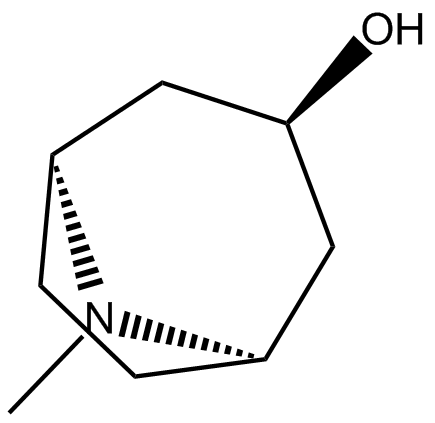
| Chemical Name | (1R,3r,5S)-8-methyl-8-azabicyclo[3.2.1]octan-3-ol |
| Canonical SMILES | O[C@H]1C[C@@H](CC2)N(C)[C@@H]2C1 |
| Shipping Condition | Small Molecules with Blue Ice, Modified Nucleotides with Dry Ice. |
| General tips | We do not recommend long-term storage for the solution, please use it up soon. |