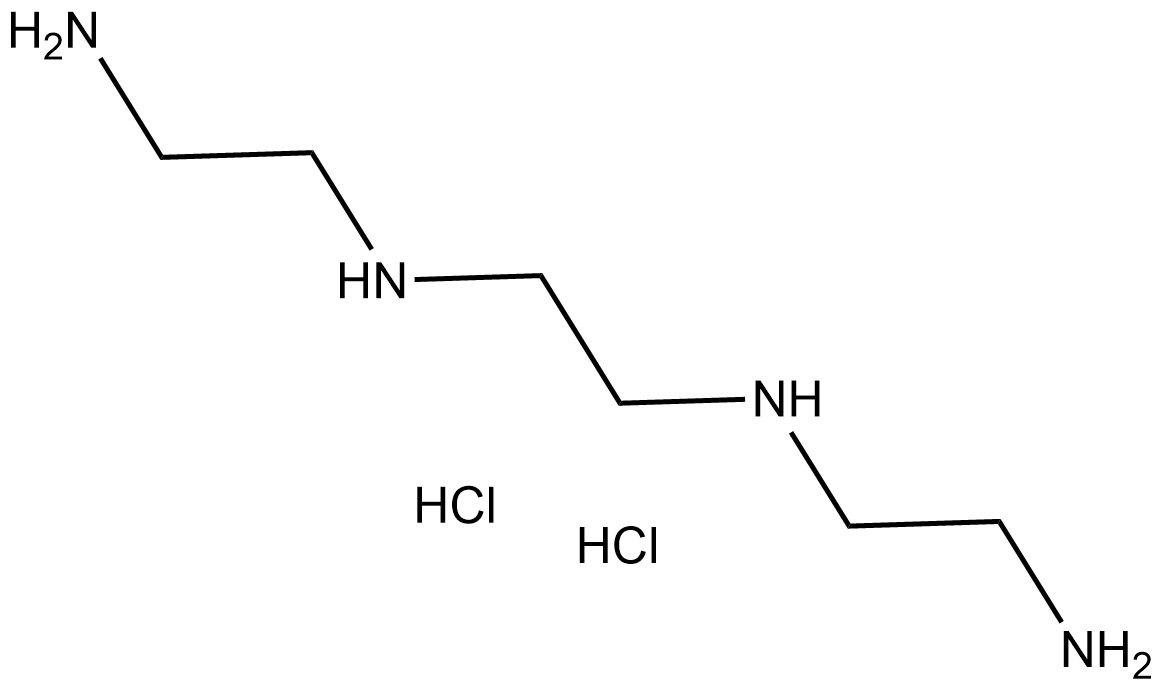
Triethylenetetramine Dihydrochloride
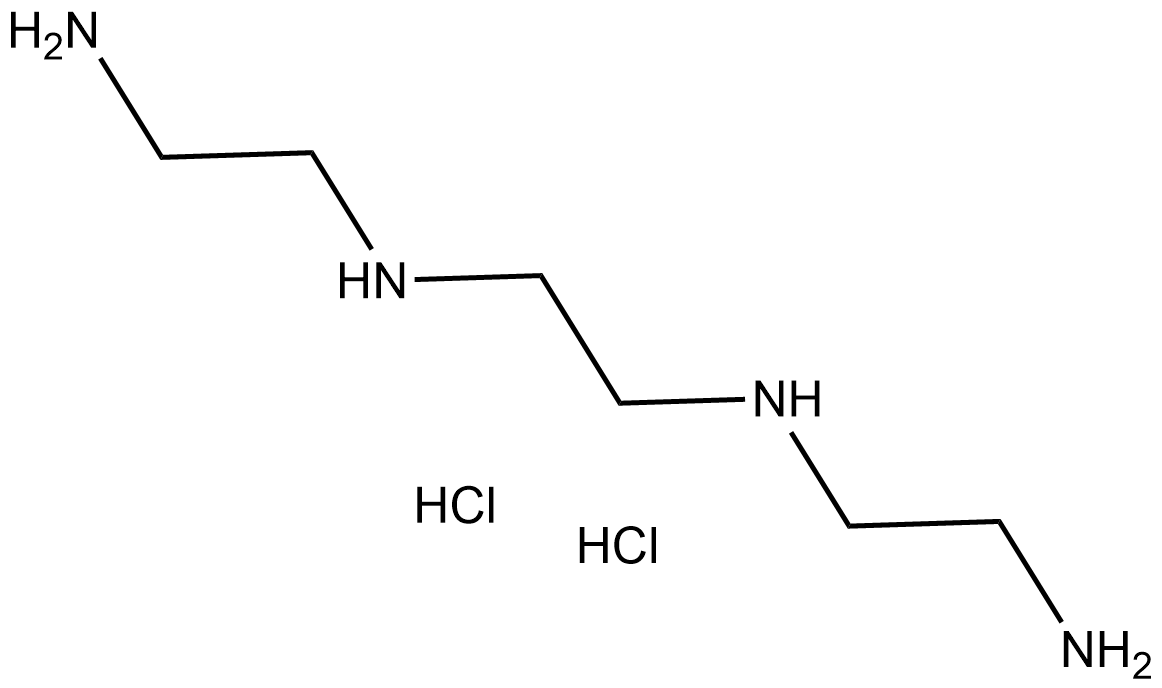
Triethylenetetramine Dihydrochloride (CAS: 38260-01-4) is the dihydrochloride salt of Triethylenetetramine (Trientine). Trientine is an FDA-approved copper chelator for the treatment of Wilson's disease. It is commonly prescribed as an alternative to D-penicillamine (DPA) in patients who are unable to tolerate DPA because of adverse effects. Trientine contains four primary and secondary amino groups that cooperatively coordinate Cu2+ to form highly stable tetradentate copper complexes. These hydrophilic complexes are readily eliminated through renal excretion, progressively reducing the systemic copper burden and promoting the mobilization of excess copper from the liver and other tissues. Although trientine generally exhibits a more favorable safety profile than DPA, its higher cost has limited its replacement of DPA as first-line therapy.
Trientine and its copper complexes exhibit poor membrane permeability and therefore have limited ability to directly deplete intracellular bioavailable copper. As a result, trientine is generally less effective than membrane-permeable copper chelators in in vitro studies, where rapid intracellular copper depletion is often required. Nevertheless, sustained systemic copper depletion reduces the availability of copper for cellular uptake, suppressing copper-dependent biological processes and indirectly inhibiting cuproptosis.
Trientine is frequently employed in studies of copper metabolism, cuproptosis, copper-dependent enzyme function, oxidative stress, and mitochondrial biology, as well as in cellular and animal models of copper overload or dysregulated copper homeostasis. It is also commonly used in rescue experiments and mechanistic studies to evaluate the contribution of copper to disease phenotypes or to determine the copper dependence of pharmacological or genetic perturbations.
References:
1. Kodama H, Fujisawa C, Bhadhprasit W. Inherited copper transport disorders: biochemical mechanisms, diagnosis, and treatment. Curr Drug Metab. 2012 Mar;13(3):237-50. doi: 10.2174/138920012799320455. PMID: 21838703; PMCID: PMC3290776.
| Storage | -20°C for 3 years |
| M.Wt | 219.16 |
| Cas No. | 38260-01-4 |
| Formula | C6H20Cl2N4 |
| Synonyms | Trientine dihydrochloride; TETA dihydrochloride |
| Solubility | insoluble in DMSO; insoluble in EtOH; ≥10.8 mg/mL in H2O |
| Chemical Name | N1,N1'-(ethane-1,2-diyl)bis(ethane-1,2-diamine) dihydrochloride |
| Canonical SMILES | NCCNCCNCCN.Cl.Cl |
| Shipping Condition | Small Molecules with Blue Ice, Modified Nucleotides with Dry Ice. |
| General tips | We do not recommend long-term storage for the solution, please use it up soon. |
Quality Control & MSDS
- View current batch:
Chemical structure