


Triclocarban
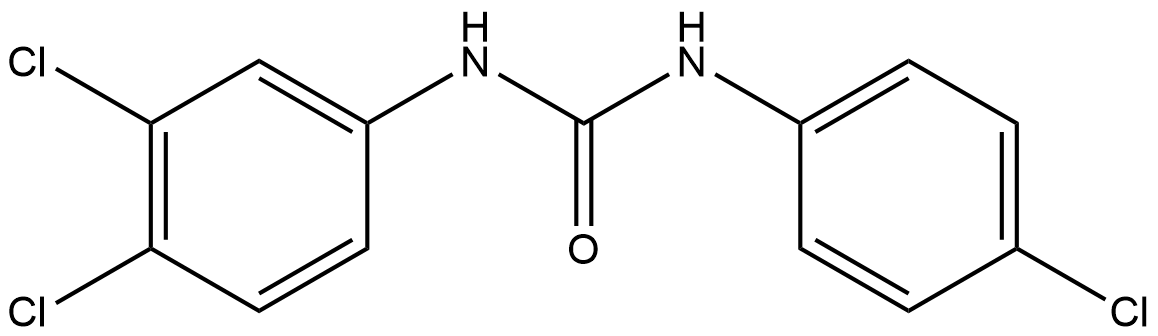
Triclocarban (CAS No.: 101-20-2) is a synthetic, broad-spectrum antimicrobial compound extensively employed as a model agent in studies of antibacterial activity and environmental toxicology, particularly due to its historical use in personal care formulations. In biomedical research, it is classified as a chlorinated aromatic antimicrobial with notable relevance for investigating endocrine-disrupting mechanisms, as it has been shown to modulate hormone receptor signaling, including androgen and estrogen pathways, and to influence other hormone-mediated biological processes. Mechanistically, triclocarban is reported to enhance hormone-dependent gene expression rather than acting as a direct agonist, thereby serving as a useful probe for studying nuclear receptor co-regulation and signaling amplification. In vitro studies demonstrate antimicrobial activity across a range of Gram-positive organisms at low micromolar concentrations, while its endocrine-related effects are typically observed in the nanomolar to micromolar range depending on the assay system. Additionally, triclocarban is widely utilized in cell-based assays and animal models to examine xenobiotic metabolism, bioaccumulation, and disruption of endocrine homeostasis, as well as to evaluate the impact of persistent environmental contaminants on biological systems. Experimental concentrations and exposure paradigms vary according to specific study designs, particularly in investigations of receptor signaling, toxicodynamics, and ecological risk assessment.
| Physical Appearance | A solid |
| Storage | -20°C |
| M.Wt | 315.58 |
| Cas No. | 101-20-2 |
| Formula | C13H9Cl3N2O |
| Synonyms | Solubacter, Procutene, Cutisan, 3,4,4′-Trichlorocarbanilide |
| Solubility | ≥44 mg/mL in DMSO; ≥5.14 mg/mL in EtOH with ultrasonic; insoluble in H2O |
| Chemical Name | 1-(4-chlorophenyl)-3-(3,4-dichlorophenyl)urea |
| Canonical SMILES | O=C(NC1=CC=C(Cl)C=C1)NC2=CC(Cl)=C(Cl)C=C2 |
| Shipping Condition | Small Molecules with Blue Ice, Modified Nucleotides with Dry Ice. |
| General tips | We do not recommend long-term storage for the solution, please use it up soon. |