Trehalose (hydrate)
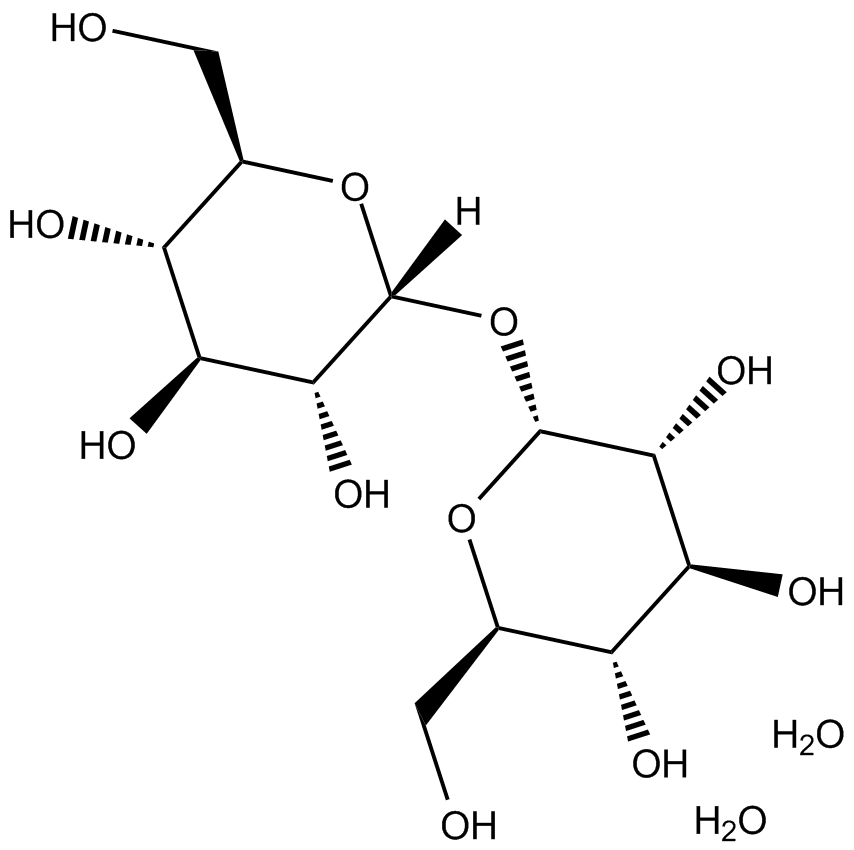
Trehalose (hydrate) (CAS No.: 6138-23-4) is a naturally occurring, non-reducing disaccharide widely distributed in microorganisms, plants, and invertebrates, and is commonly isolated from Saccharomyces cerevisiae, where it functions as an osmoprotectant, energy reserve, and cellular stress stabilizer. In biomedical research, trehalose is classified as a small-molecule modulator with roles in metabolic regulation and cytoprotection, and has been shown to influence cellular homeostasis by modulating enzyme activities involved in alternative metabolic pathways and by acting on signaling networks associated with stress responses. Notably, trehalose has been reported to induce or enhance autophagy through mechanisms that may occur independently of classical mTOR signaling, thereby supporting its use in studies of protein aggregation and neurodegenerative disease models. Although precise potency metrics such as IC50 or EC50 values are not consistently defined for its biological effects, its activity is generally characterized in cell-based systems across millimolar concentration ranges consistent with its function as a metabolic and osmotic regulator. Trehalose (hydrate) is frequently employed in in vitro and in vivo models to investigate cytoprotective mechanisms, protein stabilization, and autophagy-related pathways, and is also widely utilized as a pharmaceutical excipient and formulation stabilizer due to its ability to preserve biomolecular integrity under stress conditions; experimental concentrations or doses typically vary depending on the specific assay design and therapeutic context under investigation.
| Physical Appearance | A solid |
| Storage | -20°C |
| M.Wt | 378.33 |
| Cas No. | 6138-23-4 |
| Formula | C12H26O13 |
| Synonyms | D-(+)-Tre halose |
| Solubility | insoluble in EtOH; ≥46.7 mg/mL in DMSO; ≥610 mg/mL in H2O |
| Chemical Name | (2R,2'R,3S,3'S,4S,4'S,5R,5'R,6R,6'R)-6,6'-oxybis(2-(hydroxymethyl)tetrahydro-2H-pyran-3,4,5-triol) dihydrate |
| Canonical SMILES | OC[C@@H](O1)[C@@H](O)[C@H](O)[C@@H](O)[C@@]1([H])O[C@@H]2[C@H](O)[C@@H](O)[C@H](O)[C@@H](CO)O2.O.O |
| Shipping Condition | Small Molecules with Blue Ice, Modified Nucleotides with Dry Ice. |
| General tips | We do not recommend long-term storage for the solution, please use it up soon. |