


trans-Urocanic Acid
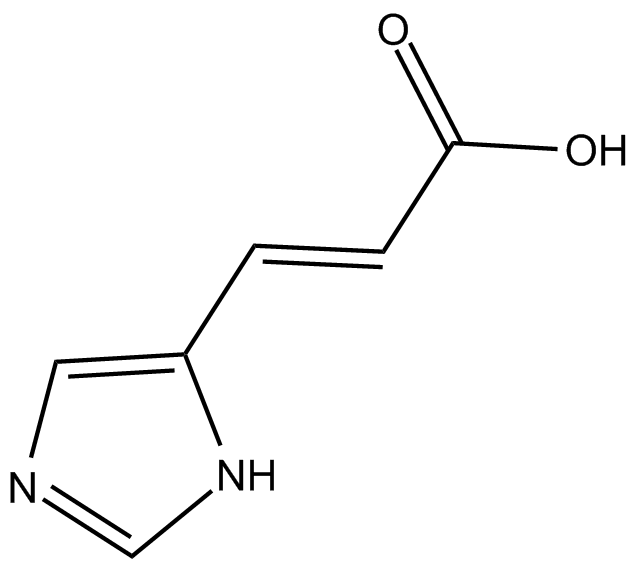
trans-Urocanic Acid (CAS No.: 3465-72-3) is a natural epidermal component in the mammalian stratum corneum, produced from L-histidine by the action of histidine ammonia-lyase. Under ultraviolet (UV) irradiation, this compound can be converted to its cis isomer, which is known to activate regulatory T cells and participate in immunosuppressive processes. In in vitro studies, trans-Urocanic Acid exhibits inhibitory effects on human natural killer (NK) cell activity, suggesting a potential role in immunomodulation. In addition, trans-Urocanic Acid contributes to acidification of the stratum corneum surface, and its function is considered similar to that of an endogenous sunscreen, providing an approximate sun protection factor (SPF) of 1.5 to protect against UV-induced DNA damage and excessive apoptosis of keratinocytes. In cell and animal models, trans-Urocanic Acid is commonly used to study its roles in immunomodulation and skin physiology, and the doses or concentrations used in experiments typically depend on the experimental design and research objectives.
| Physical Appearance | A solid |
| Storage | -20°C |
| M.Wt | 138.12 |
| Cas No. | 3465-72-3 |
| Formula | C6H6N2O2 |
| Solubility | ≥13.4 mg/mL in DMSO; ≥1.34 mg/mL in EtOH with ultrasonic; ≥3.31 mg/mL in H2O with ultrasonic |
| Chemical Name | (E)-3-(1H-imidazol-5-yl)acrylic acid |
| Canonical SMILES | OC(/C=C/C1=CN=CN1)=O |
| Shipping Condition | Small Molecules with Blue Ice, Modified Nucleotides with Dry Ice. |
| General tips | We do not recommend long-term storage for the solution, please use it up soon. |