TMA-DPH
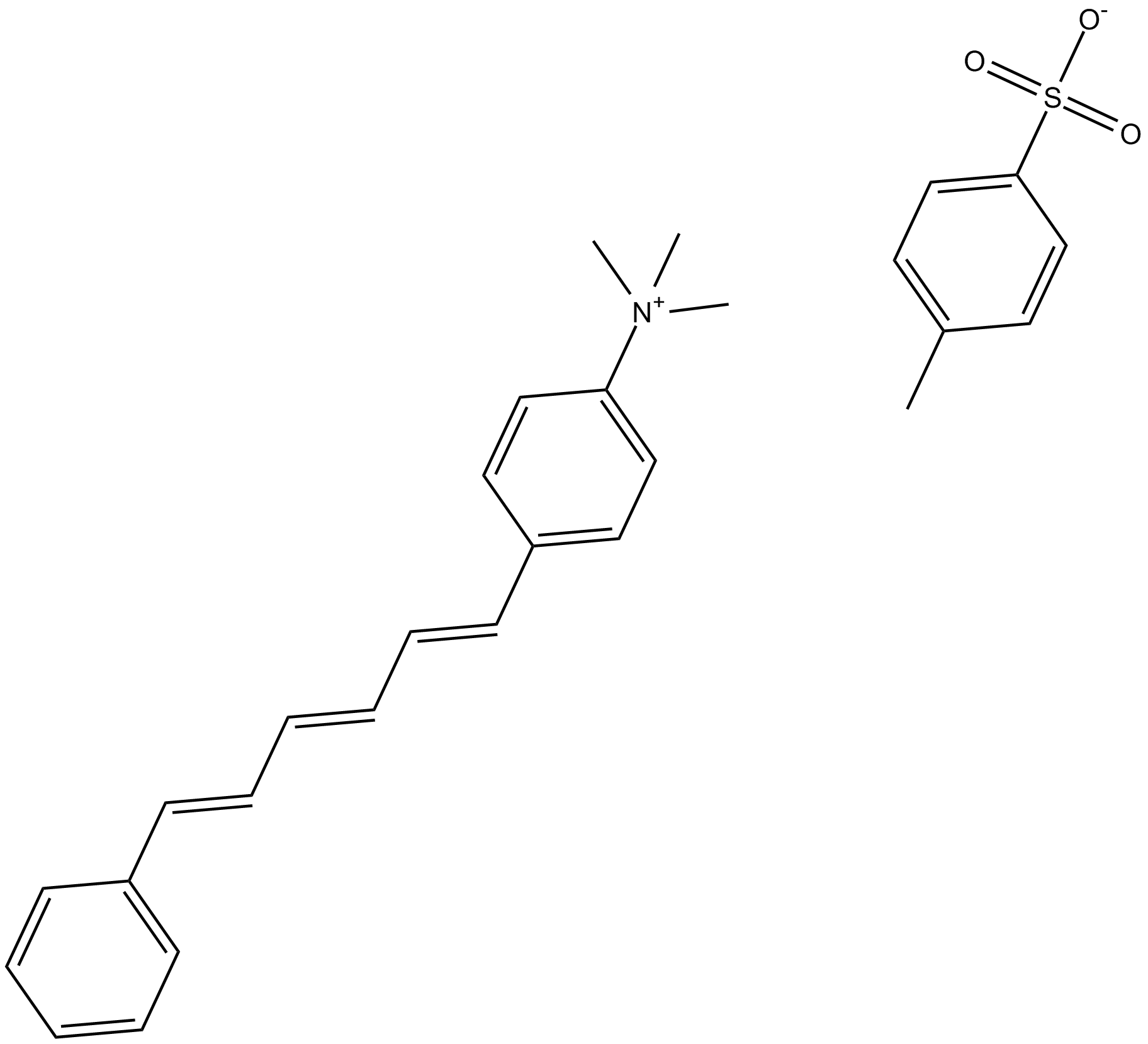
TMA-DPH (CAS No.: 115534-33-3) is a cationic, lipophilic fluorescent probe widely used in biomedical research to investigate membrane dynamics and organization in both artificial and living membrane systems. As a derivative of diphenylhexatriene, it retains strong hydrophobic character while incorporating a charged trimethylammonium group that facilitates stable anchoring at the membrane surface, particularly at the water–lipid interface of the outer leaflet of the plasma membrane. Upon insertion into phospholipid bilayers, TMA-DPH exhibits a marked increase in fluorescence intensity, with excitation and emission maxima around 355 nm and 430 nm, respectively, enabling sensitive detection of membrane-associated processes. Its fluorescence polarization properties are extensively employed to quantify membrane fluidity and microviscosity, providing insights into lipid packing, phase transitions, and membrane heterogeneity without directly targeting specific proteins or signaling pathways. TMA-DPH is commonly applied in studies of membrane trafficking, including endocytosis and exocytosis, as well as in the evaluation of drug-induced alterations in membrane properties in cell-based assays. While it does not exhibit conventional pharmacological activity such as defined IC50 or EC50 values, its utility lies in its biophysical reporting capabilities, and experimental concentrations are typically optimized according to cell type, membrane composition, and imaging or spectroscopic requirements in drug discovery and membrane biology research.
| Physical Appearance | A solid |
| Storage | -20°C |
| M.Wt | 461.62 |
| Cas No. | 115534-33-3 |
| Formula | C28H31NO3S |
| Synonyms | N,N,N-Trimethyl-4-(6-phenyl-1,3,5-hexatrien-1-yl)phenylammonium (p-toluenesulfonate) |
| Solubility | ≥10.42 mg/mL in DMSO with ultrasonic; insoluble in EtOH; insoluble in H2O |
| Chemical Name | N,N,N-trimethyl-4-((1E,3E,5E)-6-phenylhexa-1,3,5-trien-1-yl)benzenaminium 4-methylbenzenesulfonate |
| Canonical SMILES | C[N+](C)(C1=CC=C(C=C1)/C=C/C=C/C=C/C2=CC=CC=C2)C.CC3=CC=C(C=C3)S([O-])(=O)=O |
| Shipping Condition | Small Molecules with Blue Ice, Modified Nucleotides with Dry Ice. |
| General tips | We do not recommend long-term storage for the solution, please use it up soon. |