Thymoquinone
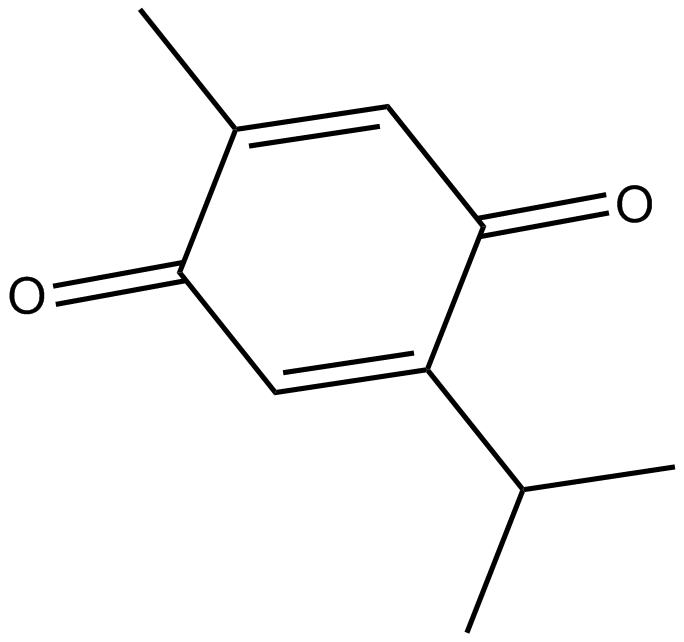
Thymoquinone (CAS No.: 490-91-5) is a bioactive quinone phytochemical isolated from the seeds of Nigella sativa and widely utilized as a small-molecule probe in biomedical research due to its pleiotropic pharmacological profile. It is classified as a natural product with prominent antioxidant, anti-inflammatory, immunomodulatory, antimicrobial, and anticancer properties, and has demonstrated activity across diverse cellular systems. Mechanistically, thymoquinone modulates multiple signaling pathways, including inhibition of the VEGFR2–PI3K–Akt axis and suppression of STAT3-dependent transcription, while also regulating apoptosis through downregulation of anti-apoptotic proteins such as Bcl-2 and upregulation of pro-apoptotic factors such as Bax. It further interferes with leukotriene biosynthesis, contributing to its anti-inflammatory effects, and exhibits antiangiogenic activity alongside broad antiviral, antifungal, and hepatoprotective actions. In vitro studies indicate that thymoquinone exerts cytotoxic and anti-proliferative effects in cancer cell models at low micromolar concentrations, with efficacy linked to apoptosis induction and cell cycle modulation. Owing to these diverse mechanisms, it is extensively applied in studies of cancer biology, neurodegenerative disorders such as Alzheimer’s disease, cardiovascular dysfunction, infectious diseases, and inflammatory conditions. The concentrations or doses used in experimental settings vary depending on specific model systems and research objectives, supporting its versatility in both mechanistic investigations and early-stage drug discovery.
| Physical Appearance | A solid |
| Storage | -20°C |
| M.Wt | 164.2 |
| Cas No. | 490-91-5 |
| Formula | C10H12O2 |
| Synonyms | NSC 2228 |
| Solubility | insoluble in H2O; ≥43.4 mg/mL in DMSO; ≥46.2 mg/mL in EtOH |
| Chemical Name | 2-isopropyl-5-methylcyclohexa-2,5-diene-1,4-dione |
| Canonical SMILES | O=C(C=C1C)C(C(C)C)=CC1=O |
| Shipping Condition | Small Molecules with Blue Ice, Modified Nucleotides with Dry Ice. |
| General tips | We do not recommend long-term storage for the solution, please use it up soon. |