


Thiocarlide
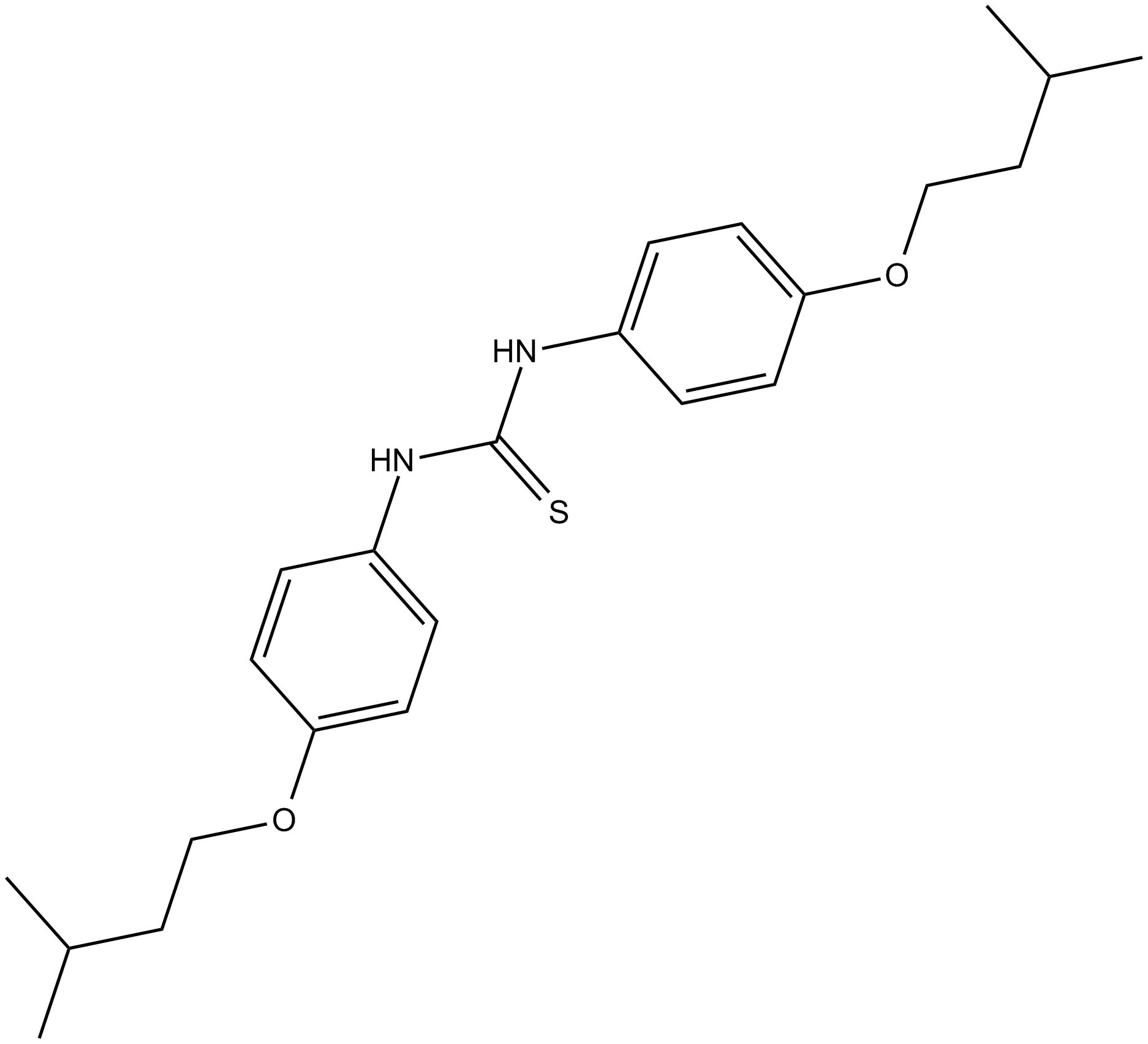
Thiocarlide (CAS No.: 910-86-1) is a thiourea-derived antibacterial agent historically investigated for the treatment of tuberculosis and now widely utilized in biomedical research focused on mycobacterial physiology and drug discovery. It exhibits potent in vitro antimycobacterial activity against multiple species, including Mycobacterium tuberculosis H37Rv, Mycobacterium bovis BCG, Mycobacterium avium, and Mycobacterium aurum, with minimum inhibitory concentrations in the low micromolar to microgram-per-milliliter range, and retains activity against multidrug-resistant strains. Mechanistically, thiocarlide interferes with mycobacterial lipid metabolism, notably inhibiting the biosynthesis of mycolic acids and partially suppressing fatty acid synthesis, a mode of action that overlaps with but is distinct from established agents such as isoniazid and ethionamide. In cellular systems, it has been shown to reduce bacterial growth without inducing acute toxicity in primary macrophage cultures, supporting its utility in host–pathogen interaction studies. Thiocarlide is therefore commonly applied in in vitro assays and experimental infection models to investigate antimycobacterial mechanisms, validate lipid biosynthesis pathways as drug targets, and screen for synergistic or resistance-modifying compounds, with concentrations tailored to specific experimental designs and endpoints.
| Physical Appearance | A crystalline solid |
| Storage | -20°C |
| M.Wt | 400.58 |
| Cas No. | 910-86-1 |
| Formula | C23H32N2O2S |
| Synonyms | Isoxyl |
| Solubility | insoluble in H2O; ≥32.9 mg/mL in DMSO; ≥9.6 mg/mL in EtOH |
| Chemical Name | 1,3-bis(4-(isopentyloxy)phenyl)thiourea |
| Canonical SMILES | CC(CCOC1=CC=C(NC(NC2=CC=C(OCCC(C)C)C=C2)=S)C=C1)C |
| Shipping Condition | Small Molecules with Blue Ice, Modified Nucleotides with Dry Ice. |
| General tips | We do not recommend long-term storage for the solution, please use it up soon. |