Thidiazuron
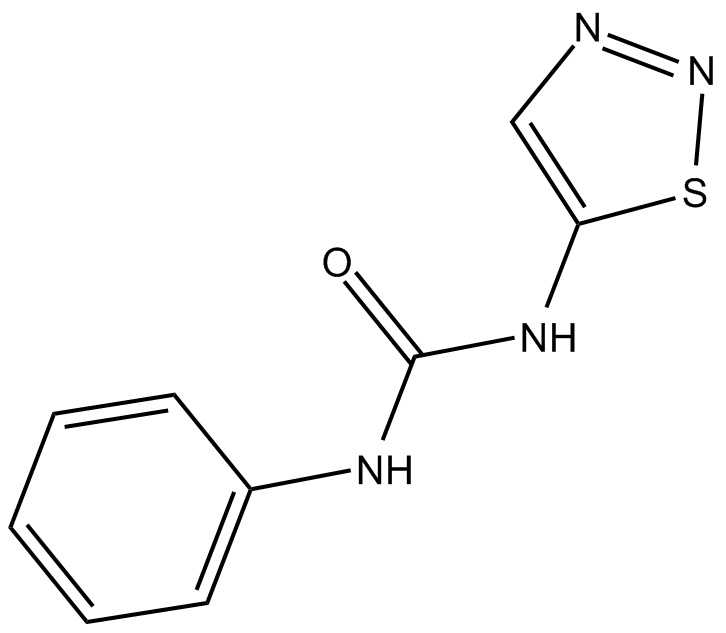





Thidiazuron (CAS No.: 51707-55-2) is a phenylurea-derived plant growth regulator with potent cytokinin-like activity that functions as a biochemical reagent widely employed in life sciences research, particularly in studies of plant cell biology and regenerative processes. Acting as a functional analog of endogenous cytokinins, thidiazuron is known to interact with cytokinin receptors and activate downstream signaling pathways that regulate cell division, dedifferentiation, organogenesis, and morphogenesis, thereby promoting callus formation and in vitro plant regeneration. It has demonstrated robust activity across nanomolar to micromolar ranges in plant tissue systems, including stimulation of callus proliferation and induction of shoot regeneration, making it a valuable tool for elucidating mechanisms of plant cell growth, differentiation, and developmental plasticity. Beyond plant systems, thidiazuron has shown notable bioactivity in mammalian cell models, where it modulates epithelial–mesenchymal transition-associated markers and induces apoptosis in certain cancer cell lines at micromolar concentrations, suggesting potential utility in exploratory oncology research. Its applications extend to the development of plant-based bioproduction platforms and experimental models for studying cellular reprogramming and signal transduction, with concentrations and treatment regimens typically optimized according to specific experimental objectives.
| Physical Appearance | A solid |
| Storage | -20°C |
| M.Wt | 220.25 |
| Cas No. | 51707-55-2 |
| Formula | C9H8N4OS |
| Synonyms | CCG-24904; SN 49537; TDZ |
| Solubility | ≥41 mg/mL in DMSO; ≥4.41 mg/mL in EtOH with ultrasonic; insoluble in H2O |
| Chemical Name | 1-phenyl-3-(1,2,3-thiadiazol-5-yl)urea |
| Canonical SMILES | O=C(NC1=CC=CC=C1)NC2=CN=NS2 |
| Shipping Condition | Small Molecules with Blue Ice, Modified Nucleotides with Dry Ice. |
| General tips | We do not recommend long-term storage for the solution, please use it up soon. |