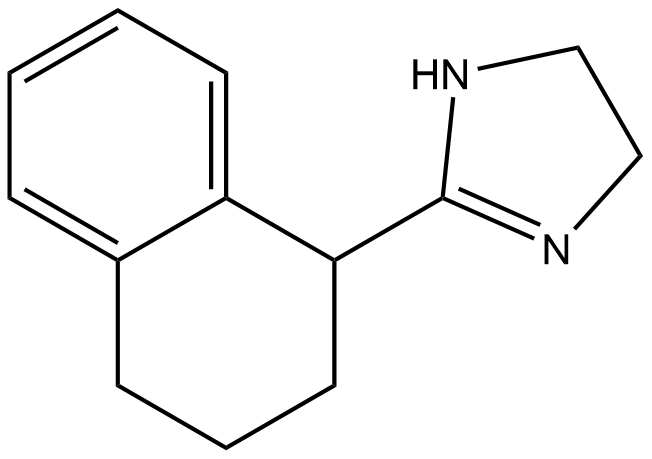
Tetrahydrozoline
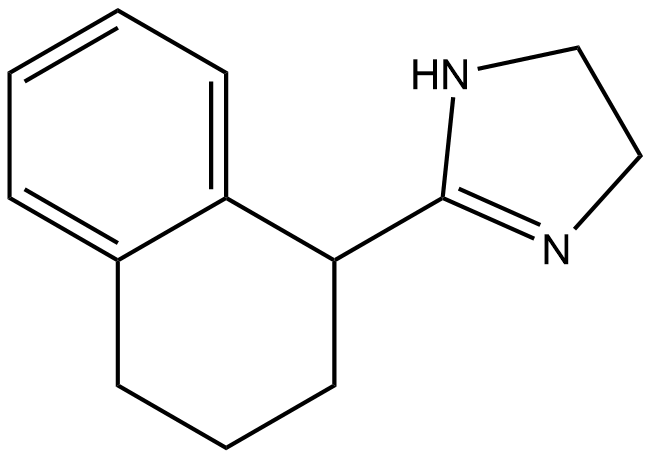





Tetrahydrozoline (CAS No.: 84-22-0) is an imidazoline derivative that, as an α-adrenergic agonist, is primarily used to study the mechanisms of nasal congestion and conjunctival hyperemia through vasoconstriction. This α agonist reduces redness and swelling caused by ocular irritants by inducing constriction of conjunctival blood vessels. Although specific experimental data on its activity levels, such as IC50 or EC50, are limited, related imidazoline compounds typically show activity in the nanomolar to micromolar range, providing context for its potential in vitro activity. In various experimental settings, Tetrahydrozoline is widely used in cell and animal models to study its effects on contractile pathways and adrenergic signaling, which are essential for understanding vasoconstriction and sympathomimetic processes. The concentrations or doses used in experiments typically depend on the specific study design and objectives, allowing researchers to explore its pharmacodynamic properties within the framework of drug discovery and biomedical research.
| Physical Appearance | Solid |
| Storage | Store at -20°C, protect from light |
| M.Wt | 200.28 |
| Cas No. | 84-22-0 |
| Formula | C13H16N2 |
| Synonyms | Tetryzoline |
| Solubility | ≥17.45 mg/mL in DMSO; ≥28.4 mg/mL in EtOH; ≥2.19 mg/mL in H2O with ultrasonic |
| Chemical Name | 2-(1,2,3,4-tetrahydronaphthalen-1-yl)-4,5-dihydro-1H-imidazole |
| Canonical SMILES | N1=C(NCC1)C2C=3C=CC=CC3CCC2 |
| Shipping Condition | Small Molecules with Blue Ice, Modified Nucleotides with Dry Ice. |
| General tips | We do not recommend long-term storage for the solution, please use it up soon. |
Quality Control & MSDS
- View current batch:
Chemical structure