


Terconazole
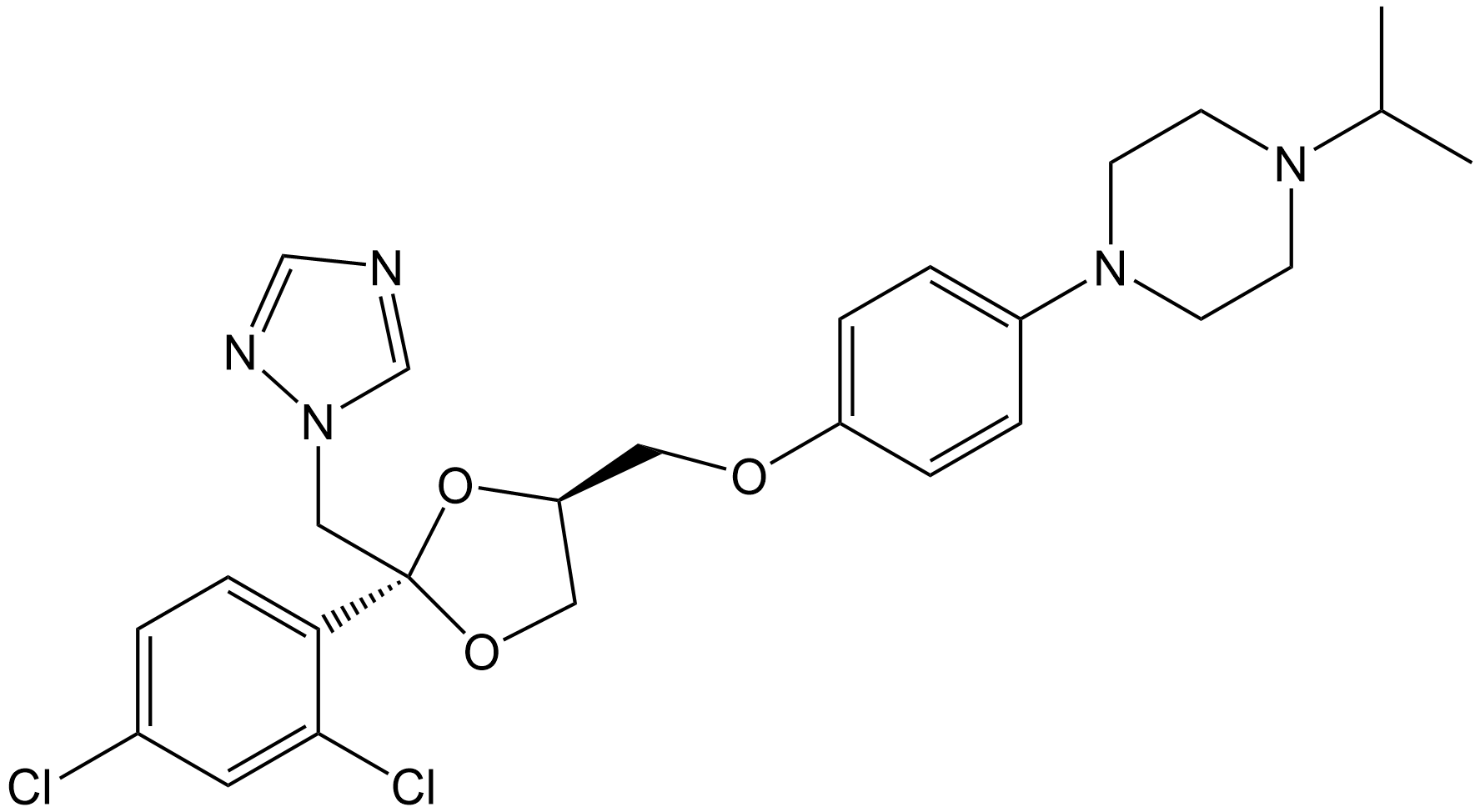
Terconazole (CAS No. 67915-31-5) is an orally available, broad-spectrum triazole antifungal drug, primarily used to treat vaginal Candida infections. It disrupts fungal cell membrane structure by inhibiting the biosynthesis of ergosterol and other 14α-demethylated sterols mediated by fungal cytochrome P450 (CYP). It has strong inhibitory activity against Candida albicans, C. glabrata, and various dermatophytes (T. rubrum, M. audouinii, M. canis, T. verrucosum), and shows bactericidal activity against some bacteria (such as E. coli, P. aeruginosa, S. aureus, S. pyogenes) at high concentrations.
In vitro, Terconazole inhibits C. albicans growth in a concentration-dependent manner: under culture conditions favorable for yeast-form growth, inhibitory effects can be observed at 0.1–10 μM, with potency varying by strain and culture conditions. Its IC₅₀ for C. albicans 14α-demethylated sterol synthesis is approximately 3 nM, significantly reducing demethylated sterol synthesis and increasing methylated sterol levels. For C. albicans ATCC 44859, sensitivity to Terconazole is markedly enhanced in Eagle MEM, which favors hyphal formation; hyphal formation begins to be inhibited at 0.1 μM, and complete necrosis occurs at 100 μM. Terconazole can also block the morphological transition from yeast form to hyphal form within the range of 0.008–0.05 μg/mL.
In animal models, topical application of 1% Terconazole ointment achieved clinical cure in 97% of rat vaginal C. albicans infection models; when administered by gavage at 10 mg/kg, approximately 50% of infections in rats were eliminated. Clinically relevant data indicate that a 0.8% Terconazole vaginal formulation used once daily for 3 consecutive days can maintain high local antifungal activity in the vagina for approximately 7 days, with generally no obvious local adverse reactions observed. Overall, Terconazole combines potent inhibition of Candida growth and morphological transition, high local exposure, and good tolerability, making it a representative triazole drug for the study and treatment of vaginal candidiasis.
References:
[1] Van Cutsem J, Van Gerven F, Zaman R, Janssen PA. Terconazole - a new broad-spectrum antifungal. Chemotherapy. 1983;29(5):322-31. doi: 10.1159/000238215. PMID: 6617296.
[2] Vanden Bossche H, Marichal P. Mode of action of anti-Candida drugs: focus on terconazole and other ergosterol biosynthesis inhibitors. Am J Obstet Gynecol. 1991 Oct;165(4 Pt 2):1193-9. doi: 10.1016/s0002-9378(12)90726-7. PMID: 1951574.
[3] Isaacson DM, Tolman EL, Tobia AJ, Rosenthale ME, McGuire JL, Vanden Bossche H, Janssen PA. Selective inhibition of 14 alpha-desmethyl sterol synthesis in Candida albicans by terconazole, a new triazole antimycotic. J Antimicrob Chemother. 1988 Mar;21(3):333-43. doi: 10.1093/jac/21.3.333. PMID: 3129389.
[4] Van Cutsem J. The in vitro activity of terconazole against yeasts: its topical long-acting therapeutic efficacy in experimental vaginal candidiasis in rats. Am J Obstet Gynecol. 1991 Oct;165(4 Pt 2):1200-6. doi: 10.1016/s0002-9378(12)90727-9. PMID: 1951575.
| Storage | Store at -20°C |
| M.Wt | 532.46 |
| Cas No. | 67915-31-5 |
| Formula | C26H31Cl2N5O3 |
| Synonyms | TCZ, R42470, (±)-Terconazole, NSC 331942 |
| Chemical Name | 1-(4-(((2R,4S)-2-((1H-1,2,4-triazol-1-yl)methyl)-2-(2,4-dichlorophenyl)-1,3-dioxolan-4-yl)methoxy)phenyl)-4-isopropylpiperazine |
| Canonical SMILES | C([C@]1(O[C@@H](COC2=CC=C(C=C2)N3CCN(C(C)C)CC3)CO1)C4=C(Cl)C=C(Cl)C=C4)N5C=NC=N5 |
| Shipping Condition | Small Molecules with Blue Ice, Modified Nucleotides with Dry Ice. |
| General tips | We do not recommend long-term storage for the solution, please use it up soon. |