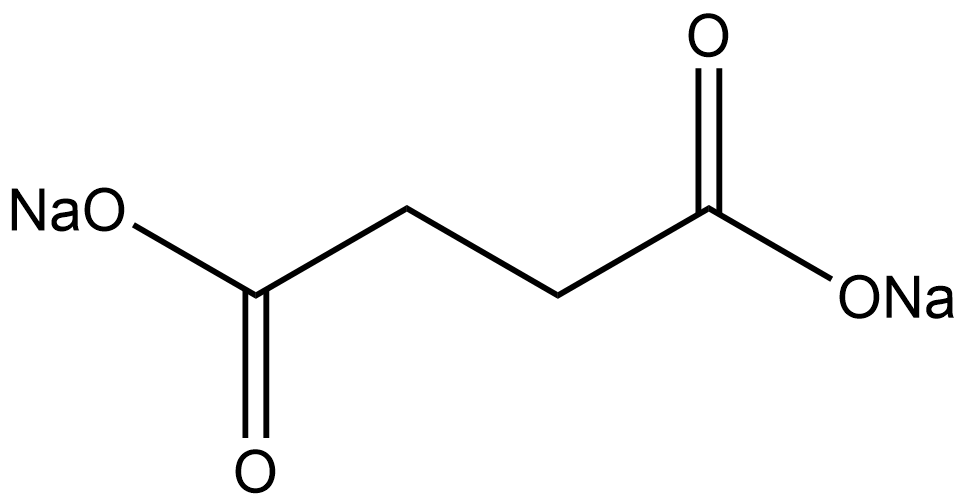
Sodium succinate
Sodium succinate (CAS No.: 150-90-3) is a small molecule metabolic reagent and sodium salt of succinate that is widely classified as a central carbon metabolism related compound and redox associated biochemical tool for life sciences research, with biological relevance as an endogenous intermediate of the tricarboxylic acid cycle and broader mitochondrial metabolic networks where succinate flux is linked to cellular bioenergetics, oxidative stress balance, and metabolite signaling crosstalk; in biomedical research and drug discovery workflows it is primarily used as a metabolism focused probe to study mitochondrial function, immunometabolic reprogramming, hypoxia responsive processes, and reactive oxygen species dynamics, and mechanistic literature generally associates succinate signaling with modulation of succinate sensitive receptor pathways and inhibition of 2 oxoglutarate dependent dioxygenase families that can influence transcriptional adaptation programs, epigenetic state regulation, and inflammatory pathway tone in context dependent systems, although target engagement profiles vary with cell type, oxygen tension, and exposure design; direct standardized potency metrics such as IC50 or EC50 are not consistently defined for this catalog reagent across assay formats, so activity is typically characterized functionally in concentration dependent cellular response windows that are commonly explored from micromolar to millimolar conditions depending on medium composition and model sensitivity, while specific values should be established empirically for each protocol; typical research applications include use in cultured cell models for metabolic stress and signaling interrogation, use in ex vivo systems for pathway mapping, and use in animal studies as a biochemical perturbation control for mechanism oriented hypothesis testing, and in screening environments it can serve as a reference metabolite for pathway deconvolution panels, with concentrations or doses used in experiments typically depending on specific experimental designs and research objectives and requiring fit for purpose optimization under appropriate laboratory controls for research use only.
| Storage | -20°C for 3 years |
| M.Wt | 162.05 |
| Cas No. | 150-90-3 |
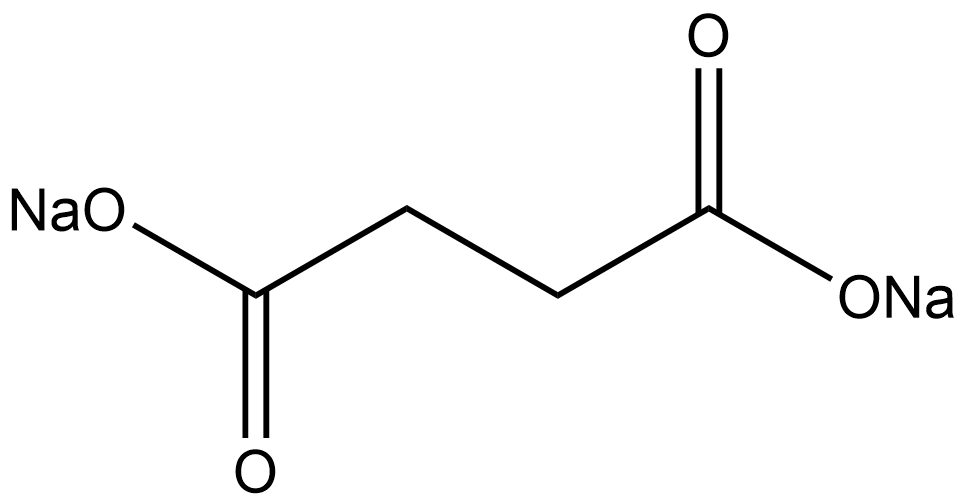
| Formula | C4H4Na2O4 |
| Chemical Name | sodium succinate |
| Canonical SMILES | O=C(O[Na])CCC(O[Na])=O |
| Shipping Condition | Small Molecules with Blue Ice, Modified Nucleotides with Dry Ice. |
| General tips | We do not recommend long-term storage for the solution, please use it up soon. |
Quality Control & MSDS
- View current batch:
Chemical structure