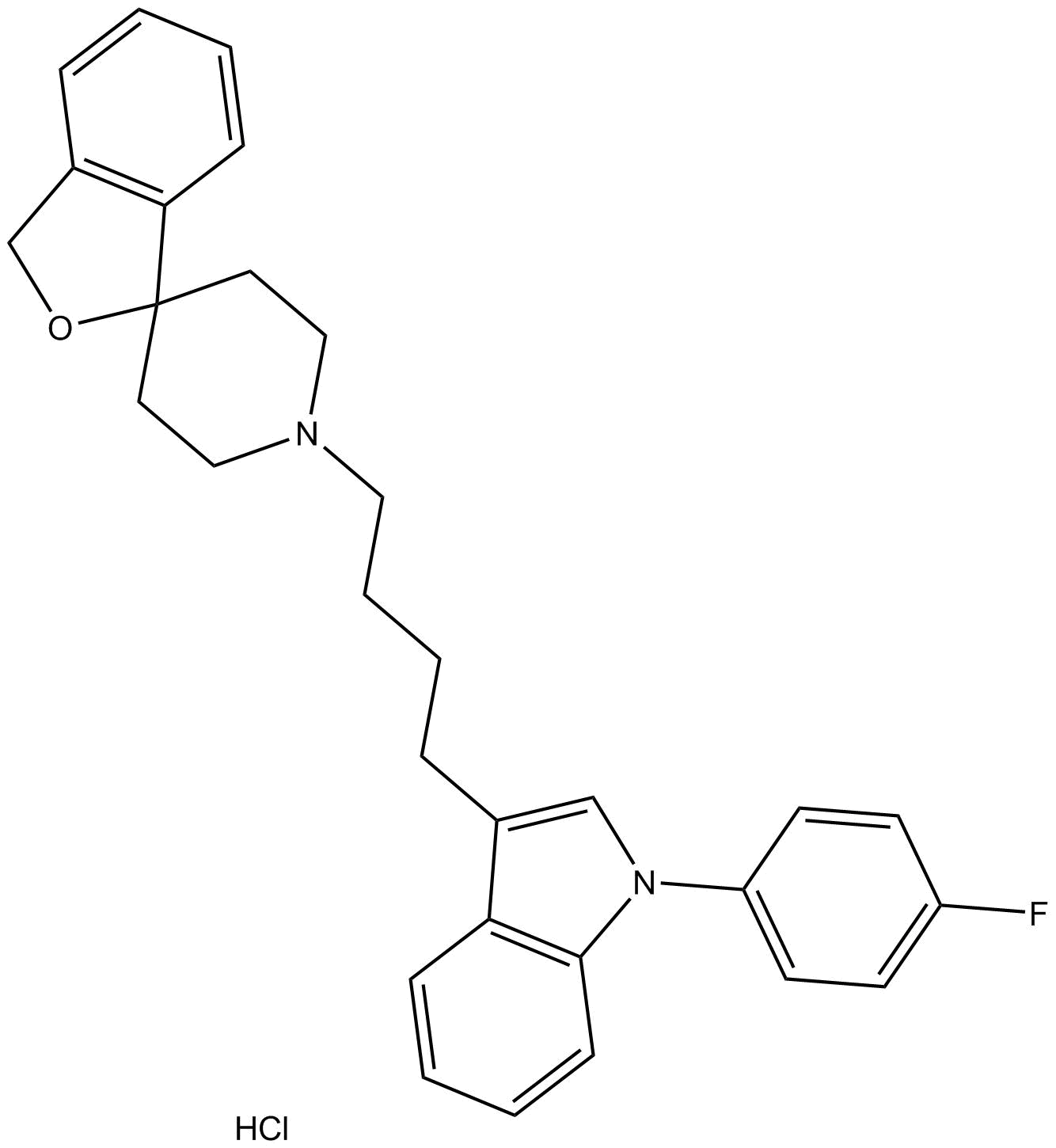
Siramesine hydrochloride
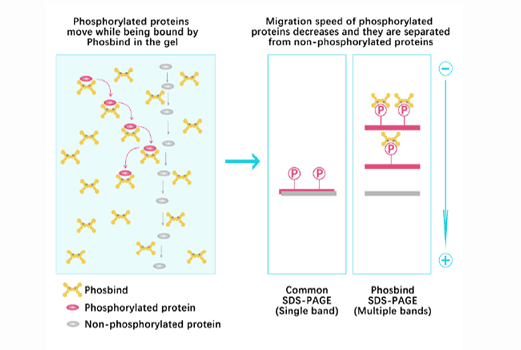
Siramesine hydrochloride (CAS No.: 224177-60-0) is the hydrochloride form of Siramesine (CAS No.: 147817-50-3). Siramesine is a multi-target small molecule whose primary activity is as a highly selective σ‑2 receptor agonist (Kd≈0.12 nM, with approximately 140-fold selectivity over σ‑1), and it can directly bind STAT3 to inhibit Tyr705 phosphorylation (SPR K_D≈8.7×10⁻⁴ M), downregulating STAT3‑MGMT and JAK2‑STAT3-related proliferation and stemness-maintenance pathways in tumors; it also disrupts lysosomal and mitochondrial function, increases lysosomal pH, inhibits lysosomal degradation, damages the mitochondrial membrane at high concentrations, triggers mitochondrial apoptosis and lysosomal dysfunction-mediated cell death, and reduces autophagic flux by blocking autophagosome–lysosome fusion. In immune inflammation and fungi, it respectively reduces the release of pro-inflammatory factors such as IL‑6 and IL‑17 by increasing mast cell secretory granule membrane permeability and inducing ROS-dependent apoptosis, and blocks ergosterol synthesis by inhibiting fungal C₈–C₇ sterol isomerase (Erg2), disrupting cell membrane homeostasis and biofilm formation.
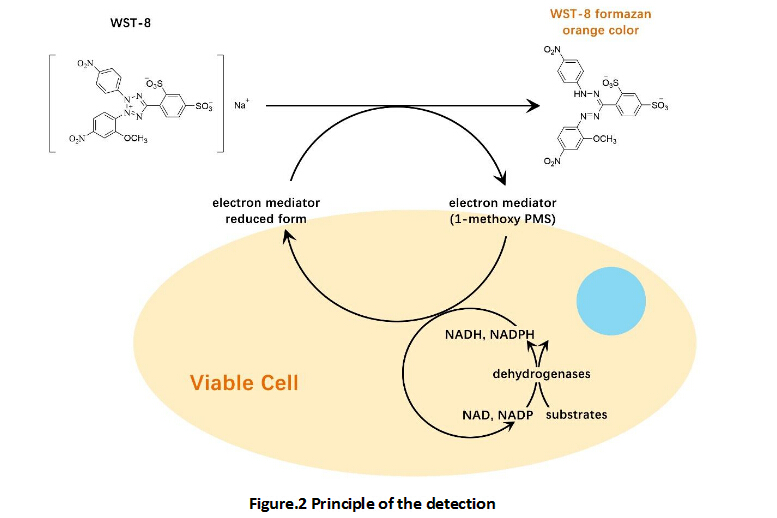
At the cellular level, Siramesine shows low- to mid-micromolar antiproliferative activity in multiple human glioblastoma cells (U87‑MG, U251‑MG, T98G), with 48 h IC₅₀ values of approximately 7.2–9.7 μM, 24 h proliferation-inhibition EC₅₀ values of approximately 12.6–19.3 μM in adherent glioma cells, and 24 h cell-death EC₅₀ values of approximately 4.97–8.97 μM in patient-derived glioma stem cell spheres. Significant cell death can occur in multiple epithelial and tumor cell lines after treatment with 20–30 μM for 8 h. Tumor-related experiments commonly use 5–40 μM treatment for 24–72 h to assess changes in proliferation, apoptosis, migration, stemness, and signaling such as STAT3/JAK2; treatment with approximately 50 μM for 3 h is used to detect changes in autophagy-related proteins and autophagic flux; treatment with 5–15 μM for 24 h can induce death of glioma stem cell spheres and inhibit sphere-forming ability, and 20 μM can inhibit cell migration in planar migration assays, but no significant anti-invasive effect was observed in a brain-slice co-culture invasion model. Skin tissue experiments show that treatment with 20 μM for 72 h can selectively induce apoptosis of mast cells in psoriatic lesions, reduce IL‑6- and IL‑17-positive mast cells, and inhibit keratinocyte proliferation, with relatively low toxicity to dermal fibroblasts. In fungal experiments, the MIC against multiple Candida strains is approximately 12.5 μg/mL, and the MBEC is approximately 50–62.5 μg/mL, while it lacks obvious activity against Yarrowia lipolytica and Aspergillus brasiliensis (MIC>250 μg/mL).
Animal-level studies have mainly focused on tumor models. In an orthotopic brain transplantation model of glioblastoma, Siramesine at 100 mg/kg orally, twice weekly, showed no obvious tumor-inhibitory effect on U87 and patient-derived T78 xenografts; in a subcutaneous glioblastoma xenograft model, monotherapy with 1 mg/kg intraperitoneal injection every other day also showed limited tumor inhibition, but it downregulated the JAK2‑STAT3‑MGMT axis and the expression of the stem cell markers SOX2 and CD133 in tumor tissue. When combined with temozolomide administered by daily intraperitoneal injection at 25 mg/kg, it exhibited enhanced antitumor activity, suggesting that it is more suitable as a signaling pathway modulator in combination therapy rather than as a single-agent cytotoxic drug.
References:
[1] Česen MH, Repnik U, Turk V, Turk B. Siramesine triggers cell death through destabilisation of mitochondria, but not lysosomes. Cell Death Dis. 2013 Oct 3;4(10):e818. doi: 10.1038/cddis.2013.361. PMID: 24091661; PMCID: PMC3824671.
[2] Jensen SS, Petterson SA, Halle B, Aaberg-Jessen C, Kristensen BW. Effects of the lysosomal destabilizing drug siramesine on glioblastoma in vitro and in vivo. BMC Cancer. 2017 Mar 7;17(1):178. doi: 10.1186/s12885-017-3162-3. PMID: 28270132; PMCID: PMC5341392.
[3] Hagforsen E, Lampinen M, Paivandy A, Weström S, Velin H, Öberg S, Pejler G, Rollman O. Siramesine causes preferential apoptosis of mast cells in skin biopsies from psoriatic lesions. Br J Dermatol. 2017 Jul;177(1):179-187. doi: 10.1111/bjd.15336. Epub 2017 May 15. PMID: 28117878.
[4] Vlainić J, Jović O, Kosalec I, Vugrek O, Čož-Rakovac R, Šmuc T. In Vitro Confirmation of Siramesine as a Novel Antifungal Agent with In Silico Lead Proposals of Structurally Related Antifungals. Molecules. 2021 Jun 8;26(12):3504. doi: 10.3390/molecules26123504. PMID: 34201401; PMCID: PMC8230181.
[5] Cui X, Yao A, Lv J, Zhang C, Chen Y, Mei T, Li H, Wu Y, Jia L. Siramesine induced cell death of glioblastoma through inactivating the STAT3-MGMT signaling pathway. J Transl Med. 2025 Jul 10;23(1):780. doi: 10.1186/s12967-025-06693-y. PMID: 40640878; PMCID: PMC12247293.
| Storage | Desiccate at -20°C |
| M.Wt | 491.04 |
| Cas No. | 224177-60-0 |
| Formula | C30H32ClFN2O |
| Synonyms | Lu 28-179 HCl; Siramesine HCl |
| Solubility | ≥49.1 mg/mL in DMSO; insoluble in H2O; ≥8.94 mg/mL in EtOH with ultrasonic |
| Chemical Name | 1'-(4-(1-(4-fluorophenyl)-1H-indol-3-yl)butyl)-3H-spiro[isobenzofuran-1,4'-piperidine] hydrochloride |
| Canonical SMILES | FC1=CC=C(N2C=C(C3=CC=CC=C32)CCCCN4CCC5(C6=CC=CC=C6CO5)CC4)C=C1.Cl |
| Shipping Condition | Small Molecules with Blue Ice, Modified Nucleotides with Dry Ice. |
| General tips | We do not recommend long-term storage for the solution, please use it up soon. |
Quality Control & MSDS
- View current batch:
Chemical structure