Rotigotine
Rotigotine (CAS No. 99755-59-6) is a non-ergoline dopamine receptor full agonist. Its core biological functions include improving motor and non-motor symptoms of Parkinson’s disease (PD), alleviating symptoms of restless legs syndrome (RLS), exerting neuroprotective and antioxidant effects, and it also has potential antidepressant activity; its targets and modes of action include activation of dopamine D1–D5 receptors (highest affinity for D2 and D3), activation of the 5-HT1A receptor, and antagonism of the α2B adrenergic receptor. Key activity data: pEC50 values (D1: 9.6±0.1, D2: 10.4±0.1, D3: 8.2±0.2, D4: 7.7±0.1, D5: 7.7±0.2), Ki values (D3: 0.71 nM, D4.2: 3.9 nM, D5: 5.4 nM, D2: 13.5 nM, D1: 83 nM). In animal studies, it is commonly used for model treatment; common models include 6-OHDA/MPTP-induced PD models, haloperidol-induced PD-related motor dysfunction models, olfactory bulbectomy / learned helplessness / forced swim depression models, and PD-related overactive bladder models.
Common applications and concentrations: in cell culture, 5 μg/mL in SH-SY5Y cells for neuroprotection and 2.5–25 μg/mL for cytotoxicity evaluation; in animal studies, intravenous injection 0.125–0.5 mg/kg, subcutaneous injection 0.05–5 mg/kg/day, intranasal administration 50 μL (nanoparticles containing 2 mg/kg drug); clinically, mainly as a transdermal patch, with an initial dose of 2 mg/24 h (maximum 6–8 mg/24 h) in early-stage PD patients and 4 mg/24 h (maximum 16 mg/24 h) in advanced-stage patients; for RLS patients, the initial dose is 1 mg/24 h (maximum 3 mg/24 h).
Effective therapeutic concentrations: in animal studies, 0.25–0.5 mg/kg intravenous injection can improve urinary function in PD rats; 5 μg/mL nanoparticles can reduce α-synuclein levels in SH-SY5Y cells and increase tyrosine hydroxylase expression; 0.3 mg/kg subcutaneous injection every 2 days can reverse hyperactivity in depression model rats; clinically, 1–8 mg/24 h transdermal patches can significantly improve PD motor symptoms (reduced UPDRS scores) and reduce RLS symptoms (reduced IRLS scores), and can exert neuroprotective effects via antioxidation (increased SOD activity, reduced ROS generation) and inhibition of inflammatory factor release.
References:
[1] Bertaina-Anglade V, La Rochelle CD, Scheller DK. Antidepressant properties of rotigotine in experimental models of depression. Eur J Pharmacol. 2006 Oct 24;548(1-3):106-14. doi: 10.1016/j.ejphar.2006.07.022. Epub 2006 Jul 22. PMID: 16959244.
[2] Benitez A, Edens H, Fishman J, Moran K, Asgharnejad M. Rotigotine transdermal system: developing continuous dopaminergic delivery to treat Parkinson's disease and restless legs syndrome. Ann N Y Acad Sci. 2014 Nov;1329:45-66. doi: 10.1111/nyas.12508. Epub 2014 Aug 21. PMID: 25145951.
[3] Bhattamisra SK, Shak AT, Xi LW, Safian NH, Choudhury H, Lim WM, Shahzad N, Alhakamy NA, Anwer MK, Radhakrishnan AK, Md S. Nose to brain delivery of rotigotine loaded chitosan nanoparticles in human SH-SY5Y neuroblastoma cells and animal model of Parkinson's disease. Int J Pharm. 2020 Apr 15;579:119148. doi: 10.1016/j.ijpharm.2020.119148. Epub 2020 Feb 19. PMID: 32084576.
[4] Mendes TC, Pinto EC, Cabral LM, de Sousa VP. Rotigotine: A Review of Analytical Methods for the Raw Material, Pharmaceutical Formulations, and Its Impurities. J AOAC Int. 2021 Jun 12;104(3):592-604. doi: 10.1093/jaoacint/qsaa145. PMID: 33276374.
[5] Ouchi M, Kitta T, Chiba H, Higuchi M, Togo M, Abe-Takahashi Y, Shinohara N. Mechanisms of D1/D2-like dopaminergic agonist, rotigotine, on lower urinary tract function in rat model of Parkinson's disease. Sci Rep. 2022 Mar 16;12(1):4540. doi: 10.1038/s41598-022-08612-3. PMID: 35296748; PMCID: PMC8927603.
| Physical Appearance | A crystalline solid |
| Storage | Store at -20°C |
| M.Wt | 315.47 |
| Cas No. | 99755-59-6 |
| Formula | C19H25NOS |
| Solubility | ≥58 mg/mL in DMSO; ≥25.25 mg/mL in EtOH; insoluble in H2O |
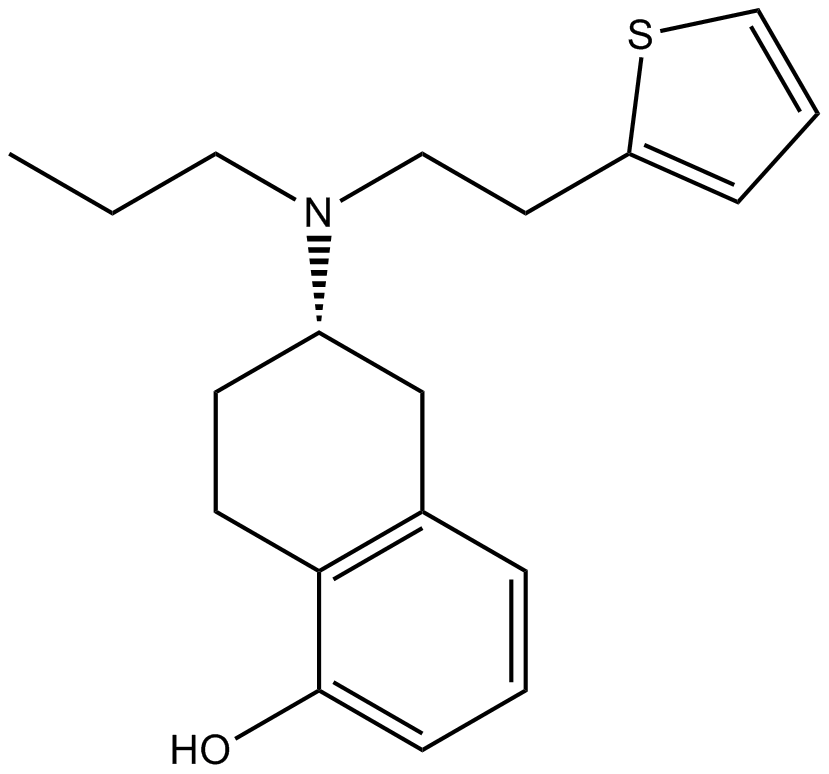
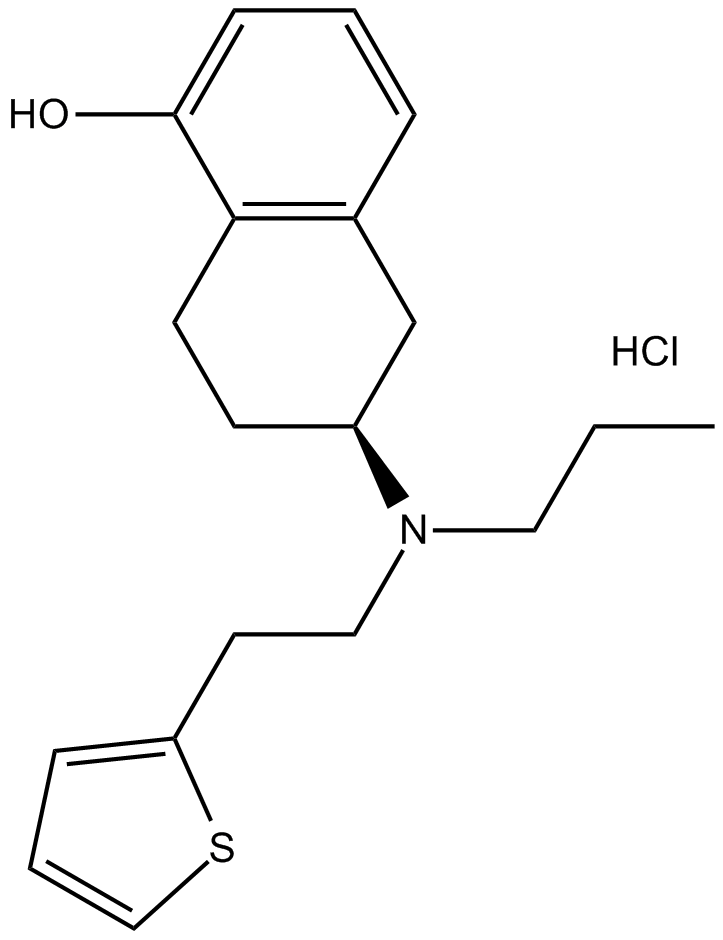
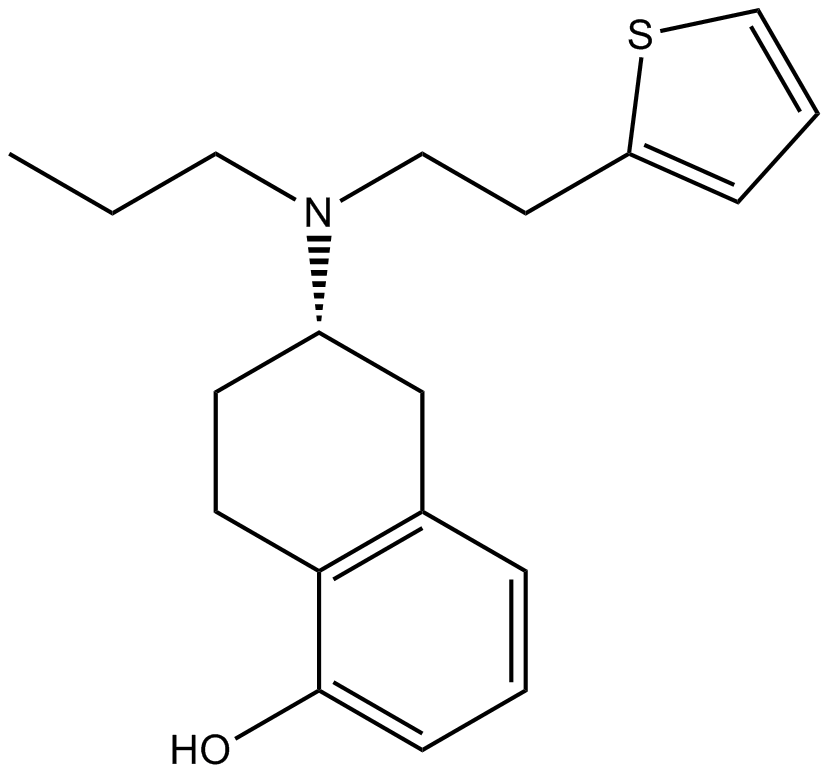
| Chemical Name | (6S)-6-[propyl(2-thiophen-2-ylethyl)amino]-5,6,7,8-tetrahydronaphthalen-1-ol |
| Canonical SMILES | CCCN(CCc1ccc[s]1)[C@@H](CC1)Cc2c1c(O)ccc2 |
| Shipping Condition | Small Molecules with Blue Ice, Modified Nucleotides with Dry Ice. |
| General tips | We do not recommend long-term storage for the solution, please use it up soon. |
Quality Control & MSDS
- View current batch:
Chemical structure