Recombinant Mouse Erythropoietin/EPO (His, Flag)
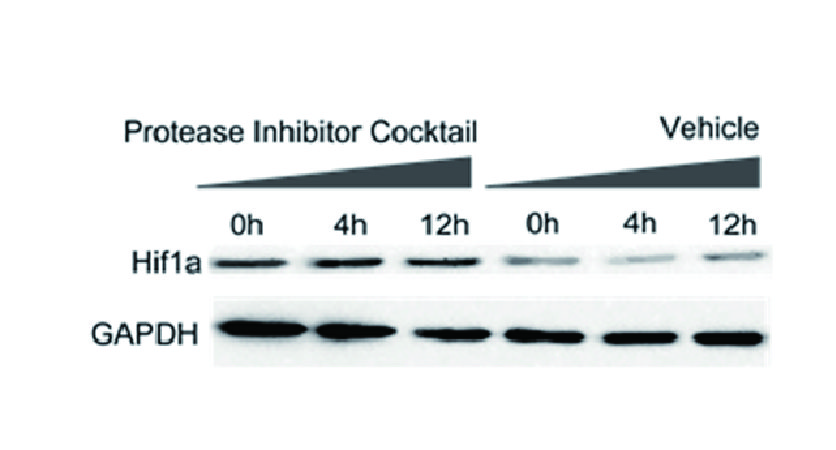
Erythropoietin (EPO) is a 34 kDa glycoprotein hormone in the type I cytokine family and is related to thrombopoietin [1]. Its three N-glycosylation sites, four alpha helices, and N- to C-terminal disulfide bond are conserved across species [2, 3]. Glycosylation of EPO is required for biological activities in vivo [4]. Mature mouse EPO shares 95% amino acid sequence identity with rat EPO and 73%-82% with bovine, canine, equine, feline, human, ovine, and porcine EPO. Epo is primarily produced in the kidney by a population of fibroblast-like cortical interstitial cells adjacent to the proximal tubules [5]. It is also produced in much lower, but functionally significant amounts by fetal hepatocytes and in adult liver and brain [6-8]. EPO promotes erythrocyte formation by preventing the apoptosis of early erythroid precursors which express the (EPO receptor (EPOR))[8, 9]. EPO R has also been described in brain, retina, heart, skeletal muscle, kidney, endothelial cells, and a variety of tumor cells [7,8,10,11]. Ligand induced dimerization of EPOR triggers JAK2-mediated signaling pathways followed by receptor/ligand endocytosis and degradation [1,12]. Rapid regulation of circulating EPO allows tight control of erythrocyte production and hemoglobin concentrations. Anemia or other causes of low tissue oxygen tension induce EPO production by stabilizing the hypoxia-induceable transcription factors HIF-1 alpha and HIF-2 alpha [1,6]. EPO additionally plays a tissue-protective role in ischemia by blocking apoptosis and inducing angiogenesis [7,8,13].
Reference
[1]. Koury, M. J. (2005) Exp. Hematol. 33:1263.
[2]. Shoemaker, C.B. and L.D. Mitsock (1986) Mol. Cell. Biol 6:849.
[3]. Wen, D. et al. (1993) Blood 82:1507.
[4]. Tsuda E. et al. (1990) Eur. J. Biochem. 188:405.
[5]. Lacombe, C. et al. (1988) J. Clin. Invest. 81:620.
[6]. Eckardt, K. U. and A. Kurtz (2005) Eur. J. Clin. Invest. 35 Suppl. 3:13.
[7]. Sharples, E. J. et al. (2006) Curr. Opin. Pharmacol. 6:184.
[8]. Rossert, J. and K. Eckardt (2005) Nephrol. Dial. Transplant 20:1025.
[9]. Koury, M.J. and M.C. Bondurant (1990) Science 248:378.
[10]. Acs, G. et al. (2001) Cancer Res. 61:3561.
[11]. Hardee, M.E. et al. (2006) Clin. Cancer Res.
[12]:332. 12. Verdier, F. et al. (2000) J. Biol. Chem. 275:18375.
[13]. Kertesz, N. et al. (2004) Dev. Biol. 276:101
| Gene ID | 13856 |
| Accession # | Q0VED9 |
| Alternate Names | ECYT5;?EP;?EPO;?epoetin;?Erythropoietin;?MGC138142;?MVCD2 |
| Source | HEK293 |
| Protein sequence | APPRLICDSRVLERYILEAKEAENVTMGCAEGPRLSENITVPDTKVNFYAWKRMEVEEQAIEVWQGLSLLSEAILQAQALLANSSQPPETLQLHIDKAISGLRSLTSLLRVLGAQKELMSPPDTTPPAPLRTLTVDTFCKLFRVYANFLRGKLKLYTGEVCRRGDR |
| M.Wt | The protein has a calculated MW of 20.6 KDa. |
| Appearance | Solution protein |
| Stability & Storage | Use a manual defrost freezer and avoid repeated freeze-thaw cycles - 36 months from date of receipt, -20 to -70°C as supplied |
| Concentration | 1 mg/mL |
| Formulation | Supplied as a 0.2 μm filtered solution in PBS, pH7.4. |
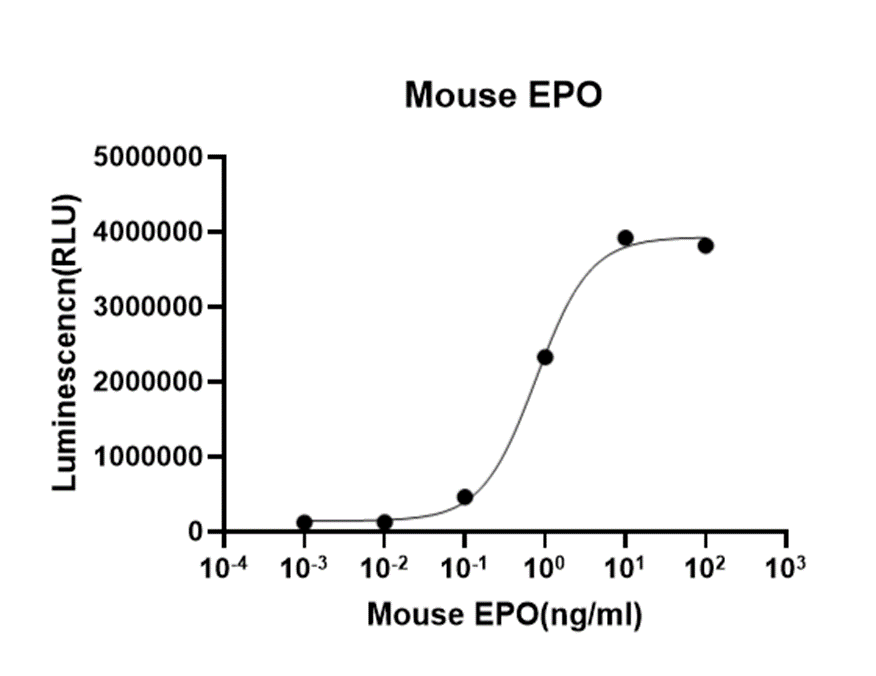
| Biological Activity | Fully biologically active as determined by a cell proliferation assay using BaF3 mouse pro?B cells transfected with mouse EPO R. The EC50 for this effect is 0.84 ng/mL. |
| Shipping Condition | Shipping with dry ice. |
| Usage | For Research Use Only! Not to be used in humans. |