Recombinant Human Vitronectin Protein, Tag Free
Recombinant Human Vitronectin, abbreviated as VN or VTN, is a multifunctional cell-adhesive glycoprotein, also commonly known by its aliases S-protein and Serum Spreading Factor. Encoded by the human VTN gene, this protein consists of 478 amino acids with a molecular weight of approximately 54 kDa. As a key component of the extracellular matrix and serum, it primarily mediates cell adhesion, spreading, and migration through its RGD sequence (Arginine-Glycine-Aspartic acid) by binding to integrin receptors on the cell surface. Additionally, acting as the S-protein, it inhibits the membrane attack complex of the complement system, thereby exerting an immunomodulatory role. The recombinant form is widely used for coating substrates in stem cell culture, tumor invasion research, and tissue engineering.
| Gene ID | 7448 |
| Accession # | P04004 |
| Alternate Names | VTN; Serum-spreading factor; V75; VN; S-protein |
| Source | E. coli |
| Protein sequence | V62-L478 |
| M.Wt | The protein has a calculated MW of 47.5 KDa. |
| Appearance | Solution protein |
| Stability & Storage | Use a manual defrost freezer and avoid repeated freeze-thaw cycles - 36 months from date of receipt, -20 to -70°C as supplied |
| Concentration | 1 mg/mL |
| Formulation | Supplied as a 0.2 μm filtered solution in PBS, pH7.4. |
| Reconstitution | We recommend that this vial be briefly centrifuged prior to opening to bring the contents to the bottom. This solution can be diluted into other aqueous buffers |
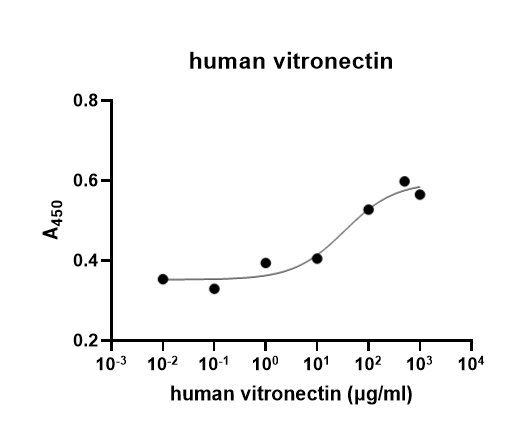
| Biological Activity | Fully biologically active as determined by the ability of the immobilized protein to support the adhesion of B16-F1 mouse melanoma cells. The EC50 for this effect is 33.89 μg/mL. |
| Shipping Condition | Dry ice |
| Handling | Centrifuge the vial prior to opening. |
| Usage | For Research Use Only! Not to be used in humans. |
Quality Control & DataSheet
- View current batch:
-
Purity > 95 % by SDS-PAGE
- Datasheet
Endotoxin: Less than 1.0 EU/µg as determined by LAL method.
Related Biological Data