


(R)-CR8 (CR8)
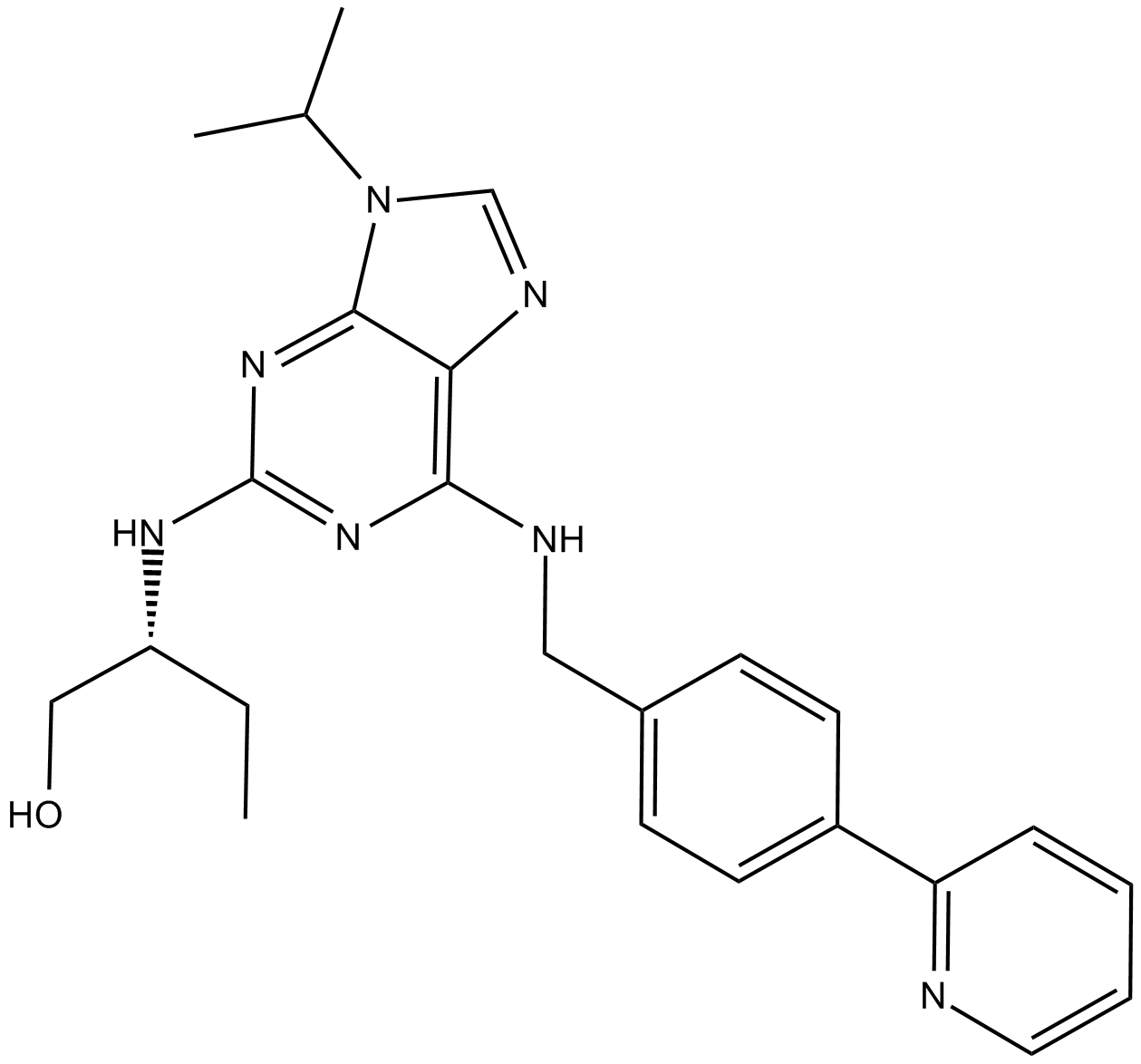
(R)-CR8 (CR8) (CAS No.: 294646-77-8) is a second-generation analog of roscovitine and a potent, broad-spectrum inhibitor of cyclin-dependent kinases (CDKs), a class of serine/threonine kinases that regulate cell cycle progression and transcriptional control, positioning this compound as a valuable tool in cancer biology and neurobiology research. It exhibits high inhibitory activity against CDK1/cyclin B, CDK2/cyclin A and E, CDK5/p25, CDK7/cyclin H, and CDK9/cyclin T, with potency in the low nanomolar to low micromolar range, and additionally targets casein kinase 1 isoforms and, to a lesser extent, GSK3, reflecting a multi-kinase inhibitory profile. Functionally, (R)-CR8 suppresses cell proliferation and induces apoptosis in tumor cell models, while also demonstrating neuroprotective effects in experimental systems, including attenuation of neuronal loss, reduction of microglial and astrocytic activation, and improvement of behavioral and cognitive deficits in injury models. Notably, (R)-CR8 has been identified as a molecular glue degrader that promotes the interaction between CDK12–cyclin K complexes and the CUL4-DDB1 ubiquitin ligase machinery, leading to selective ubiquitination and degradation of cyclin K, thereby expanding its mechanistic relevance beyond kinase inhibition into targeted protein degradation. This compound is widely used in in vitro and in vivo studies to investigate CDK-driven signaling pathways, transcriptional regulation, neurodegeneration, and anticancer mechanisms, with experimental concentrations or dosing regimens typically optimized according to specific cellular systems or animal models.
| Physical Appearance | A solid |
| Storage | -20°C |
| M.Wt | 431.53 |
| Cas No. | 294646-77-8 |
| Formula | C24H29N7O |
| Solubility | ≥45.4 mg/mL in DMSO |
| Chemical Name | (R)-2-((9-isopropyl-6-((4-(pyridin-2-yl)benzyl)amino)-9H-purin-2-yl)amino)butan-1-ol |
| Canonical SMILES | OC[C@@H](CC)NC1=NC(NCC2=CC=C(C3=NC=CC=C3)C=C2)=C(N=CN4C(C)C)C4=N1 |
| Shipping Condition | Small Molecules with Blue Ice, Modified Nucleotides with Dry Ice. |
| General tips | We do not recommend long-term storage for the solution, please use it up soon. |