


Quinine
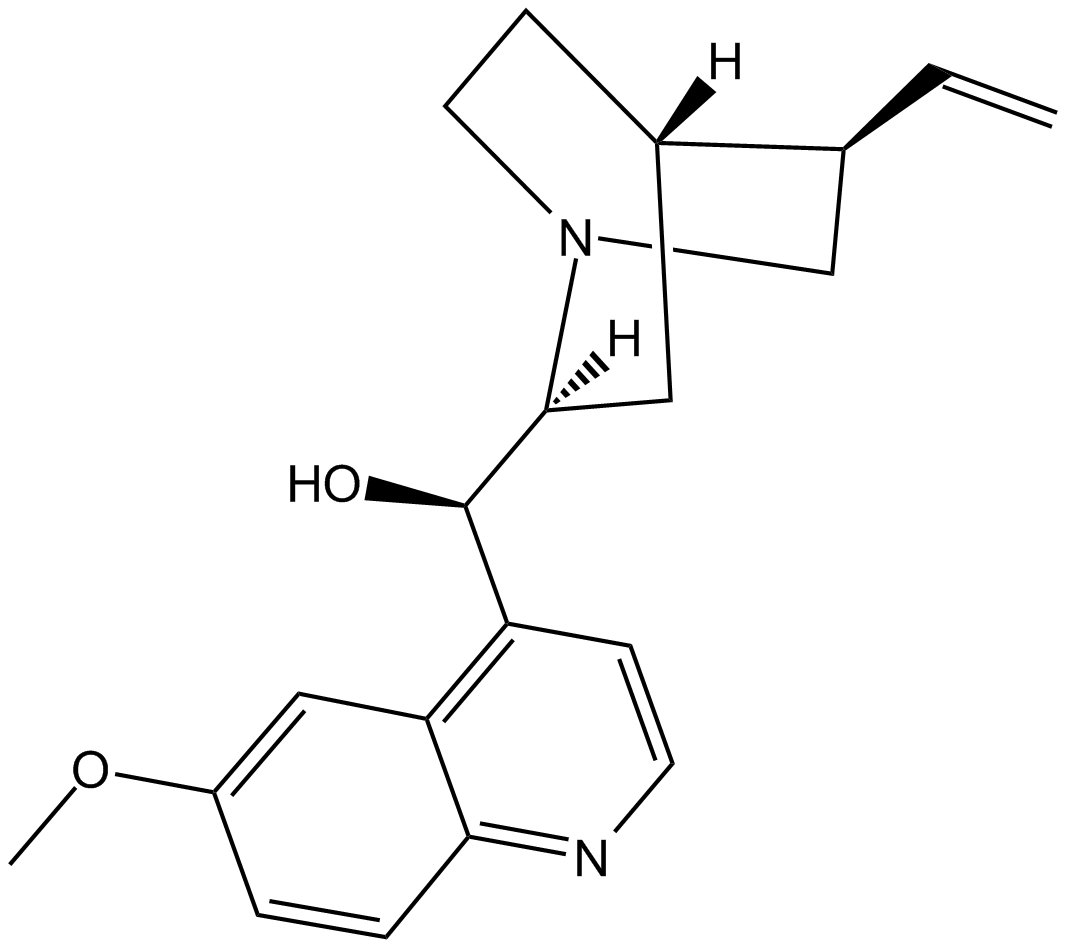
Quinine (CAS No.: 130-95-0) is a naturally occurring cinchona alkaloid widely utilized in biomedical research as a prototypical antimalarial agent and ion channel modulator, originally isolated from the bark of the cinchona tree and historically employed for the treatment of malaria and related parasitic infections. Functionally, quinine exerts antiplasmodial activity primarily through inhibition of hemozoin biocrystallization within Plasmodium trophozoites, leading to accumulation of cytotoxic free heme and parasite death, while additional pharmacological effects include modulation of ion transport pathways, such as inhibition of potassium channels including Slo3 (KCa5.1) currents, and interactions with muscle membrane excitability via sodium channel-related mechanisms. In vitro studies demonstrate potent activity against Plasmodium falciparum isolates in the nanomolar range, while electrophysiological assays indicate potassium channel inhibition at low micromolar concentrations; in vivo, quinine reduces parasitemia in murine malaria models at pharmacologically relevant doses. Beyond antiparasitic applications, quinine is also employed as a tool compound in studies of muscle physiology, ion channel function, and membrane excitability, as well as in investigations of febrile and analgesic responses. Its multifaceted pharmacology makes it valuable in drug discovery programs targeting malaria, ion channel regulation, and host–pathogen interactions, with experimental concentrations or dosing regimens tailored to specific cellular systems, electrophysiological assays, or animal models.
| Physical Appearance | A solid |
| Storage | -20°C |
| M.Wt | 324.42 |
| Cas No. | 130-95-0 |
| Formula | C20H24N2O2 |
| Synonyms | NSC 192949 |
| Solubility | insoluble in H2O; ≥49.4 mg/mL in DMSO; ≥50.5 mg/mL in EtOH |
| Chemical Name | (1R)-(6-methoxyquinolin-4-yl)((2S,4S,5R)-5-vinylquinuclidin-2-yl)methanol |
| Canonical SMILES | OC(C=1C=CN=C2C=CC(OC)=CC21)C3N4CCC(C3)C(C=C)C4 |
| Shipping Condition | Small Molecules with Blue Ice, Modified Nucleotides with Dry Ice. |
| General tips | We do not recommend long-term storage for the solution, please use it up soon. |