


Pteridine-2,4(1H,3H)-dione
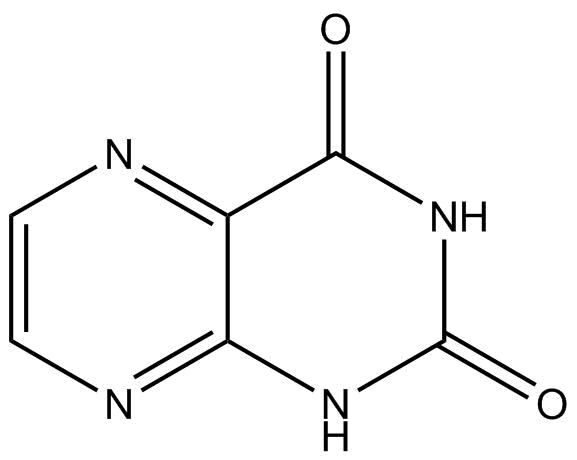





Pteridine-2,4(1H,3H)-dione (CAS No.: 487-21-8) is an endogenous pteridine-derived metabolite that occurs naturally in biological systems and is closely associated with the metabolic network governing pterin homeostasis. As a member of the lumazine family, it has been identified in organisms such as Dictyostelium discoideum and exhibits intrinsic fluorescence with characteristic excitation and emission maxima, making it a useful probe in biochemical and cellular studies. Functionally, this compound participates in interconnected biosynthetic and degradation pathways of pteridine cofactors, which are essential for diverse enzymatic processes including redox reactions and cofactor-dependent hydroxylation systems. Although it is not typically characterized as a direct pharmacological inhibitor or receptor ligand, it serves as a valuable substrate analog and reference standard in enzymology studies investigating enzymes involved in pteridine metabolism, such as those regulating folate and biopterin pathways. In vitro applications commonly leverage this molecule to monitor enzymatic activity, pathway flux, or metabolic perturbations, typically at concentrations ranging from low micromolar to higher micromolar levels depending on assay sensitivity and design. In drug discovery and systems biology contexts, Pteridine-2,4(1H,3H)-dione is primarily used to elucidate metabolic pathway dynamics, validate analytical platforms, and support mechanistic studies of diseases linked to altered pteridine metabolism, with experimental dosing and conditions tailored to specific cellular or biochemical models.
| Physical Appearance | A solid |
| Storage | -20°C |
| M.Wt | 164.12 |
| Cas No. | 487-21-8 |
| Formula | C6H4N4O2 |
| Synonyms | 2,4-Dihydroxypteridine; NSC 225113; NSC 41801; 2,4-Pteridinediol |
| Solubility | Insoluble in DMSO; insoluble in EtOH; insoluble in H2O |
| Chemical Name | pteridine-2,4(1H,3H)-dione |
| Canonical SMILES | O=C(N1)NC2=NC=CN=C2C1=O |
| Shipping Condition | Small Molecules with Blue Ice, Modified Nucleotides with Dry Ice. |
| General tips | We do not recommend long-term storage for the solution, please use it up soon. |