


Picaridin
Picaridin (CAS No.: 119515-38-7) is a synthetic piperidine-derived cyclic amine widely used as a broad-spectrum arthropod repellent and increasingly studied in biomedical and vector-borne disease research contexts. Originally developed through molecular modeling efforts, picaridin functions primarily by modulating olfactory receptor proteins in arthropods, including mosquitoes and ticks, thereby disrupting host-seeking behavior in species such as Aedes aegypti. In addition to its established role in vector control, picaridin has demonstrated ancillary antimicrobial properties, including antibacterial, anticandidal, and antifungal activities, suggesting potential utility in studies of host–pathogen interactions and topical antimicrobial formulations. Compared to traditional repellents, it exhibits a favorable tolerability profile with reduced irritation, supporting its use in prolonged exposure models. Although detailed molecular targets in mammalian systems remain incompletely characterized, its effects are generally attributed to interactions with sensory signaling pathways in invertebrates. In vitro studies indicate activity across low micromolar to higher concentration ranges depending on organism and assay conditions, while experimental applications in cell-based or in vivo models typically vary according to study design, particularly in investigations of vector behavior, skin exposure, and microbial inhibition.
| Physical Appearance | An oily?liquid |
| Storage | -20°C |
| M.Wt | 229.32 |
| Cas No. | 119515-38-7 |
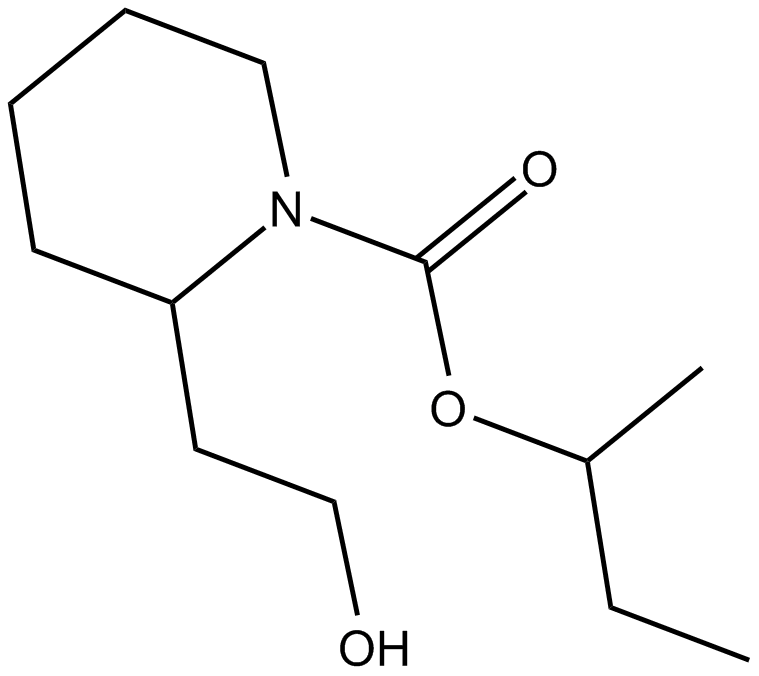
| Formula | C12H23NO3 |
| Synonyms | Icaridin; KBR 3023 |
| Solubility | ≥36.8 mg/mL in DMSO; ≥34.2 mg/mL in EtOH; insoluble in H2O |
| Chemical Name | sec-butyl 2-(2-hydroxyethyl)piperidine-1-carboxylate |
| Canonical SMILES | O=C(N1C(CCCC1)CCO)OC(CC)C |
| Shipping Condition | Small Molecules with Blue Ice, Modified Nucleotides with Dry Ice. |
| General tips | We do not recommend long-term storage for the solution, please use it up soon. |