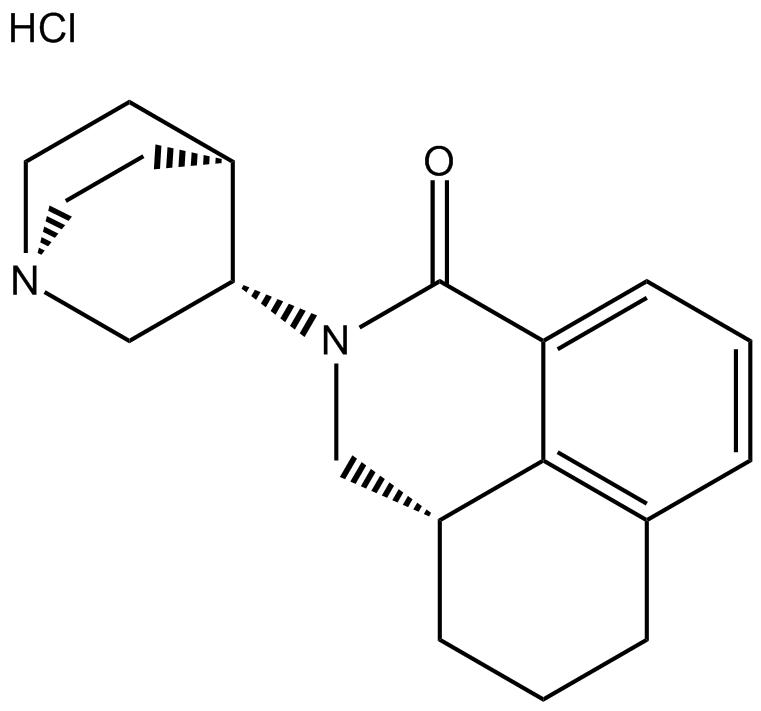
Palonosetron HCl
Palonosetron hydrochloride (CAS No. 135729-62-3) is a highly selective 5-hydroxytryptamine 3 (5-HT?) receptor antagonist. Its core bioactivity is the prevention of chemotherapy- / radiotherapy-induced nausea and vomiting (CINV/RINV). Its targets include the 5-HT?A and 5-HT?AB receptor subtypes (the orthosteric binding site and an allosteric site at the interface between the transmembrane region and extracellular domain). It acts through allosteric binding, receptor internalization, and prolongation of the inhibitory effect, and shows very low affinity for other receptors. The IC?? data are highly specific: in vitro inhibition of 5-HT?A receptor function is 0.24 nM and of 5-HT?AB is 0.18 nM (fluorescence assay in HEK293 cells); inhibition of the renal transporter OCT2 is 2.6 μM, and inhibition of MATE1 is comparable to that of tropisetron. Commonly used application concentrations: in vitro cell experiments 0.1-0.3 nM (5-HT? receptor function modulation), 0.5-20 μM (OCT2/MATE1 inhibition assays). In animal experiments, intravenous injection of 0.04 μg/kg in rats can inhibit 2-methyl-5-HT-induced reflex bradycardia; in dogs, an intravenous dose of 30 μg/kg produces an antiemetic effect lasting 7 hours; in ferrets, oral administration of 3.2 μg/kg yields an ID?? of 3.2 μg/kg against cisplatin-induced emesis. In clinical use, the effective therapeutic concentration corresponds to a single 0.25 mg intravenous dose in adults (30 minutes before chemotherapy); in Japanese patients receiving highly emetogenic chemotherapy, the dose is 0.75 mg. The steady-state peak plasma concentration reaches the high nanomolar to low micromolar range, with a half-life of about 40 hours, maintaining >70% receptor occupancy for more than 5 days. It is commonly used in combination with dexamethasone and aprepitant, is effective against both acute and delayed CINV, and does not require dose adjustment based on hepatic or renal function.
References:
[1] Ruhlmann C, Herrstedt J. Palonosetron hydrochloride for the prevention of chemotherapy-induced nausea and vomiting. Expert Rev Anticancer Ther. 2010 Feb;10(2):137-48. doi: 10.1586/era.09.175. PMID: 20131990.
[2] Ajioka H, Morita F, Akizawa Y, Yoshida K, Kitamura R, Takimoto H. [Pharmacological, pharmacokinetic, and clinical profile of palonosetron hydrochloride (ALOXI I.V. Injection 0.75 mg), a novel antiemetic 5-HT3-receptor antagonist]. Nihon Yakurigaku Zasshi. 2010 Aug;136(2):113-20. Japanese. doi: 10.1254/fpj.136.113. PMID: 20702972.
[3] Fabi A, Malaguti P. An update on palonosetron hydrochloride for the treatment of radio/chemotherapy-induced nausea and vomiting. Expert Opin Pharmacother. 2013 Apr;14(5):629-41. doi: 10.1517/14656566.2013.771166. Epub 2013 Feb 18. PMID: 23414148.
[4] Lummis SC, Thompson AJ. Agonists and antagonists induce different palonosetron dissociation rates in 5-HT?A and 5-HT?AB receptors. Neuropharmacology. 2013 Oct;73:241-6. doi: 10.1016/j.neuropharm.2013.05.010. Epub 2013 Jun 5. PMID: 23747573; PMCID: PMC3778450.
[5] Lohning AE, Marx W, Isenring L. In silico investigation into the interactions between murine 5-HT3 receptor and the principle active compounds of ginger (Zingiber officinale). J Mol Graph Model. 2016 Nov;70:315-327. doi: 10.1016/j.jmgm.2016.10.008. Epub 2016 Oct 26. PMID: 27816008.
[6] George B, Wen X, Jaimes EA, Joy MS, Aleksunes LM. In Vitro Inhibition of Renal OCT2 and MATE1 Secretion by Antiemetic Drugs. Int J Mol Sci. 2021 Jun 16;22(12):6439. doi: 10.3390/ijms22126439. PMID: 34208557; PMCID: PMC8234231.
| Physical Appearance | A solid |
| Storage | Store at -20°C |
| M.Wt | 332.87 |
| Cas No. | 135729-62-3 |
| Formula | C19H25ClN2O |
| Synonyms | Palonosetron hydrochloride |
| Solubility | insoluble in EtOH; ≥16.6435 mg/mL in DMSO; ≥32.3 mg/mL in H2O |
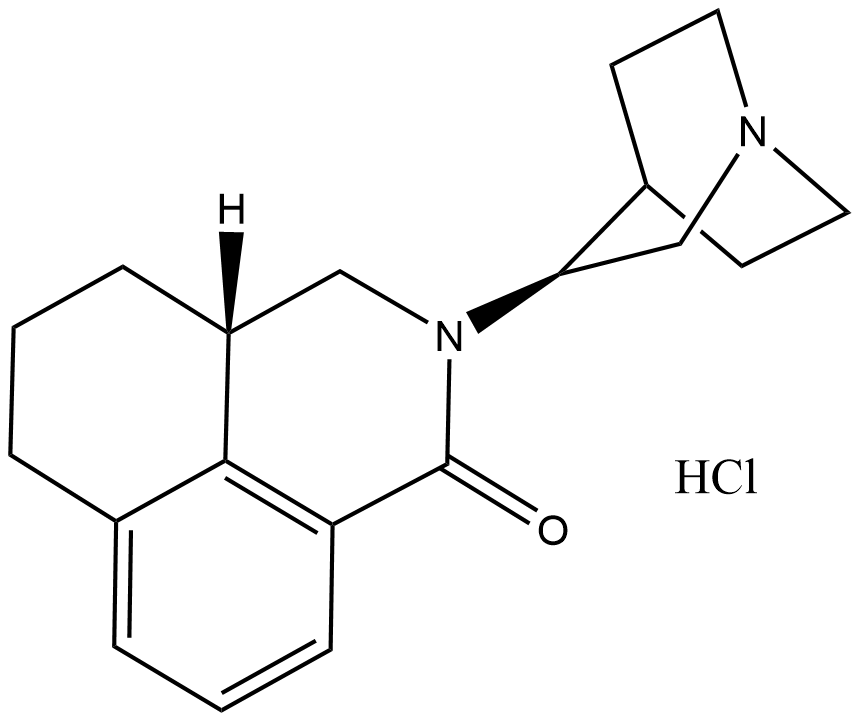
| Chemical Name | (S)-2-((S)-quinuclidin-3-yl)-2,3,3a,4,5,6-hexahydro-1H-benzo[de]isoquinolin-1-one hydrochloride |
| Canonical SMILES | O=C1C2=C3[C@@](CN1[C@H]4C5CCN(C4)CC5)(CCCC3=CC=C2)[H].Cl |
| Shipping Condition | Small Molecules with Blue Ice, Modified Nucleotides with Dry Ice. |
| General tips | We do not recommend long-term storage for the solution, please use it up soon. |
Quality Control & MSDS
- View current batch:
Chemical structure