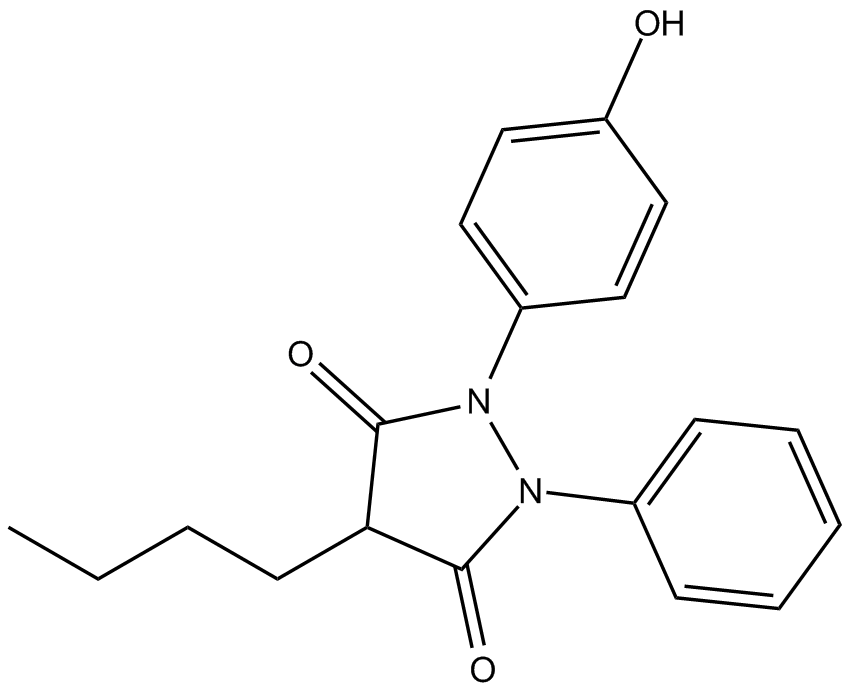
Oxyphenbutazone
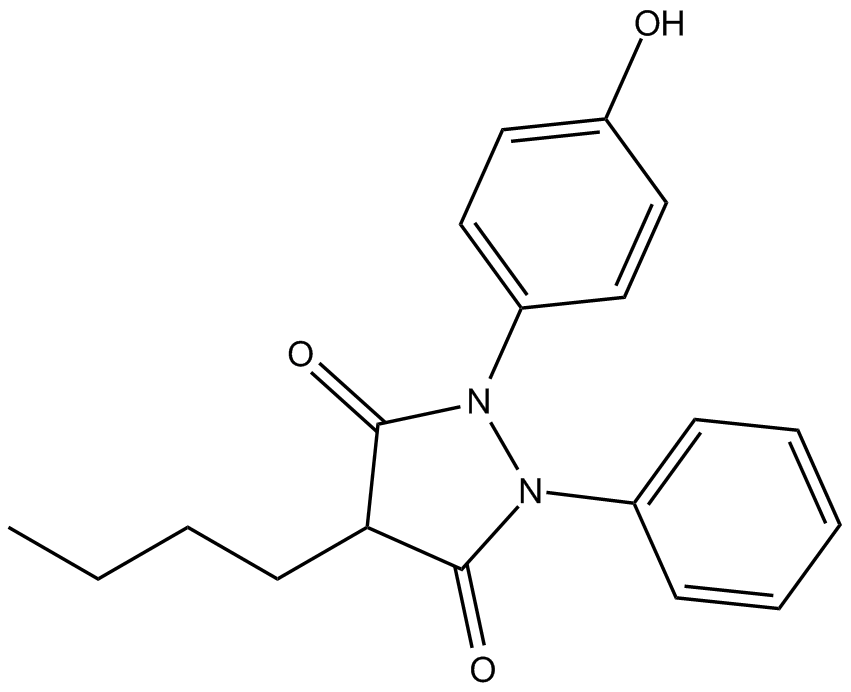
Oxyphenbutazone (CAS No.: 129-20-4) is a well-characterized nonsteroidal anti-inflammatory drug (NSAID) metabolite derived from phenylbutazone through conversion by the CYP2C9 isoform of the cytochrome P450 (CYP) enzyme system. As a nonselective cyclooxygenase (COX) and organic anion transporter 1 (OAT1) inhibitor, Oxyphenbutazone plays an important role in biomedical research, particularly in antimicrobial research, where it can selectively exert significant effects against non-replicating Mycobacterium tuberculosis. Its biological activity includes the ability to inhibit interleukin-6 (IL-6)-induced MH60 B cell proliferation at low micromolar levels, and it can enhance neurite outgrowth in neuronal cell models through nerve growth factor (NGF). In cellular and animal models, Oxyphenbutazone has demonstrated diverse experimental applications, and its anti-inflammatory properties have shown in animal models that it can effectively reduce joint swelling and edema. The concentrations or doses used in experiments typically depend on the specific experimental design and research objectives. As an active metabolite of phenylbutazone, Oxyphenbutazone continues to play a key role in understanding the dynamics of inflammation and infection at the cellular level.
| Physical Appearance | A crystalline solid |
| Storage | -20°C |
| M.Wt | 324.37 |
| Cas No. | 129-20-4 |
| Formula | C19H20N2O3 |
| Synonyms | G 27202; p-Hydroxyphenylbutazone; NSC 526053; Ro 04-4410 |
| Solubility | ≥50 mg/mL in DMSO; ≥48 mg/mL in EtOH; insoluble in H2O |
| Chemical Name | 4-butyl-1-(4-hydroxyphenyl)-2-phenylpyrazolidine-3,5-dione |
| Canonical SMILES | O=C(C1CCCC)N(C2=CC=CC=C2)N(C3=CC=C(O)C=C3)C1=O |
| Shipping Condition | Small Molecules with Blue Ice, Modified Nucleotides with Dry Ice. |
| General tips | We do not recommend long-term storage for the solution, please use it up soon. |
Quality Control & MSDS
- View current batch:
Chemical structure