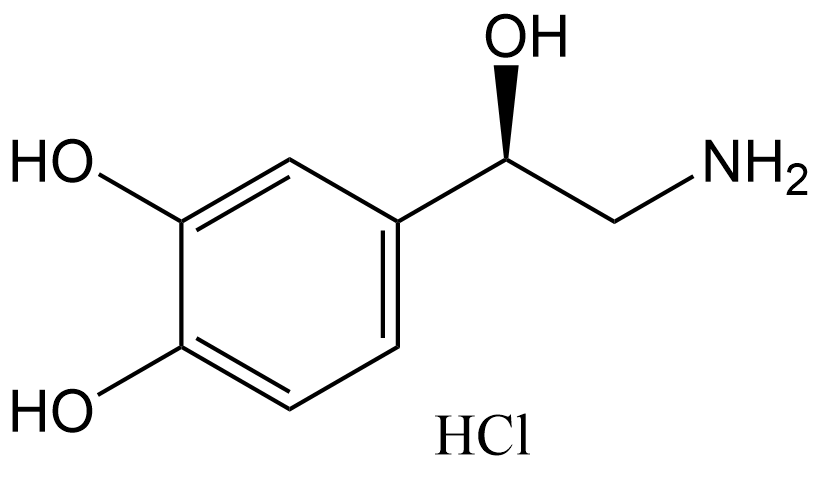
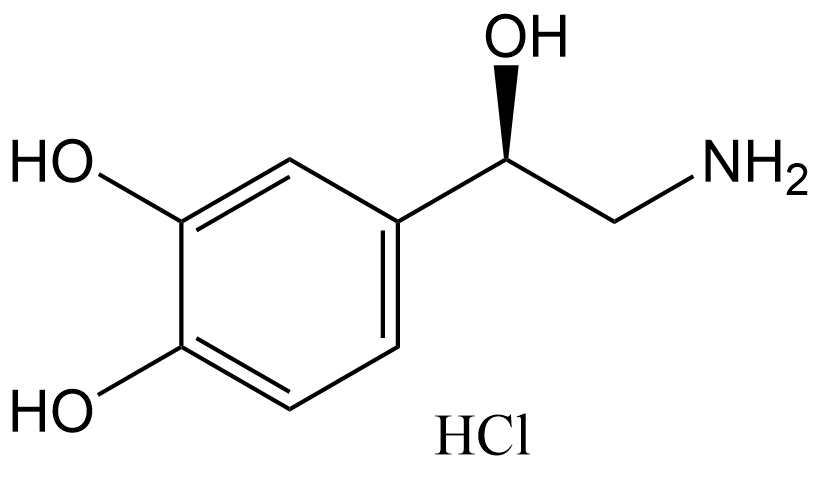
(-)-Norepinephrine hydrochloride
(-)-Norepinephrine hydrochloride (CAS No. 329-56-6) is an endogenous catecholamine neurotransmitter that exerts physiological effects such as vasoconstriction and blood pressure elevation primarily through activation of α1 and α2 adrenergic receptors. In biomedical research, norepinephrine is commonly used to study the function and regulatory mechanisms of the sympathetic nervous system. In in vitro experiments, its active concentration is typically in the nanomolar to low micromolar range, depending on the experimental design and cell type. In cell models, norepinephrine is used to investigate processes such as the contractile function of cardiomyocytes and the proliferation and migration of vascular smooth muscle cells. In animal models, norepinephrine is often used to induce hypertension models to study the pathogenesis of hypertension and potential therapeutic strategies. The dose or concentration used in experiments usually depends on the experimental design and research objectives.
| Storage | 4°C, stored under nitrogen |
| M.Wt | 205.64 |
| Cas No. | 329-56-6 |
| Formula | C8H12ClNO3 |
| Synonyms | Levarterenol hydrochloride; R-(-)-Norepinephrine monohydrochloride; Arterenol hydrochloride |
| Solubility | ≥7.84 mg/mL in DMSO; insoluble in EtOH; ≥19.7 mg/mL in H2O |
| Chemical Name | (R)-4-(2-amino-1-hydroxyethyl)benzene-1,2-diol hydrochloride |
| Canonical SMILES | [C@@H](CN)(O)C1=CC(O)=C(O)C=C1.Cl |
| Shipping Condition | Small Molecules with Blue Ice, Modified Nucleotides with Dry Ice. |
| General tips | We do not recommend long-term storage for the solution, please use it up soon. |
Quality Control & MSDS
- View current batch:
Chemical structure