


Nilutamide
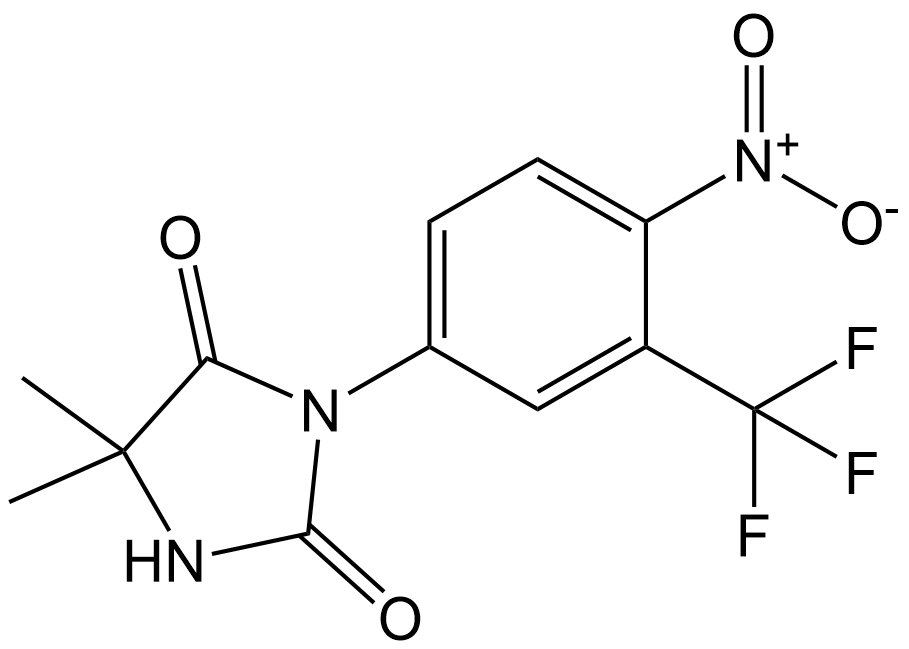
Nilutamide (Nilandron, CAS No. 63612-50-0) is an orally active nonsteroidal androgen receptor (AR) antagonist that selectively binds to and blocks AR, with very low affinity for progesterone, estrogen, and glucocorticoid receptors. It exerts antiandrogenic effects by inhibiting androgen-mediated transcription and cell proliferation. It is one of the commonly used second-generation nonsteroidal antiandrogen drugs for the study and treatment of prostate cancer (especially advanced/metastatic prostate cancer in combination with surgical castration), and also has certain anti-schistosomal (Schistosoma mansoni) activity.
In vitro, Nilutamide can reverse testosterone-induced cell proliferation and secretory responses: in mouse mammary carcinoma cells, its IC₅₀ for inhibiting testosterone-induced proliferation is ≈ 412 nM; in human breast cancer cells T‑47D and ZR‑75‑1, it can block GCDFP‑15 secretion induced by 1 nM testosterone, with IC₅₀ values of 87 nM and 75 nM, respectively. In human liver microsomes, 110 μM Nilutamide can inhibit multiple CYP-related activities (such as hexobarbital hydroxylase, benzphetamine N‑demethylase, etc.), with inhibition rates of approximately 25–85%, suggesting its inhibitory potential against drug-metabolizing enzymes at high concentrations, which needs to be considered in studies of concomitant medications.
In androgen-dependent animal models, Nilutamide shows clear antiandrogenic effects: administration of 2.5 mg/kg in intact or castrated rats can significantly inhibit testosterone propionate-induced prostatic hyperplasia; clinical formulations are commonly used in combination with surgical castration for “complete androgen blockade” regimens in metastatic prostate cancer. In addition to its antiandrogenic effects, in parasite models, a single oral dose of 50–400 mg/kg Nilutamide can reduce the burden of juvenile and adult Schistosoma mansoni in infected mice, demonstrating its anti-schistosomal activity and providing experimental evidence for the development of multi-target drugs or the repurposing of old drugs.
References:
[1] Singh SM, Gauthier S, Labrie F. Androgen receptor antagonists (antiandrogens): structure-activity relationships. Curr Med Chem. 2000 Feb;7(2):211-47. doi: 10.2174/0929867003375371. PMID: 10637363.
[2] Simard J, Singh SM, Labrie F. Comparison of in vitro effects of the pure antiandrogens OH-flutamide, Casodex, and nilutamide on androgen-sensitive parameters. Urology. 1997 Apr;49(4):580-6; discussion 586-9. doi: 10.1016/s0090-4295(97)00029-0. PMID: 9111629.
[3] Wakeling AE, Furr BJ, Glen AT, Hughes LR. Receptor binding and biological activity of steroidal and nonsteroidal antiandrogens. J Steroid Biochem. 1981 Dec;15:355-9. doi: 10.1016/0022-4731(81)90297-1. PMID: 7339263.
[4] Babany G, Tinel M, Letteron P, Freneaux E, Berson A, Larrey D, Pessayre D. Inhibitory effects of nilutamide, a new androgen receptor antagonist, on mouse and human liver cytochrome P-450. Biochem Pharmacol. 1989 Mar 15;38(6):941-7. doi: 10.1016/0006-2952(89)90284-0. PMID: 2930595.
[5] Harris MG, Coleman SG, Faulds D, Chrisp P. Nilutamide. A review of its pharmacodynamic and pharmacokinetic properties, and therapeutic efficacy in prostate cancer. Drugs Aging. 1993 Jan-Feb;3(1):9-25. doi: 10.2165/00002512-199303010-00002. PMID: 8453188.
[6] Keiser J, Vargas M, Vennerstrom JL. Activity of antiandrogens against juvenile and adult Schistosoma mansoni in mice. J Antimicrob Chemother. 2010 Sep;65(9):1991-5. doi: 10.1093/jac/dkq233. Epub 2010 Jun 24. PMID: 20576641; PMCID: PMC2920177.
| Storage | Store at -20°C |
| M.Wt | 317.22 |
| Cas No. | 63612-50-0 |
| Formula | C12H10F3N3O4 |
| Synonyms | Anandron, RU 23908-10, Nilandron |
| Chemical Name | 5,5-dimethyl-3-(4-nitro-3-(trifluoromethyl)phenyl)imidazolidine-2,4-dione |
| Canonical SMILES | O=C1NC(C(=O)N1C2=CC=C(C(=C2)C(F)(F)F)N(=O)=O)(C)C |
| Shipping Condition | Small Molecules with Blue Ice, Modified Nucleotides with Dry Ice. |
| General tips | We do not recommend long-term storage for the solution, please use it up soon. |