


Neuromedin U-23 (rat) TFA
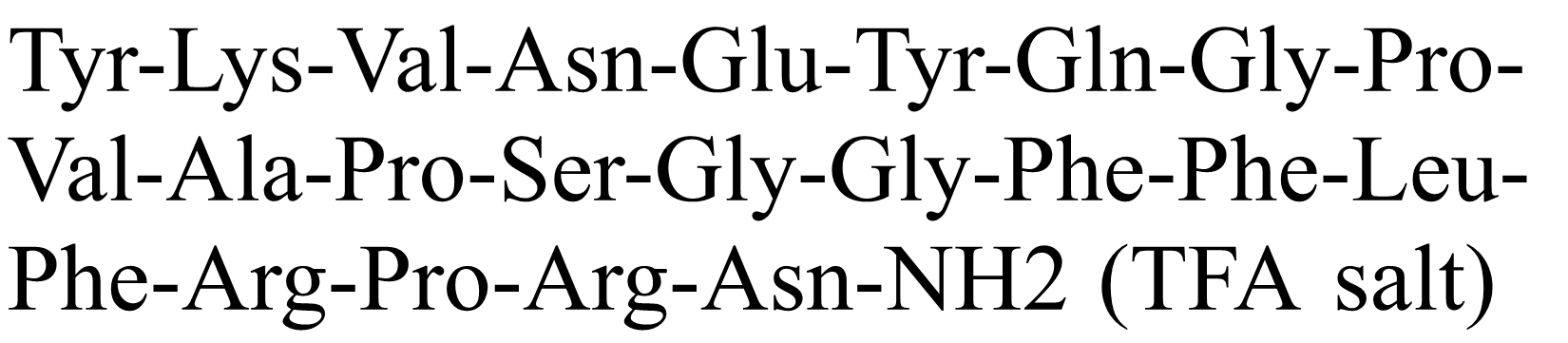
Neuromedin U‑23 TFA is the trifluoroacetate salt form of NMU‑23. NMU‑23 (CAS No.: 117505-80-3) is a C-terminally amidated active polypeptide composed of 23 amino acids. The rat sequence is Tyr-Lys-Val-Asn-Glu-Tyr-Gln-Gly-Pro-Val-Ala-Pro-Ser-Gly-Gly-Phe-Phe-Leu-Phe-Arg-Pro-Arg-Asn-NH₂, in which C-terminal amidation is essential for maintaining biological activity. Its core targets are two G protein-coupled neuromedin U receptors: NMU‑R1, mainly distributed in peripheral tissues, and NMU‑R2, mainly distributed in the central nervous system, at both of which it acts as a receptor agonist; the former predominantly signals through Gq/11‑Ca²⁺, while the latter predominantly signals through Gi‑Ca²⁺. NMU‑23 regulates contraction of smooth muscles such as the gastrointestinal tract, uterus, and bladder by activating NMU‑R1, participates in the regulation of energy homeostasis and feeding behavior through hypothalamic NMU‑R2, and promotes nociceptive transmission in the dorsal horn of the spinal cord, making it an important polypeptide signaling molecule linking peripheral smooth muscle function, metabolic centers, and pain pathways.
At the cellular level, NMU‑23 exhibits nanomolar high affinity and high potency in receptor binding and functional assays. In rat uterine membrane receptor binding assays, rat-derived NMU‑23 has a Kd of approximately 5.10±2.83 nM for NMU receptors, while the tree frog skin-derived homologous peptide NMU‑23 has a Kd of approximately 12.72±5.29 nM, suggesting that interspecies sequence differences have a certain effect on affinity. In cell lines stably expressing human or murine NMU‑R1/NMU‑R2, NMU‑23 can induce rapid calcium influx and is commonly used for calcium mobilization and receptor activation curve determination; structure-activity relationship studies show that the electron density of the aromatic rings of phenylalanine at positions 16, 17, and 19 of the peptide chain is crucial for anorectic activity. [Phe(4F)¹⁶,¹⁷,¹⁹]-modified analogs exert stronger inhibition of food intake than native NMU‑23 at the same dose, whereas methylation of N-terminal Tyr¹ and Tyr⁶ significantly weakens or abolishes anorectic activity, indicating that the C-terminal hydrophobic aromatic residue cluster and N-terminal tyrosine structures play key roles in receptor selectivity and signaling bias.
At the animal experiment level, NMU‑23 has validated its smooth muscle, metabolic, and pain-related effects in multiple models. In isolated rat uterine smooth muscle, the EC₅₀ of the NMU‑23 contractile response is approximately 1.1±0.1 nM, with a potency about 10.9 times that of the short peptide NMU‑8; in human bladder detrusor strips, the contractile effect of 10 nM NMU‑23 is higher than that of porcine NMU‑25 under the same conditions, reflecting its highly efficient smooth muscle agonist activity toward NMU‑R1. In metabolic studies, central administration of NMU‑23 to diet-induced obese mice or ob/ob obese mice can significantly suppress food intake, increase energy expenditure, promote brown adipose thermogenesis and white adipose browning, and improve glucose tolerance; the related effects involve the hypothalamic paraventricular nucleus‑CRF pathway and the brainstem nucleus tractus solitarius catecholaminergic pathway. In pain models, intrathecal injection of NMU‑23 (0.4–4.0 nmol/10 μL) in rats dose-dependently decreases mechanical and thermal pain thresholds. A dose of 4 nmol/10 μL increases touch-evoked responses by approximately 439±94% and pinch-evoked responses by approximately 188±36%; mechanical allodynia peaks at approximately 30 minutes after administration, and thermal hyperalgesia persists for 10–30 minutes, suggesting a key role of spinal NMU‑R2 in pro-nociception.
References:
[1] Salmon AL, Johnsen AH, Bienert M, McMurray G, Nandha KA, Bloom SR, Shaw C. Isolation, structural characterization, and bioactivity of a novel neuromedin U analog from the defensive skin secretion of the Australasian tree frog, Litoria caerulea. J Biol Chem. 2000 Feb 18;275(7):4549-54. doi: 10.1074/jbc.275.7.4549. PMID: 10671478.
[2] Abiko T, Takamura Y. Synthesis of two neuromedin U (NMU) analogues and their comparative effect of reducing food intake in rats. Prep Biochem Biotechnol. 2002 Feb;32(1):79-86. doi: 10.1081/PB-120013163. PMID: 11934079.
[3] Yu XH, Cao CQ, Mennicken F, Puma C, Dray A, O'Donnell D, Ahmad S, Perkins M. Pro-nociceptive effects of neuromedin U in rat. Neuroscience. 2003;120(2):467-74. doi: 10.1016/s0306-4522(03)00300-2. PMID: 12890516.
[4] Botticelli L, Micioni Di Bonaventura E, Del Bello F, Giorgioni G, Piergentili A, Quaglia W, Bonifazi A, Cifani C, Micioni Di Bonaventura MV. The neuromedin U system: Pharmacological implications for the treatment of obesity and binge eating behavior. Pharmacol Res. 2023 Sep;195:106875. doi: 10.1016/j.phrs.2023.106875. Epub 2023 Jul 29. PMID: 37517560.
| Storage | Desiccate at -20°C |
| M.Wt | 2642.97 (free base) |
| Cas No. | 117505-80-3 (free base) |
| Formula | C124H180N34O31·xCF3COOH |
| Synonyms | NMU-23 TFA, Rat neuromedin U-23 TFA |
| Canonical SMILES | YKVNEYQGPVAPSGGFFLFRPRN-NH2 |
| Shipping Condition | Small Molecules with Blue Ice, Modified Nucleotides with Dry Ice. |
| General tips | We do not recommend long-term storage for the solution, please use it up soon. |