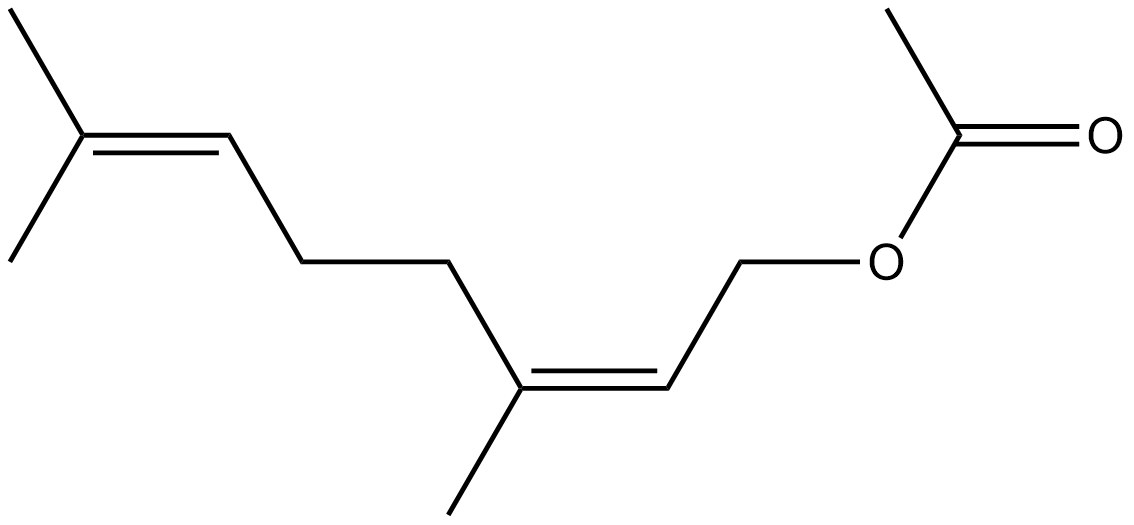
Neryl acetate
Neryl acetate (CAS No.: 141-12-8) is a naturally occurring monoterpenoid ester commonly detected in essential oils, including citrus derived and Helichrysum italicum volatile fractions, and is primarily positioned in life sciences catalogs as a bioactive natural product and aroma related small molecule for mechanistic and phenotypic research use. Current experimental evidence indicates that it can modulate epidermal differentiation and barrier associated biology in vitro, with reported upregulation of gene programs linked to epidermal maturation, skin barrier assembly, and ceramide biosynthesis, together with increased filaggrin expression and elevation of total lipid and ceramide content, supporting its use as a probe for studying keratinocyte lipid homeostasis and barrier formation pathways. In addition, as a major contributor to bioactivity profiles observed in certain essential oil matrices, it is investigated in antimicrobial and host barrier interaction models to dissect multi component natural product effects, while specific direct protein targets and canonical upstream signaling nodes remain incompletely defined and are therefore best treated as under active investigation rather than conclusively assigned. Quantitative potency metrics such as IC50, EC50, or MIC are not uniformly established across standardized assay systems for this specific molecule, so activity is generally interpreted in low concentration in vitro paradigms that vary by endpoint and model context, and screening programs typically determine working windows empirically from subcytotoxic to biologically responsive ranges. Typical applications include cell based assays of keratinocyte differentiation, lipid metabolism, and barrier relevant transcriptional responses, exploratory antimicrobial susceptibility workflows, and natural product fraction deconvolution studies, whereas in vivo exploratory use and dose selection, when performed, are study dependent and should be defined according to experimental design, analytical readouts, and research objectives under non clinical, non food, and non consumer use conditions.
| Storage | -20°C for 2 years |
| M.Wt | 196.29 |
| Cas No. | 141-12-8 |
| Formula | C12H20O2 |
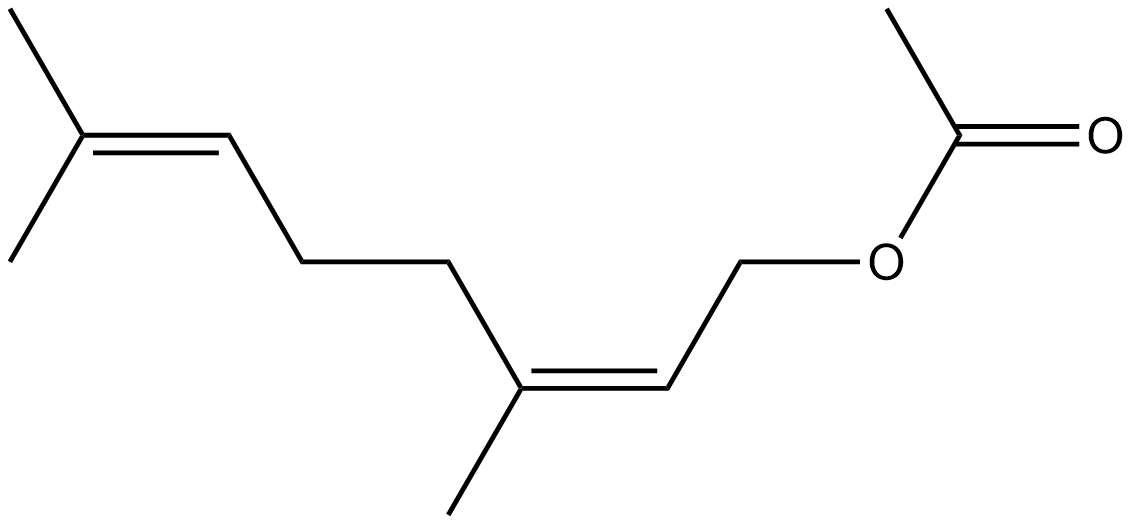
| Chemical Name | (Z)-3,7-dimethylocta-2,6-dien-1-yl acetate |
| Canonical SMILES | C(\CCC=C(C)C)(=C\COC(C)=O)/C |
| Shipping Condition | Small Molecules with Blue Ice, Modified Nucleotides with Dry Ice. |
| General tips | We do not recommend long-term storage for the solution, please use it up soon. |
Quality Control & MSDS
- View current batch:
Chemical structure