


Nanaomycin A
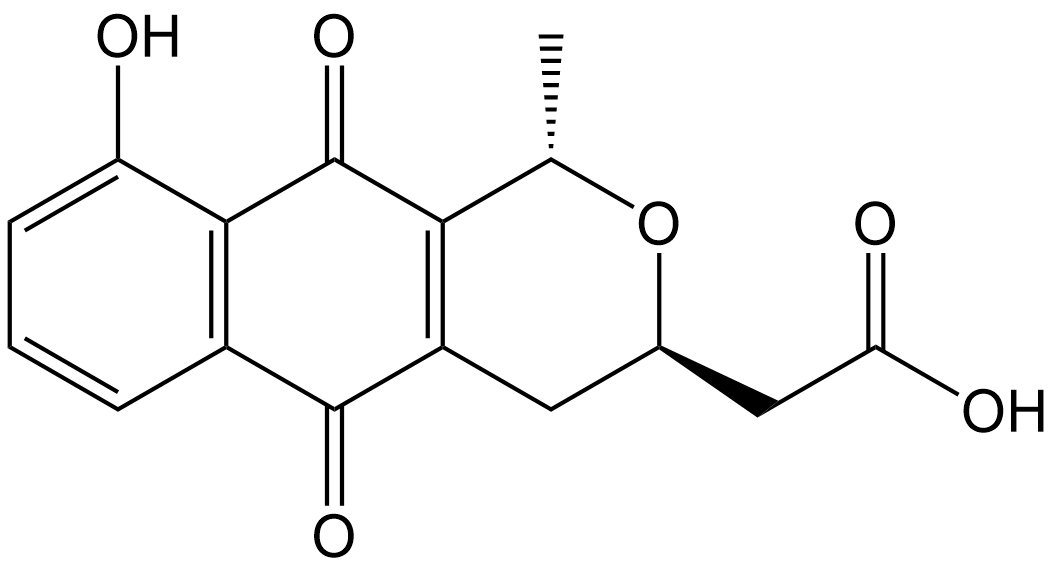
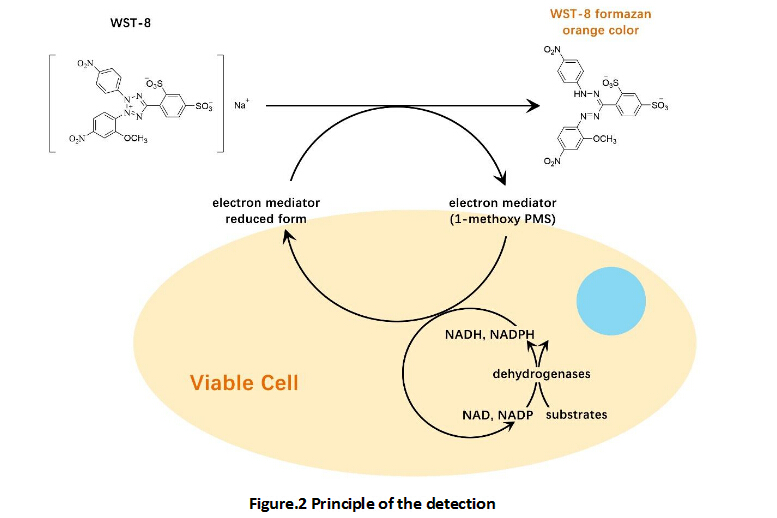
Nanaomycin A (CAS No.: 52934-83-5) is an anthracycline quinone antibiotic isolated from Streptomyces cultures and is a selective inhibitor of the DNA methyltransferase DNMT3B. Biochemical methyltransferase assays showed that Nanaomycin A has an IC50 of 500 nM against recombinant human DNMT3B2, with no obvious inhibition of DNMT1 within the same test range, and is regarded as the first non-SAH analog DNMT3B-selective small-molecule inhibitor. Biologically, Nanaomycin A mainly induces genome-wide and RASSF1A promoter demethylation by inhibiting DNMT3B-mediated DNA methylation, reversing epigenetic silencing of tumor suppressor genes; in addition, its traditional antibacterial activity is associated with autoxidation to generate O₂⁻ after reduction by respiratory-chain NADH/flavin dehydrogenases.
At the cellular level, Nanaomycin A exhibits submicromolar to low-micromolar antiproliferative activity in multiple human tumor cell lines, and does not activate caspase-3/7 at IC50 concentrations, suggesting that cell death is not typical caspase-dependent death. Trypan blue counting assays after 72 h of treatment showed proliferation IC50 values of approximately 400 nM in HCT116 colon cancer cells, approximately 800 nM in HL60 leukemia cells, and approximately 4.1 μM in A549 lung cancer cells. As an epigenetic modulation tool, Nanaomycin A can induce genome-wide DNA demethylation at concentrations well below the cytotoxic threshold: in HCT116 cells, 500 nM treatment for 72 h reduced genome-wide methylation levels from approximately 3.8% to 2.2%; in HL60, 1000 nM reduced them from 3.4% to 2.6%; in A549, 5000 nM reduced them from 2.7% to 1.1% (all P<0.001, with decreases also observed at lower doses). In A549 cells, 5000 nM treatment for 72 h increased RASSF1A mRNA transcription levels by approximately 18-fold, significantly stronger than the approximately 6-fold induction caused by 25 μM 5-azacytidine, while RG108 (300 μM) and procainamide (1 mM) were ineffective in the same system; 3000 nM also produced approximately 2-fold transcriptional upregulation, and induced RASSF1A protein expression over the 500–5000 nM range. Importantly, at 5000 nM, it neither degraded DNMT1/DNMT3B proteins nor reduced their mRNA levels, and did not significantly increase the DNA damage marker γH2AX, indicating that its demethylating effect is mainly achieved through functional inhibition of the catalytic site rather than regulation of enzyme expression or a DNA damage response.
References:
[1] Kuck D, Caulfield T, Lyko F, Medina-Franco JL. Nanaomycin A selectively inhibits DNMT3B and reactivates silenced tumor suppressor genes in human cancer cells. Mol Cancer Ther. 2010 Nov;9(11):3015-23. doi: 10.1158/1535-7163.MCT-10-0609. Epub 2010 Sep 10. PMID: 20833755.
| Storage | Store at -20°C |
| M.Wt | 302.28 |
| Cas No. | 52934-83-5 |
| Formula | C16H14O6 |
| Synonyms | OM173-αA; Nanaomycin αA; Nanaomycin A methyl ester |
| Chemical Name | 2-((1S,3R)-9-hydroxy-1-methyl-5,10-dioxo-3,4,5,10-tetrahydro-1H-benzo[g]isochromen-3-yl)acetic acid |
| Canonical SMILES | O=C(O)C[C@H]1CC(C(C2=C3C(O)=CC=C2)=O)=C(C3=O)[C@H](C)O1 |
| Shipping Condition | Small Molecules with Blue Ice, Modified Nucleotides with Dry Ice. |
| General tips | We do not recommend long-term storage for the solution, please use it up soon. |