


NADH
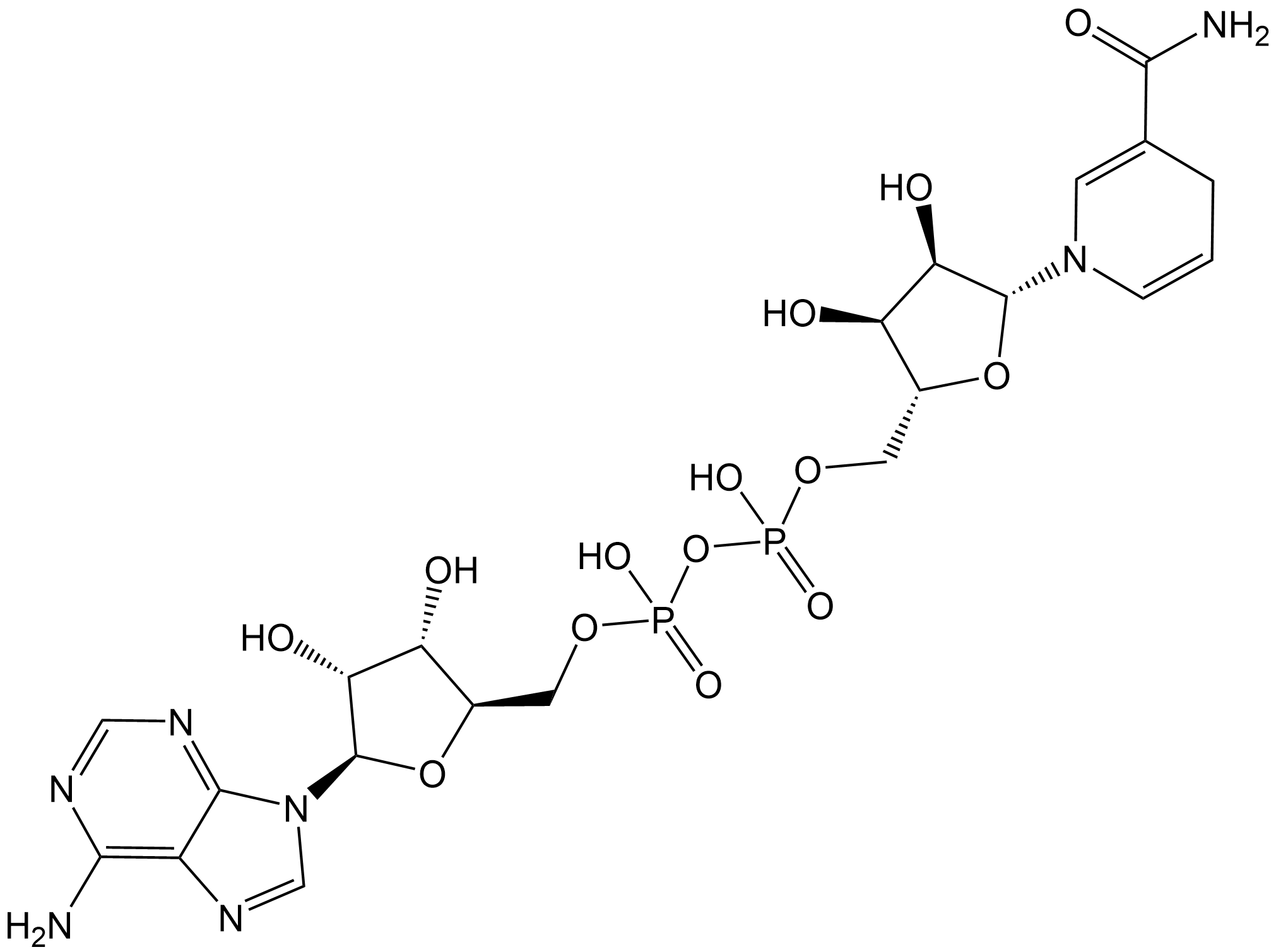





NADH (CAS No. 58-68-4) is a central reduced coenzyme in living organisms. Its core biological functions include participation in glycolysis, the tricarboxylic acid (TCA) cycle, and the mitochondrial electron transport chain, where it acts as an electron donor to drive redox reactions in energy metabolism. The NADH/NAD⁺ ratio is a key indicator of the cellular metabolic state; disruption of this balance (elevated NADH leading to reductive stress) is closely associated with diseases such as diabetic nephropathy, Leigh syndrome, and cancer [1][3][4][5][6]. NADH also exerts effects via multiple molecular targets, including regulation of Sirtuin family deacetylases, the Nrf2 signaling pathway, and the activities of various dehydrogenases. In photocatalytic cancer therapy, NADH can be oxidized by metal-based photocatalysts such as Ir(III), Ru(II), Re(I), and Os(II), with reported turnover frequencies (TOF) for NADH oxidation ranging from 1.9 to 2525 h⁻¹ [6].
In animal models, NADH is involved both in disease induction and as an adjuvant in model treatment. For disease induction, high-glucose feeding and genetic knockout strategies (e.g., Ndufs4⁻/⁻ mice) are used to establish models of diabetic nephropathy and Leigh syndrome, thereby mimicking pathological states of NADH accumulation [3][4]. As a therapeutic adjuvant, NADH can serve as a metabolic modulator or as a substrate in photocatalytic therapy: modulation of the NADH/NAD⁺ ratio can alleviate tissue damage in disease model animals, while catalyst-mediated oxidation of NADH can induce tumor cell death [3][6].
Common applications and concentrations are as follows. In cell culture, micromolar concentrations are typically employed to maintain metabolic activity (e.g., 1–10 μM in A549 cell–based experimental systems), and NADH is used to assess redox balance in studies of mitochondrial respiratory chain mutants [1][6]. In animal experiments, endogenous NADH levels are altered via genetic manipulation or metabolic intervention (for example, markedly elevated brain NADH levels in Ndufs4⁻/⁻ mice), and photocatalytic therapies rely on catalyst-mediated oxidation of NADH [4][6]. The NADH/NAD⁺ ratio can serve as a biomarker for disease severity in conditions such as Leigh syndrome and diabetic nephropathy (e.g., significantly increased NADH levels in fibroblasts from Leigh syndrome patients compared with healthy controls) [4]. In photocatalytic cancer therapy, the Ru22 complex achieves a TOF of up to 2117 h⁻¹ for NADH oxidation, sufficient to induce tumor cell death; in diabetic nephropathy models, modulation of the NADH/NAD⁺ ratio can mitigate renal injury; and in fungal hypoxia adaptation, NdxA-mediated NADH hydrolysis contributes to the maintenance of metabolic homeostasis [2][3][6].
References:
[1] Eto, K., Tsubamoto, Y., Terauchi, Y., Sugiyama, T., Kishimoto, T., Takahashi, N., Yamauchi, N., Kubota, N., Murayama, S., Aizawa, T., et al. (1999) Role of NADH Shuttle System in Glucose-Induced Activation of Mitochondrial Metabolism and Insulin Secretion. Science (Washington, DC, U. S.), 283(5404), 981−985.
[2] Lehninger, A., Nelson, D. L., and Cox, M. M. (2008) Lehninger Principles of Biochemistry, W. H. Freeman.
[3] Koch-Nolte, F., Haag, F., Guse, A. H., Lund, F., and Ziegler, M. (2009) Emerging Roles of NAD+ and Its Metabolites in Cell Signaling. Sci. Signaling, 2, mr1.
[4] Santidrian, A. F., Matsuno-yagi, A., Ritland, M., Seo, B. B., Leboeuf, S. E., Gay, L. J., Yagi, T., and Felding-habermann, B. (2013) Mitochondrial Complex I Activity and NAD+/NADH Balance Regulate Breast Cancer Progression. J. Clin. Invest., 123(3), 1068−1081.
[5] Forster, A. H., and Gescher, J. (2014) Metabolic Engineering of Escherichia Coli for Production of Mixed-Acid Fermentation End Products. Front. Bioeng. Biotechnol., 2(May), 16.
[6] Friedrich, T., and Scheide, D. (2000) The Respiratory Complex I of Bacteria, Archaea and Eukarya and Its Module Common with Membrane-Bound Multisubunit Hydrogenases. FEBS Lett., 479, 1−5.
| Storage | Store at -20°C, protect from light |
| M.Wt | 665.44 |
| Cas No. | 58-68-4 |
| Formula | C21H29N7O14P2 |
| Synonyms | Methanamine, N,N-dimethyl-, N-oxide, dihydrate; Trimethylamine, N-oxide, dihydrate |
| Canonical SMILES | O[C@H]1[C@H](N2C=3C(N=C2)=C(N)N=CN3)O[C@H](COP(OP(OC[C@H]4O[C@H]([C@H](O)[C@@H]4O)N5C=C(C(N)=O)CC=C5)(=O)O)(=O)O)[C@H]1O |
| Shipping Condition | Small Molecules with Blue Ice, Modified Nucleotides with Dry Ice. |
| General tips | We do not recommend long-term storage for the solution, please use it up soon. |