


N-butyryl-L-Homoserine lactone
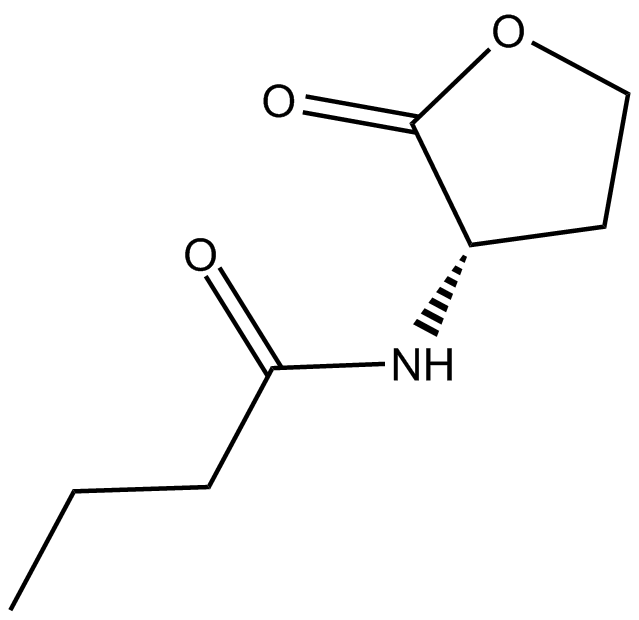
N-butyryl-L-Homoserine lactone (CAS No.: 67605-85-0) is a diffusible acyl homoserine lactone quorum-sensing signaling molecule predominantly produced by Gram-negative bacteria such as Pseudomonas aeruginosa, where it mediates cell–cell communication and coordinates population density-dependent gene expression. Functioning within LuxIR-type regulatory systems, this molecule modulates transcription of virulence-associated genes, including those involved in protease production and rhamnolipid biosynthesis, and thereby plays a critical role in pathogenicity and biofilm formation. In vitro studies demonstrate that N-butyryl-L-Homoserine lactone exerts biological activity in the low micromolar range, inducing quorum-sensing-regulated gene expression and promoting accumulation of virulence factors, while antagonism of its signaling pathway has been shown to inhibit biofilm development. Beyond microbial systems, it can act as an interkingdom signaling molecule, eliciting physiological responses in plant cells, including rapid increases in cytosolic calcium levels mediated by plasma membrane calcium channels, highlighting its relevance in host–microbe interactions. Additionally, this compound has been explored as a functional moiety in drug discovery applications, including its use as a cleavable linker in antibody–drug conjugates and as a target for aptamer-based quorum sensing inhibitors. N-butyryl-L-Homoserine lactone is widely utilized in microbiology, cell signaling, and anti-infective research, with experimental concentrations typically tailored to specific assay conditions and biological models.
| Physical Appearance | A solid |
| Storage | -20°C |
| M.Wt | 171.19 |
| Cas No. | 67605-85-0 |
| Formula | C8H13NO3 |
| Synonyms | BHL; C4-HSL; PAI-2 |
| Solubility | ≥43.4 mg/mL in DMSO; ≥53.6 mg/mL in EtOH; ≥43.6 mg/mL in H2O |
| Chemical Name | (S)-N-(2-oxotetrahydrofuran-3-yl)butyramide |
| Canonical SMILES | CCCC(N[C@H]1CCOC1=O)=O |
| Shipping Condition | Small Molecules with Blue Ice, Modified Nucleotides with Dry Ice. |
| General tips | We do not recommend long-term storage for the solution, please use it up soon. |