


N-Acetyl-DL-serine
N-Acetyl-DL-serine (CAS No.: 97-14-3) is a hydrophobic amino acid derivative that occurs endogenously and can exist in free form or as salts with small organic acids or phosphate, making it relevant to studies of metabolic intermediates and amino acid modification. This compound is primarily utilized in biochemical and microbiological research, where it has demonstrated antimicrobial activity against representative Gram-positive organisms such as Bacillus cereus and Staphylococcus aureus, with observed effects typically reported in the low micromolar to millimolar concentration range depending on assay conditions. Although its precise molecular targets remain incompletely characterized, its activity is thought to involve interference with bacterial growth processes and membrane-associated functions. In addition to its antimicrobial properties, N-Acetyl-DL-serine is employed in nucleic acid research for the immobilization of DNA fragments on solid supports, facilitating optical detection and biosensing applications, and it also serves as a useful reagent in investigations of protein synthesis pathways and amino acid-derived modifications. In experimental settings, it is commonly applied in cell-free systems, microbial cultures, or biochemical assays, with concentrations tailored to specific experimental objectives, supporting its role as a versatile tool compound in molecular biology, analytical chemistry, and early-stage drug discovery research.
| Physical Appearance | A solid |
| Storage | -20°C |
| M.Wt | 147.13 |
| Cas No. | 97-14-3 |
| Formula | C5H9NO4 |
| Solubility | ≥41.2 mg/mL in DMSO; ≥47.2 mg/mL in EtOH; ≥48 mg/mL in H2O |
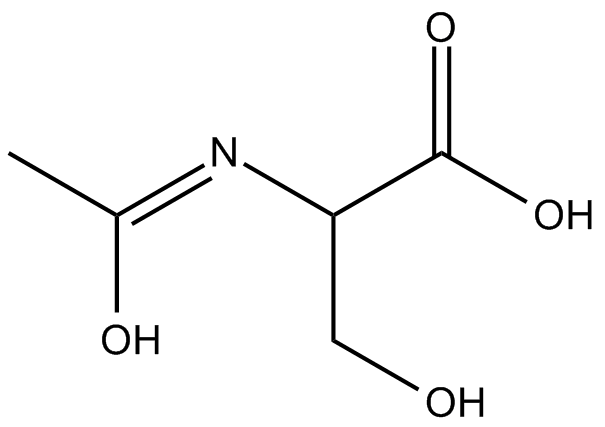
| Chemical Name | (Z)-3-hydroxy-2-((1-hydroxyethylidene)amino)propanoic acid |
| Canonical SMILES | C/C(O)=N/C(C(O)=O)CO |
| Shipping Condition | Small Molecules with Blue Ice, Modified Nucleotides with Dry Ice. |
| General tips | We do not recommend long-term storage for the solution, please use it up soon. |